
Imagine someone applying for a permit online. He receives a confirmation and a case number. Several weeks later, the screen still says “in progress”. He cannot tell what is missing, who needs to act or when to expect a decision. A friend asks: “Do you know anyone there?”
On the other side of the screen, a clerk is waiting for information from another authority. Her supervisor asks her to move one application ahead of the others. Is there a valid reason for changing the order? Who approved it? The applicant sees a delay, the clerk sees an obstacle, and the public mostly sees a screen.
Digital government could give both people the same useful piece of information: whose turn it is to act. Alongside it would be the required action, its deadline and the person or body to contact if it does not happen.
The institution has obligations too
An applicant proves their identity, eligibility and the accuracy of their information. The institution has its own work to do: act within its remit, apply the appropriate rules and enable people to exercise their rights. A clear process connects those two sides.
A delay may arise from an error, a wait for another authority, a technical problem or the complexity of a case. When the cause is invisible, people turn to the last official they spoke to, even if that person cannot remove the obstacle. Time passes, mistrust grows, and someone once again starts looking for “a contact”.
Opacity can also favour corruption. A clearer record of actions helps distinguish pressure, mistakes and justified departures from the normal process. It protects applicants as well as officials doing their work conscientiously.
The foundations are already there
Serbia’s eGovernment portal launched in June 2010. [1] Later developments brought services whose value people could experience directly. “Welcome to the World, Baby”, known as eBeba, began in April 2016. Birth registration, residence registration and a child’s health insurance could be initiated from the maternity hospital. In January 2018, an expansion began to include applications for parental allowance. Parents gained time they would otherwise have spent connecting administrative steps themselves. [2]
Operational since 2017, eZUP enables authorities to exchange information from official records during administrative procedures. Citizens can stop acting as couriers between government offices. [3][4] The Office for IT and eGovernment was established that same year, followed by the adoption of the Law on eGovernment in 2018. [5][6]
Accessible services, connected registers and an organisational framework provide a foundation for the next stage: following how institutions fulfil their obligations. How long does a case take? Where does it get held up? How many errors have been corrected? What happened after a complaint?
Estonia offers a useful example of making personal-data use visible. Citizens log in to the state portal eesti.ee and use Data Tracker to see queries about their data in connected registers: when a query was made, who made it and what it concerned. They can ask for an explanation of an unclear query. This record raises a practical question for our proposal too: how can we make the path of a person’s case through institutions just as understandable? [7] [8]
Improving a service starts with seeing its course
The European Commission’s 2025 report on Serbia recognises progress in data exchange and connecting databases, alongside fragmented responsibilities and insufficient coordination of eGovernment development. [9] Connected computers create an opportunity to coordinate the work of institutions more effectively too.
SIGMA’s assessment of public administration in Serbia for 2024, published in early 2025, offers a concrete view of one problem: in a sample of twelve services, average completion-time data were unavailable for eight. [10] That finding directs attention to a missing measurement. Reliable records of duration would help identify delays and establish whether a change to a procedure had actually helped.
The OECD views digital government through six connected dimensions: digital by design, a data-driven public sector, government as a platform, openness by default, services driven by users’ needs and proactivity. This framework also covers what happens behind the screen: how institutions organise their work, cooperate and use data. In our proposal, the value of those changes would be assessed through clearer procedures, fewer delays and problems resolved for citizens. [11]
The SIGMA assessment also records rights to access a case file, be heard and challenge administrative action, including an authority’s failure to act. [10] A digital record could make these rights easier to use: alongside a case status, a clear explanation of available steps and what the institution did in response to the person’s request.
There are also records showing what happens after oversight. According to a State Audit Institution notice published in May 2026 about audits for 2024, action had been taken on 2,887 of 3,736 recommendations; 189 had not been acted on within the specified period, while the others had different statuses. [12] A next step would be making it easier to connect such information with a particular obligation and the procedure for fulfilling it.
Following public money through to the result

Imagine a municipality has paid for a new school. Parents want to know when their children will enter the classrooms. A citizen looking through the records should be able to follow how much money was approved, how the contractor was selected, what was agreed and how much was paid. If the price or deadline changed, the change would be accompanied by an explanation and a record of who approved it.
The scale of this question is substantial. The OECD’s 2026 profile of Serbia reports that the public procurement market in 2024 was worth 10.87 per cent of GDP. There were an average of 2.4 bids per procedure, and 50.75 per cent of tenders received one bid. Such data direct analysis towards participation requirements, available suppliers and the design of a procurement. It is especially useful to follow where the same pattern recurs and how it changes over time. [13]
Part of the foundation already exists. A rulebook applicable since January 2024 governs the publication of contract data and amendments on the Public Procurement Portal. It also provides for the contract’s final status, end date and actual value. This could serve as the basis for an overview connecting the contract with budget allocations, individual payments and evidence of delivery. [14]
For our school, that would mean being able to see, alongside each paid stage of construction, who inspected it, what they found and which document confirms acceptance. If a defect was found, the record would follow the request for repairs and confirmation that it had been remedied. For a school as for a tunnel, findings from the site should be connected to the contract and the decision that follows from them.
Analytical tools could flag repeated procurements receiving one bid, frequent contract amendments or large differences between planned and actual value. The competent authorities would then examine market conditions, documentation and the completed work, recording their findings. This approach is also consistent with the OECD’s recommendation to assess competition by combining indicators and data across the full procurement cycle. [15]
For projects carried out under special rules, it should be clear which information the public can follow and who checks the result. The final measure remains simple: the school is complete, defects have been remedied and children can use it.
How many applications, how many licences, how long a wait?

A similar overview is needed wherever an institution decides on a licence. On 2 November 2026, the National Bank of Serbia’s register listed three virtual-currency service providers: VESCON, MCM 965 and AX CRYPTO. The first two licences were issued in December 2022 and the third in June 2025. [16]
The NBS publishes other outcomes too. Its annual report for 2022 records two decisions granting licences and seven decisions dismissing applications. The report for 2025 lists one new licence and one decision dismissing an application. These figures add to the picture provided by the register and offer a basis for following how applications are handled over time. [17] [18]
The next step would be a single overview: how many new applications were received, how many cases were carried over from the previous year, how many were completed and how many are still in progress? Repeat applications and their outcomes would be distinguished. The dates of submission, requests for additional documentation, its delivery and the decision would show where time is actually spent.
The public would have access to aggregate data on duration, outcomes and reasons for delays, with confidential information protected. Applicants would see the detailed course of their own case and the next obligation. This would make it easier to distinguish processing time within the institution from time needed to supply additional documentation, providing a concrete basis for assessing the predictability of the procedure and consistency of its criteria.
In public procurement, we follow the obligation to deliver what was agreed. In licensing, we follow the obligation to decide on an application. Both share the question at the heart of this article: who takes the next step, on what basis do they act and how can we see that they have completed their part?
A proposal: map obligations from the first step to a correction
The starting point could be a single, selected procedure. Its digital map would connect the legal basis, competent authority, responsible role, requirements, deadlines and avenues for legal protection. It would use existing records and clearly distinguish current rules from earlier versions. This would preserve the basis on which each decision was made.
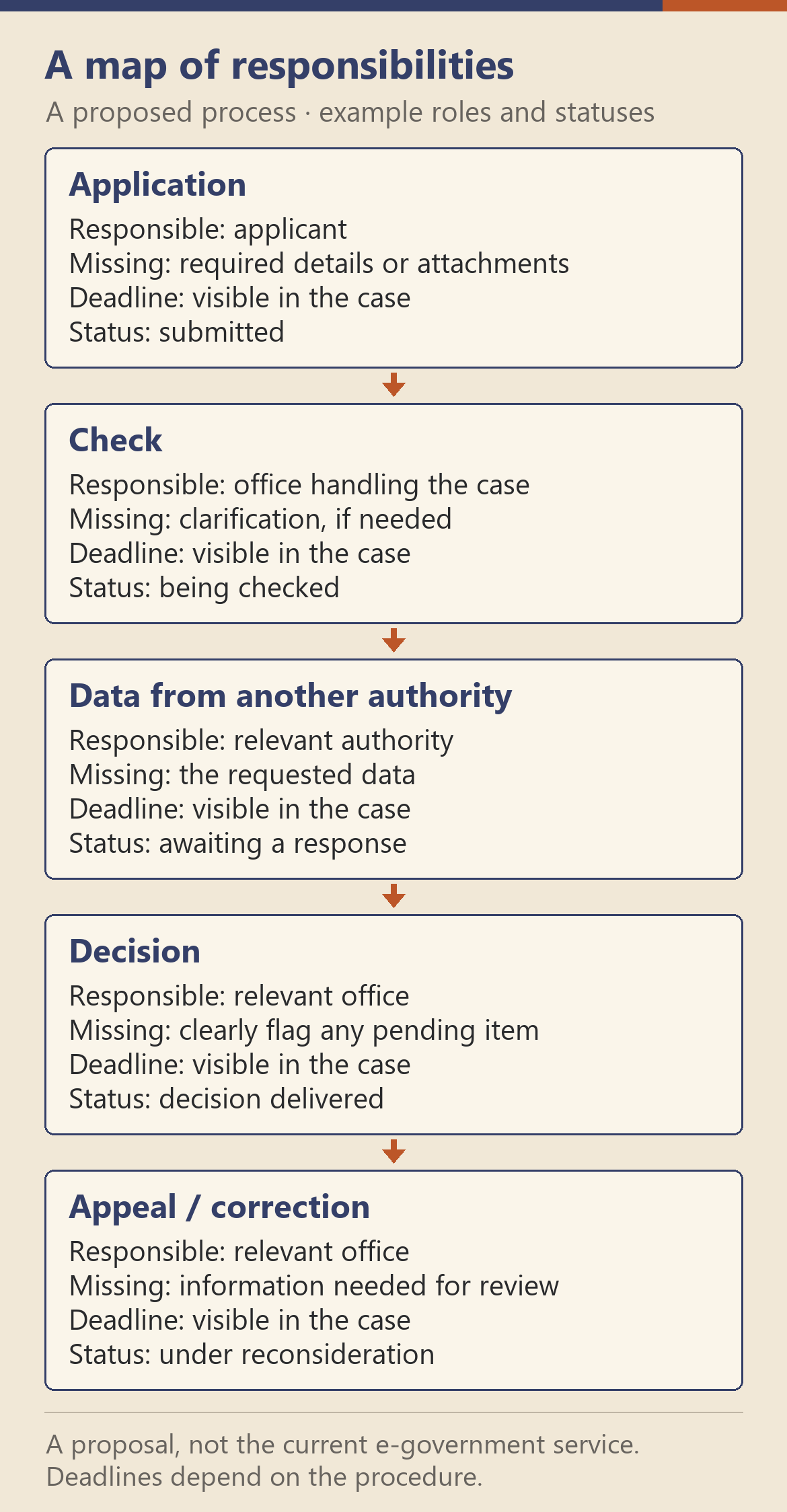
Part of this idea can be seen in South Korea’s e-People system. Citizens submit a petition through a shared portal, which routes it to the appropriate institution and assigns it to an official or department for handling. They can follow its progress on the portal and receive text messages or emails confirming receipt, requesting additional information and reporting the outcome. When jurisdiction is unclear, the Anti-Corruption and Civil Rights Commission helps determine the appropriate authority. This provides an important foundation for our proposal: routing a case and taking responsibility for its next steps are part of the service itself. [19] [20]
For an individual case, the record would show what is missing and who needs to act next. Each status change would have a time, a responsible role and an explanation. Legally permitted urgency and exceptional circumstances would have their place, together with the reason for departing from the usual sequence.
A warning before a deadline would reach the responsible official. If a delay persisted, the case would go to a manager or oversight body under known rules. The record would follow their response too: what was requested, who acted and whether the measure was carried out. Responsibility would become visible throughout the chain, from the service desk to management.
Simple software rules can track deadlines and mandatory steps. Artificial intelligence could help compare similar cases and spot unusual patterns. Such a signal would direct a review. The authority legally empowered to decide would make and explain the decision.
Who follows the system that follows everyone else?
Managing this system must also leave a record. Who changed a rule, who approved a new model and how was its effect checked? Incorrectly linked companies, confused identities and incomplete records can cause serious injustice. Alongside an explanation of a decision, there must be an accessible way to challenge information and correct an error.
In its guidance on governing digital government, the OECD emphasises clear roles, coordination between institutions and accountability for decisions. For the proposed map of obligations, this would also mean verifiable rules for accessing data, a record of changes and independent oversight of the system. Those who run it belong within the same circle of accountability. [21]
Officials need protection when they report pressure. Citizens need assistance even when they have no computer or do not use an electronic identity. These provisions belong within the procedure itself. Their availability shows how usable the system really is.
A pilot could begin where obligations are clearly described. It would measure duration, unexplained delays, corrected errors and responses to complaints and recommendations. The results would show what needs improvement before expansion.
The man at the beginning of this story could then understand why he is waiting and what he can do. The clerk would have a clearer framework and a record showing where the obstacle arose. Both could get on with their day more easily.
The next step for digital government is to make visible how the law binds both the citizen submitting an application and the institution deciding it.
Sources
- Government of Serbia — launch of the eGovernment portal, 11 June 2010
- Office for IT and eGovernment — the second phase of eBeba, 30 January 2018
- Ministry of Public Administration — eZUP in operation, 13 June 2017
- Office for IT and eGovernment — the eZUP data exchange system
- Office for IT and eGovernment — establishment, 2017
- Ministry of Public Administration — adoption of the Law on eGovernment, 5 April 2018
- Estonian Information System Authority (RIA) — Data Tracker, updated 30 April 2026; checked 2 November 2026
- eesti.ee — Data Tracker privacy notice, checked 2 November 2026
- European Commission — Serbia Report 2025, pp. 27–28
- SIGMA — Public Administration in Serbia 2024, published 27 January 2025, p. 81
- OECD — The OECD Digital Government Policy Framework: Six Dimensions of a Digital Government, 7 October 2020
- State Audit Institution — Register of Recommendations for 2024, notice of 4 May 2026
- OECD — SME Policy Index 2026, Serbia profile; public procurement data for 2024
- Serbian Public Procurement Office — rulebook on publishing contract data and amendments, applicable from January 2024
- OECD — Competition in Public Procurement, 26 October 2026
- National Bank of Serbia — licensing decisions for virtual-currency service providers, checked 2 November 2026
- National Bank of Serbia — Annual Report 2022, printed p. 112
- National Bank of Serbia — Annual Report 2025, printed pp. 114–115
- Anti-Corruption and Civil Rights Commission — e-People service and petition-handling process
- Anti-Corruption and Civil Rights Commission — e-People progress notifications, 23 February 2026
- OECD — The E-Leaders Handbook on the Governance of Digital Government: Institutional Models, 21 December 2021
Sources / Provenance
Primary sources: the Government of Serbia, Office for IT and eGovernment, MDULS, European Commission, SIGMA, State Audit Institution, OECD, National Bank of Serbia, Public Procurement Office, Estonia’s RIA/eesti.ee and South Korea’s ACRC. Base sources checked on 1 November 2026; international additions and expanded procurement and licensing sections checked on 2 November 2026. The map of obligations is an editorial proposal for developing digital government.