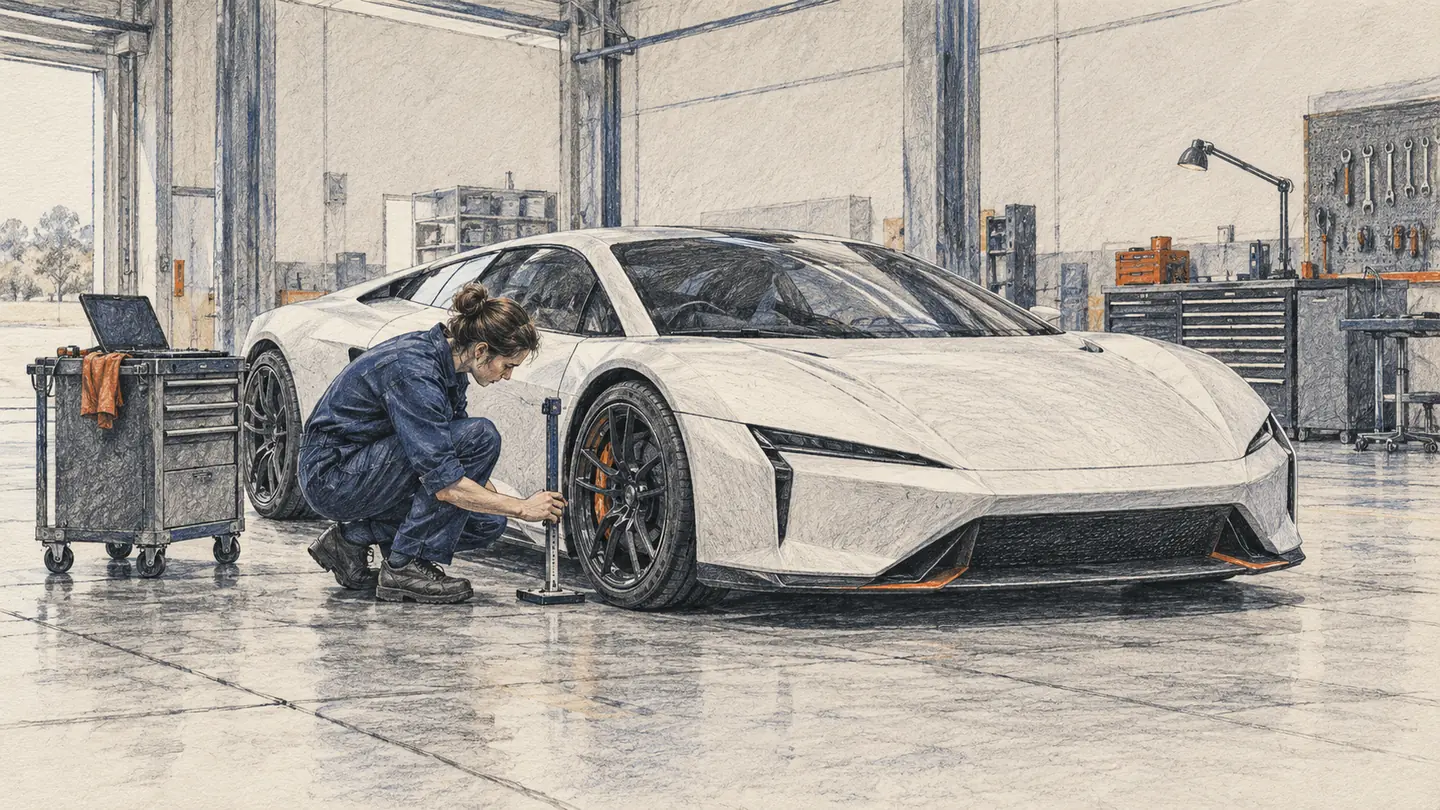
At Tesla’s presentation on 15 October, a car climbs a structure, continues upside down, leaves the surface and returns to the ground in a cloud of gas. MotorTrend’s journalists watched the demonstration at SpaceX’s facility in Texas after speaking to the people developing the prototype. [1] The audience had a scene to talk about. A driver who had spent that morning queuing in traffic might have had an idea: perhaps next time we could simply jump over the congestion.
The traffic, of course, had not disappeared. It had acquired another floor.
The impressive part of the scene is the control: the car has to leave the surface, change its attitude, stop any unwanted rotation and prepare to touch down. Several short bursts of thrust must become one controlled movement. Tesla’s presentation also showcases SpaceX’s engineering expertise: the car becomes a stage where the audience can see what precise control of forces makes possible.
Who is this kind of day behind the wheel for?
Tesla’s website sets out three distinct uses. It presents Performance as a two-seater for the road, with active aerodynamics and a fan system; Thrust as a limited-release two-seater for the track, with rear thrusters; and Rocket as an invitation-only single-seater, with thrust for moving forwards, upwards and turning. It explicitly states that Rocket is not approved for public road use. [2]
That line-up suggests an audience: collectors, track-day drivers and buyers for whom the experience and distinctive engineering are an important part of a car. For them, practicality means being able to arrange a track outing, complete the session they want and prepare the vehicle for the next one. A charger, nitrogen filling equipment, room to manoeuvre and support in the pits all become part of the experience they are buying. Production has been announced for 2028; what we are seeing now are the prototypes through which that product is being developed. [1]
What is actually rocket technology in this car?
A cold gas thruster releases compressed gas through a nozzle. The gas goes one way; the vehicle receives thrust in the other. The energy for that burst has already been put into compressing the gas. SpaceX’s Falcon documentation describes nitrogen thrusters for attitude control, so the connection with space technology has a specific meaning. [10]
In the Roadster, that means a pressure vessel, valves, pipes and precise control of flow. MotorTrend reports the explanation given by Lars Moravy, Tesla’s engineering chief: equal-length supply pipes help deliver even thrust, while an uneven supply could turn the car. It also describes titanium pipes and nozzles, with splitter sections made of Inconel alloy. [3] Much of the spectacle therefore depends on the coordination of mechanics and control. Each burst needs to reach the right place and end at the right moment.
The tanks take up space in the story — and in the cabin
According to MotorTrend’s first-hand inspection, Thrust carries a 200-litre tank at pressures of up to about 10,000 psi, or 690 bar. It sits behind the seats, in the space intended for luggage. Rocket gains another 400 litres in the passenger’s position: 600 litres in total and one seat. [1]
These are COPVs: pressure vessels reinforced with an outer wrapping of composite fibres. The figure in litres describes their internal volume; the amount of compressed gas also depends on pressure and temperature. The wrapping, mounts, valves and pipes take up space too. A 200-litre vessel therefore does not mean that exactly 200 litres of usable luggage space have been lost. Final measurements of the remaining space have yet to be published.
Thrust has four rear nozzles. Rocket adds four pointing downwards near the wheels, and two at the front for turning the vehicle from side to side. [3] That layout also explains the difference in purpose: acceleration calls for a short push forwards; leaving the ground and returning requires several forces to be controlled at once.
Five seconds of thrust, then back to the filling equipment
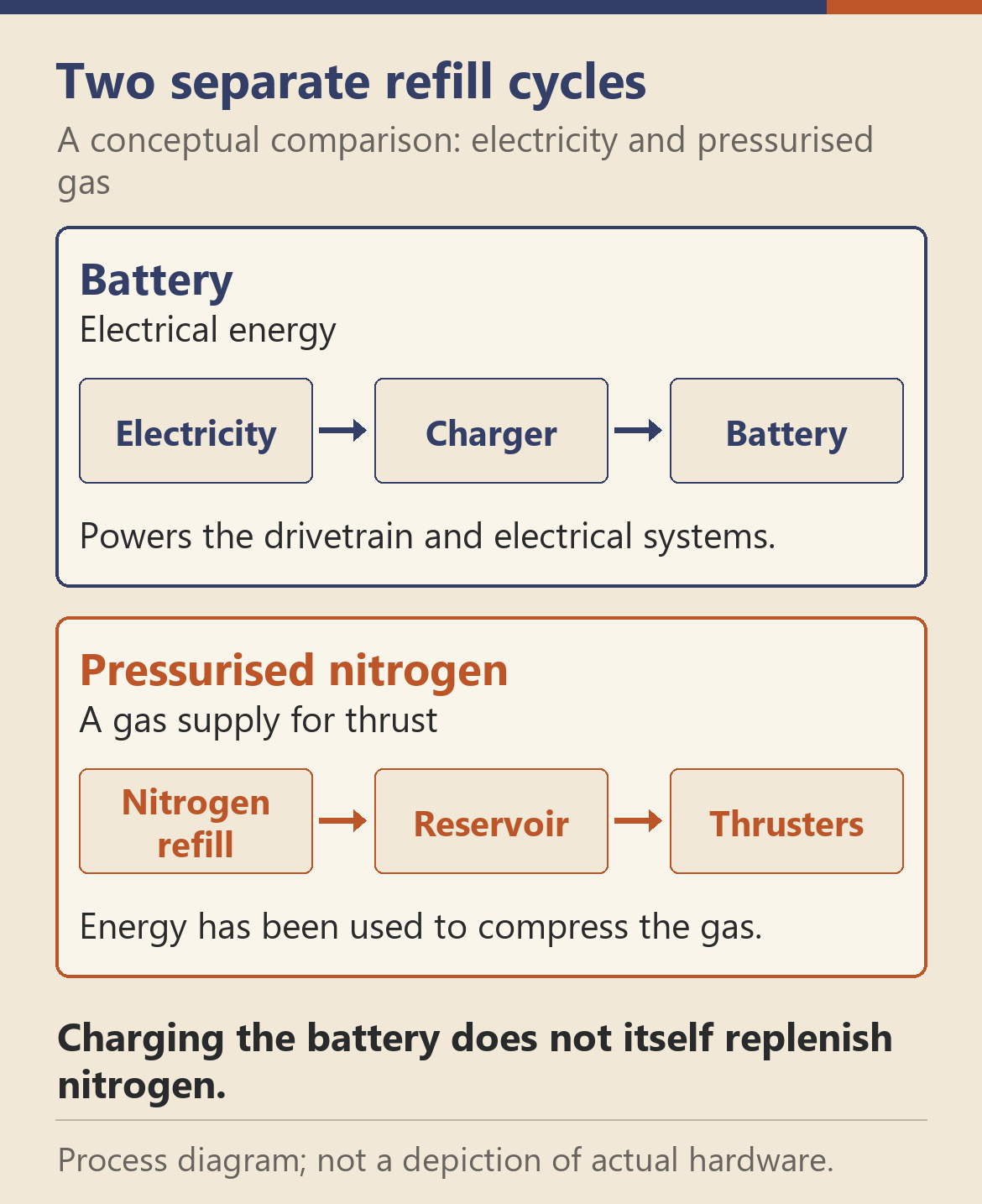
Speaking to Top Gear about the Thrust on display, Moravy describes around five seconds of thrust during a single quarter-mile acceleration run. Asked how many times it can do this before the supply is depleted, he answers: once. For the 200-litre tank, he describes an external high-pressure nitrogen filling system and a current refill time of two to six hours. The new process intended to bring that below half an hour is still in development. [4]
Hagerty’s report gives six to seven hours to fill the full 600 litres, with a target of bringing that closer to half an hour. [5]
This has a substantial effect on how the car is used. A full burst of thrust is something to plan for, followed by replenishing the gas supply. The number of shorter bursts would depend on their duration and strength; no reliable figure has been published for Rocket jumps per refill. Charging the battery does not, by itself, replenish the nitrogen.
The practical question is where a driver goes for a fresh supply. The interviews point to separate filling equipment. The announcements reviewed do not yet identify a station network, a refill price or a final procedure for owners. For now, an owner would need to arrange access to suitable equipment at the venue or through service support. This part of the future service will help determine how often the capability is actually used.
How many laps, and how much time in the pits?
For battery-powered driving, Moravy sets out a development target in the Hagerty interview: 25–30 minutes on track without limiting performance, followed by recharging. The same report gives a battery charging target of 15–80% in ten minutes. That is the intended rhythm of a future day at the track. [5]
To make repeated sessions possible, he describes specially developed cells and cooling on both sides. He puts each of the four fans at approximately 20 kW. [5] That adds up to around 80 kW if all four were running at that power; it is not their average consumption over a lap. Alongside propulsion, airflow control and cooling also need energy, while braking recovers some of it.
Answering “how many kilometres of all-out driving?” requires a measured track session: the circuit, pace, temperature, consumption and system behaviour throughout. The published 25–30-minute target does not establish a distance or promise continuous use of the thrusters. Available energy may limit the number of laps, but temperature could do so before the battery runs out.
Another outing with a full supply of thrust has to wait until everything is ready: the battery recharged, components cooled and gas replenished. The tyres and lower sealing skirts also need checking. To repeat the displayed Thrust’s full burst, the current hours-long nitrogen refill takes far longer than the promised quick battery charge. Driving without that extra thrust follows a separate cycle of battery charging and cooling. The final cooling time after a full session has yet to be published.
The road surface enters the calculation
The fan system draws air out from beneath the vehicle. Movable sealing edges, often called skirts, restrict the air entering from the sides; the pressure difference then presses the tyres more firmly against the ground. That force can exist at low speed, when a wing does not yet have enough airflow. Tesla’s patent provides for adjusting the skirts and fan operation to the surface conditions. [6]
But there is more than air and clean asphalt beneath a car. A twig can strike the lower edge, a leaf can lodge on an intake guard, and sand and fine dust can travel with the air. A screen that catches a stone does not automatically deal with smaller particles. Tesla’s patent therefore mentions protective screens and dust separation. [6] For buyers, what matters will be turning that concept into parts that are easy to inspect, clean and replace where they touch the ground.
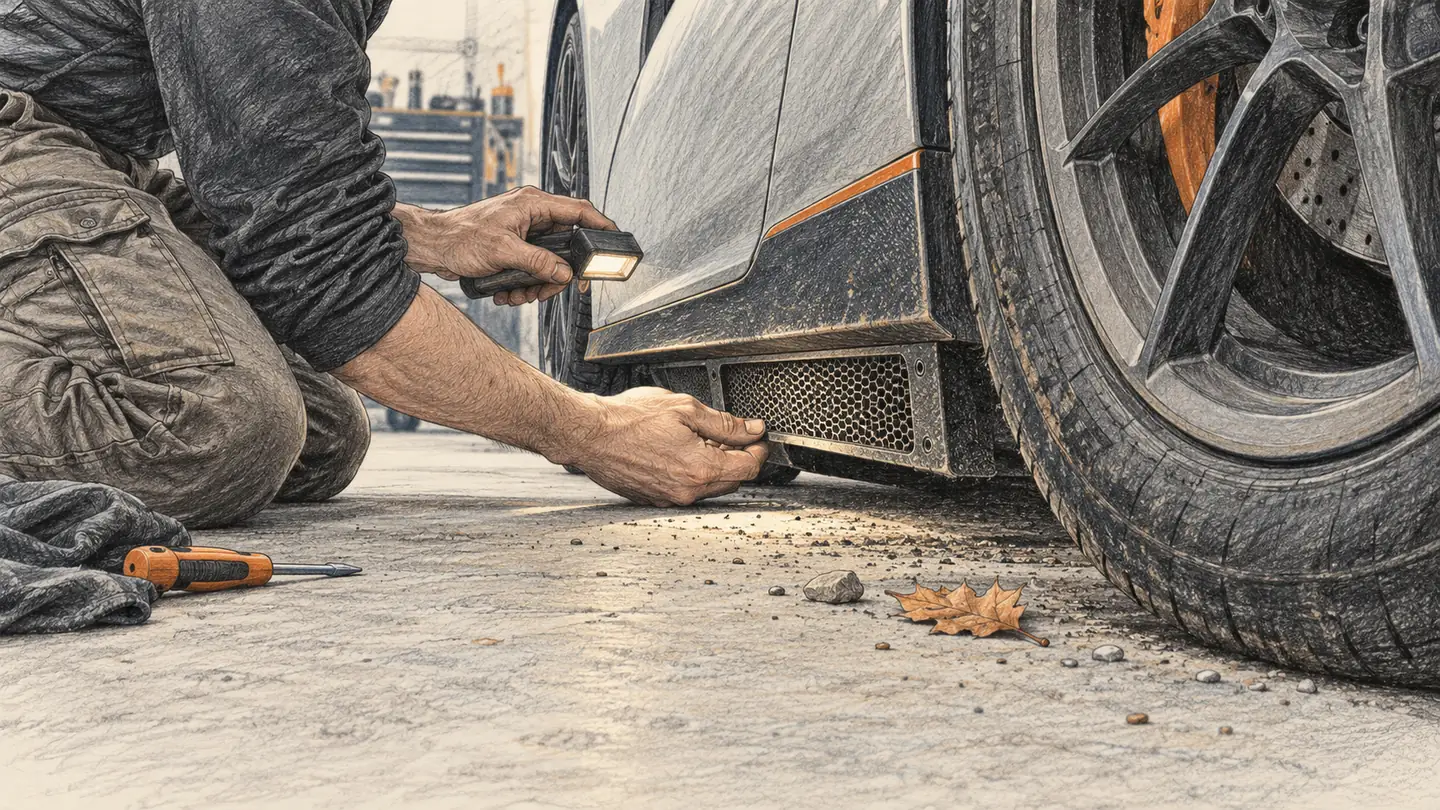
McMurtry’s patent application for filtration explains why this matters: a dirty filter increases resistance to airflow, which can reduce the available downforce. Its proposed solution separates the flow carrying debris away from the main airflow. [7]
A detail from the production version of McMurtry’s Spéirling is even more concrete: the filter cassette can be emptied through access panels in the sides of the body, while the lower skirt can be raised for loading onto a trailer and manoeuvring in the pits. [8] This is a useful example of what practicality looks like with this technology. Extra grip comes with a way for someone to reach the parts that get dirty.
Fans, air ducts and service access take up some of the vehicle’s space. We do not yet have an exact figure for the volume lost in the final Roadster. The gas-equipped versions already show a clear compromise: Thrust uses luggage space, while Rocket also takes the passenger’s place. Buyers are therefore choosing how they will live with the car between demonstrations, too.
Tyres remain the point of contact with the ground
The Top Gear interview gives tyre sizes of 295/30 R20 at the front and 335/30 R21 at the rear for the prototype shown. [4] That tells us about width and profile, but the final choice also requires load capacity, speed rating, compound and behaviour at the temperatures the vehicle reaches. Extra downforce puts more load on the tyres; thrusters can help acceleration, while the tyres still do most of the work in braking and cornering.
Track tyres use compounds and constructions that withstand heavy loads and provide repeatable grip in their intended conditions. For its Trofeo R/RS, for example, Pirelli describes use on dry asphalt, faster wear on track and reduced performance in cold and wet conditions; it refers users to the vehicle manufacturer’s pressure recommendation. [9] This illustrates the demands on this class of tyre. The Roadster’s final specification must match the tyre to the particular version and its operating modes.
What remains when the gas clears
For the audience, the moment the car leaves the ground is striking. For engineers, the interest lies in how valves, nozzles, fans and control systems work together to maintain the intended movement. For buyers, another story begins: where they will drive, what they need to prepare, how often they can repeat the experience and who will help get the car ready again.
There is room here for play, pleasure and engineering exploration. Someone may want a car like this precisely for the unusual experience. Its practical value grows when that capability comes with a dependable way to use it: a known rhythm of driving and refilling, accessible maintenance and somewhere suitable to do it all.
The car took flight. Now it would be worth seeing how it lives on the ground — and how soon it can leave the pits again.
Sources expanded and checked on 3 November 2026. Technical statements refer to the prototypes shown and the original interviews; charging, refilling and track-session targets are identified as development goals. The practical implications and account of a day’s use are editorial analysis.
Sources
- MotorTrend — prototype inspection and direct conversations with Tesla’s team, 16 October 2026.
- Tesla — current presentation of the Performance, Thrust and Rocket versions, reviewed on 3 November 2026.
- MotorTrend — hardware description and discussion of thrust control, 16 October 2026.
- Top Gear — conversation with Tesla’s team: tyres 09:28; tank 20:13; refilling and thrust duration 22:30–23:27.
- Hagerty — Henry Catchpole and Lars Moravy: cooling and track-session target 03:29–07:57; fans 12:52; filling 600 litres 20:17.
- Tesla — US12377920B1, Adaptive vehicle aerodynamics for downforce, 5 August 2025.
- McMurtry — GB2643105A, Filter system for vehicle, published on 11 February 2026.
- McMurtry — production version of the Spéirling PURE and practical maintenance features, 2 July 2026.
- Pirelli — technical guidance on using P Zero Trofeo R/RS tyres, as an example of track-tyre requirements.
- SpaceX — Falcon User’s Guide, 9 May 2025, nitrogen thrusters for attitude control.
Sources / Provenance
Sources expanded and checked on 3 November 2026. Primary sources: Tesla’s current website; the original Top Gear and Hagerty interviews with Tesla’s team; MotorTrend’s first-hand inspection; Tesla’s patent and McMurtry’s patent application; McMurtry’s presentation of the production version; the SpaceX Falcon User’s Guide; and Pirelli’s technical guidance as an example of tyre requirements. Thrust duration and current refill times are attributed to their sources and configurations. Shorter charging and refilling times and track-session duration remain development targets. Range at maximum pace, gas refill pricing and infrastructure, cooling time and the final tyre specification have not been established. The practical implications are editorial analysis.