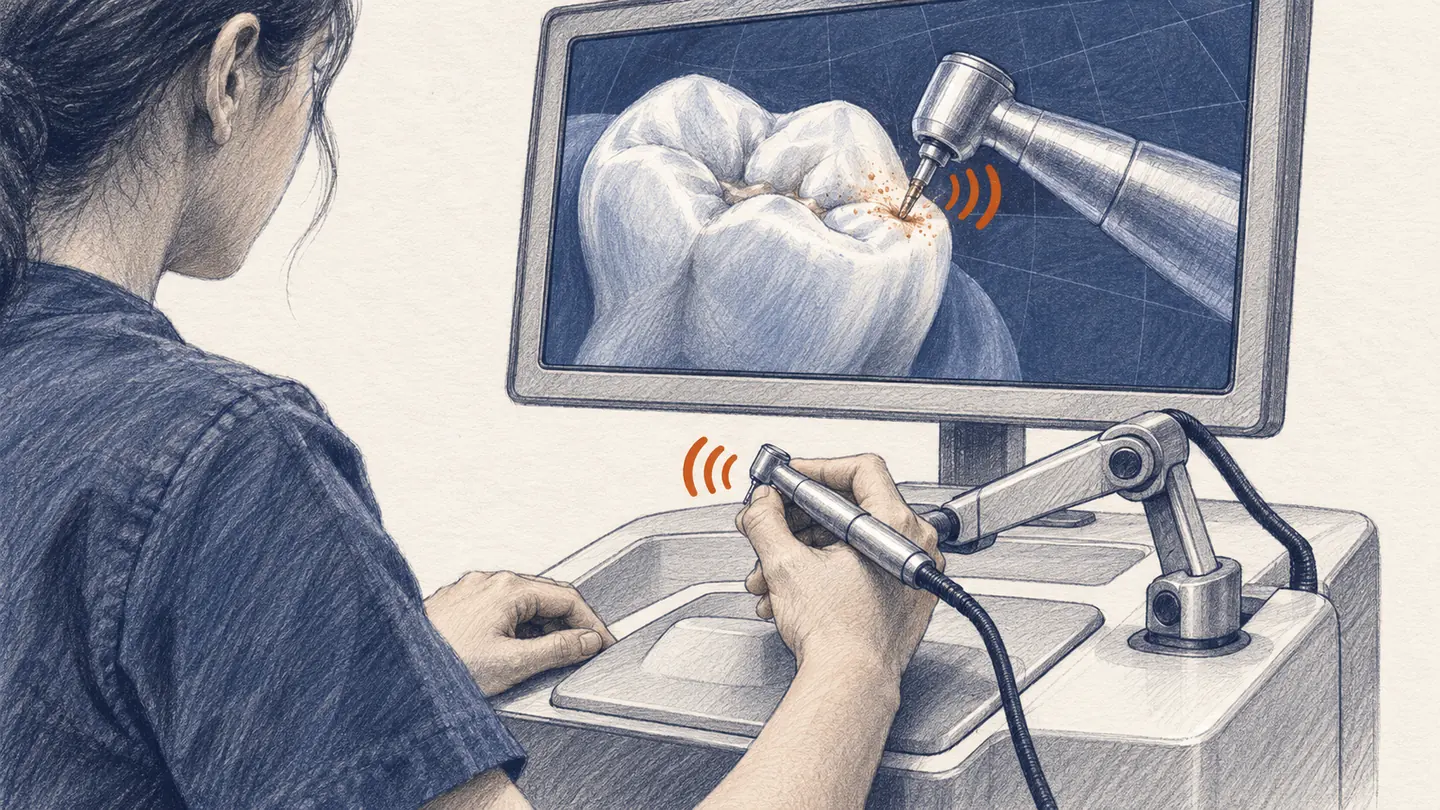
A dental student guides an instrument through a virtual tooth, and the device pushes back. They can pause, change the angle and try again. The exercise gains something an image alone struggles to convey: a sense of how the action changes beneath the hand. This is how dental simulators such as Simodont work.
A similar need arises far from the classroom. For someone using a prosthesis, it matters to feel what they are touching and how the artificial limb is moving. A person wearing an exoskeleton needs assistance at the right point in the step, in tune with their movement. The motor supplies power, but useful movement emerges through an exchange: we try something, feel the result and adjust our next move.
That is what feedback is about: technology that connects an action with information about its outcome. Sometimes a simple signal is enough. Sometimes we need force, temperature or a sense of position. Training, prosthetics and robotics are developing different ways to bring that response to where we can use it. Sometimes the person feels the response; in an exoskeleton, movement data can return to the controller, which then adjusts the assistance.
Getting a feel for the work before the first patient
In a dental trainer, the student uses a physical instrument while the software displays the tooth and calculates the removal of material. The mechanism creates resistance as they work. The student looks, moves their hand and feels the contact at the same time, practising the coordination that a real procedure will depend on. Simodont offers tasks ranging from basic dexterity to crown preparation and root canal access preparation. [1]
Another part of the feedback comes after the attempt. The teacher can review the work and send comments to the student through the teaching software. One response reaches the hand during the task; the other reaches the person trying to understand where they went wrong. Good training connects the two: feeling the difference and learning what it means.
From a bell to a touch
There is no need to start with anything exotic. An oven timer rings to tell us that the time is up. We hear it, check the food and decide what to do next. Sound is enough because we know how it relates to the event. We learn what a signal means by using it; a device does not always have to speak the language of the sense that first picked up the information.
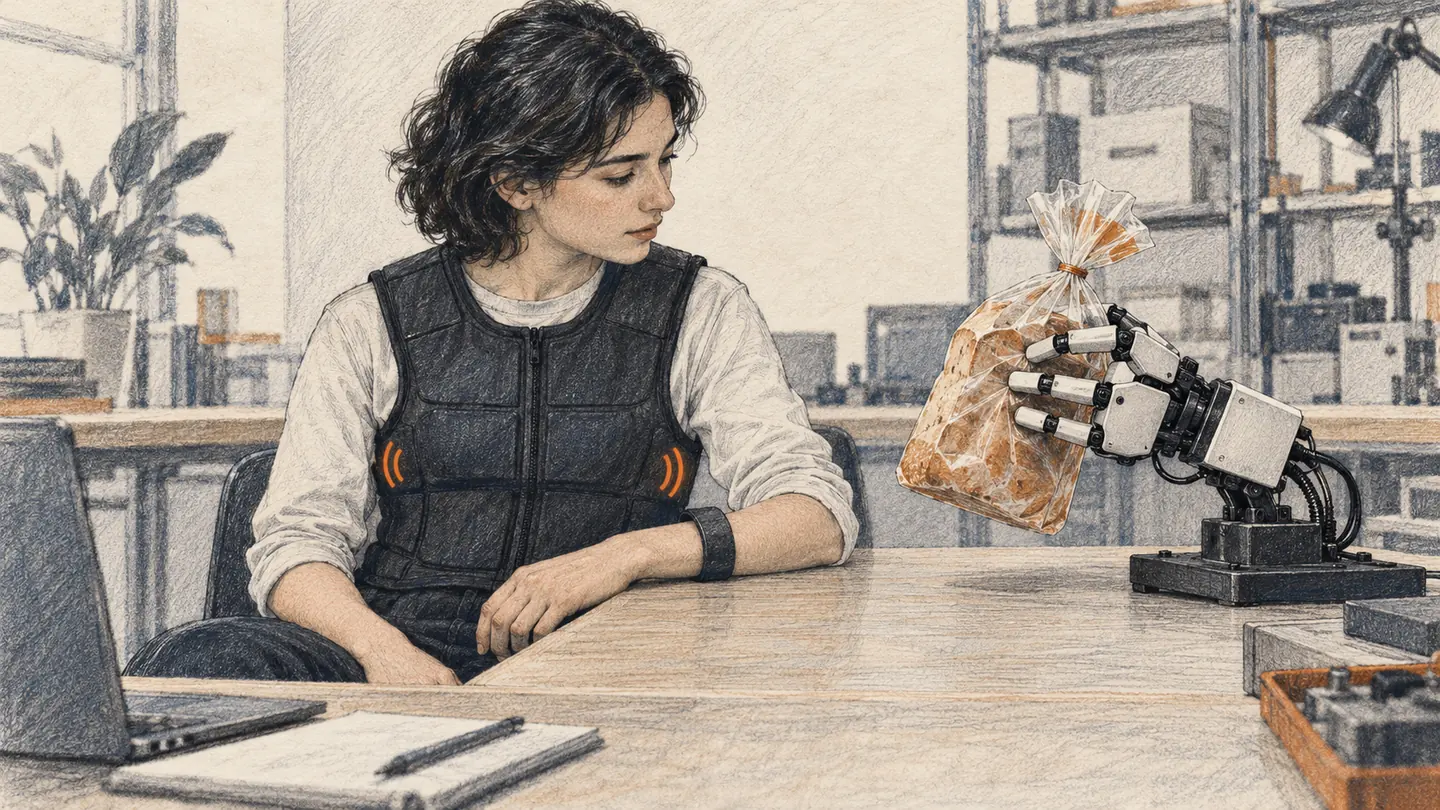
Gamers already know this kind of translation. A force-feedback steering wheel conveys resistance and events from a simulation through the hands, while a vibrating vest distributes sensations across the body. In a game, this deepens the experience. In training or assistance, a similar channel can carry information needed for the next action.
The research prototype TEGA, described in 2026, fits precisely here: electrical muscle activity controls a robotic hand’s grip, while contact sensors on its fingers send data to a vibrating vest. The person receives feedback while handling an object. A laboratory trial with participants without limb impairments involved a bottle, a box of wet wipes and a bag of bread. The useful idea is easy to grasp: a firmer object needs to be held securely, while a softer one needs protection from an excessive grip. This prototype demonstrates one way of returning that information to the user.
A hand that tells you something is warm
With a prosthesis, the question of feedback comes closer to everyday experience. Two bottles may look almost identical yet contain water at different temperatures. Sight then leaves a gap that touch would usually fill.
In the MiniTouch study, published in 2024, a sensor on a prosthetic finger measures temperature. A small thermal device applies warmth or cooling to a selected point on the skin of the remaining arm. For the study participant, this stimulus creates a sensation of temperature in part of the missing hand. EPFL describes the approach as a feedback link between the object being touched and the prosthesis user.
In tests with Fabrizio, a man with a below-elbow amputation, the system enabled him to sort objects by temperature. In the research team’s report, he also described the powerful experience of feeling another person’s warmth. The paper in Med follows one user; that concrete encounter with objects and people provides a good reason to develop this approach further. The prosthesis gains another connection to the world it touches.
Feeling where the leg is
Feedback also includes the sense of our own body’s position, or proprioception. As we lift a foot over an obstacle, we need to coordinate its position, speed and support. With a powered prosthesis, a motor and control of the artificial joint become part of that process.
In a 2024 study, MIT and Brigham and Women’s Hospital combined surgical preservation of the interaction between pairs of muscles with a robotic ankle prosthesis. The remaining muscles provide electrical control signals, while the way they stretch each other preserves some movement information for the nervous system. Seven participants with this combination were compared with seven people who had undergone a conventional amputation, using the same type of prosthesis.
In tasks involving stairs, slopes and obstacles, the first group moved faster and adjusted their steps more naturally. The movements recorded included raising the toe when stepping over an obstacle. [2] That detail carries the whole story: the exchange between body and prosthesis helps shape movement as it happens.
A little further on foot
For one person, the gain is another climb on a day out. For an older person whose walks are cut short by fatigue, the same principle could mean visiting a friend and having enough energy to get home. An exoskeleton is worn alongside existing limbs and adds assistance to their movement. Sensors track walking, while the controller decides when the motor should apply force and when it should ease off. Information about the step returns to the device; the person receives mechanical assistance in tune with their rhythm.
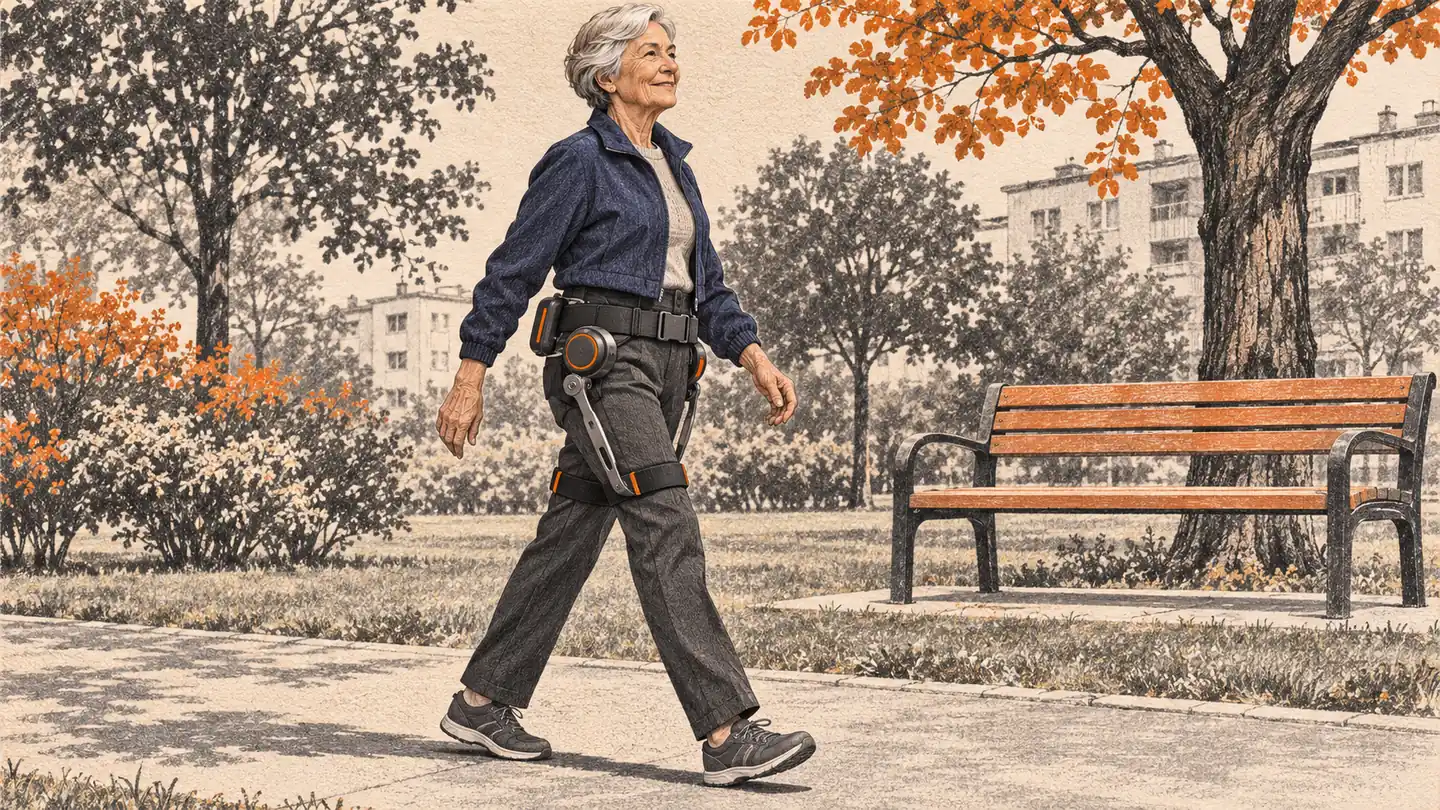
Chinese manufacturers are already turning this principle into equipment people can buy. The Kenqing H1 Pro, sold internationally as the VIGX Ant-H1 Pro, is intended for older users. It is worn as a waist belt, with motors beside the hips and straps around the thighs. The manufacturers’ pages list a weight of around two and a half kilograms. Four physical buttons and spoken confirmations show how much simple controls matter when an aid is meant for daily use. This lightweight model assumes that the user can already maintain their own balance; the extra power eases movement, while the person continues to direct their own body.
A 2026 hands-on test of the Dnsys X1 shows what this looks like beyond the advertising. The reviewer felt clear assistance uphill, but also pressure from the belt beneath her backpack. Her first battery lasted around 70 minutes, mostly uphill in Sport mode. This neatly illustrates the relationship between power and duration: more intense assistance uses up the energy supply faster. It matters for users to know how a device behaves on their own route, with their own clothing and the things they carry.
Independence begins at the buckle
Before the first step comes putting it on. With these lightweight systems worn around the hips, the waist belt and thigh straps fasten over clothing. The initial fitting takes time: the motor positions, support lengths and strap tension must suit the body. Some of those settings can be retained for later use. Yet ordinary movements remain that can be demanding: lifting the device, holding it in place, reaching a buckle, tightening a strap and reaching a button. Instructions for wearing the device reveal this part of the experience better than footage of someone walking effortlessly up stairs.
In a 2025 test of the Dnsys X1 Carbon Pro, the complete setup weighed 2.09 kilograms. Putting it on required both hands, the rear button required a good range of reach, and the controller got in the way when sitting down. This puts the number on the scales in context. Two kilograms distributed around the hips may be acceptable while walking, yet a button behind the back can determine whether someone uses the aid at all. For one person, a little help putting it on is an acceptable price for a longer independent walk. For another, the same process could become an obstacle to every outing.
These experiences also show what further development needs to address: less equipment that rubs or gets in the way when sitting, more accessible controls, easier fastenings, simple battery changes and assistance that adapts as the person’s steps change. Its value is tested across the whole journey, from putting it on, through walking and resting on a bench, to returning home. Price, servicing and training belong in that calculation just as much as motor power.
Where AI comes in
Feedback is a foundation of control and can work through sensors, clearly defined rules and a fast motor response. In the TEGA prototype, for example, rules translate muscle signals into grip positions; the authors leave learning from data to future development.
AI has a specific role when patterns need to be recognised and assistance tailored to a person. In a 2022 study involving ten healthy adults already experienced in using exoskeletons, a Stanford team used a pretrained model to estimate a more beneficial pattern of ankle-exoskeleton assistance from walking data. An optimiser then adjusted the assistance; after an hour of adaptation, participants walked faster and used less energy per distance travelled than in ordinary shoes. This provides a research foundation for the next step: an aid that becomes better attuned to its wearer through use. In an everyday device, that progress would also mean less manual adjustment, leaving more attention for the route and the person walking beside you.
Monk: when a response opens a possibility
In these examples, feedback takes on different jobs. The classroom turns it into skill. A prosthesis turns it into touch or better-guided movement. In an exoskeleton, it helps adjust the assistance the body receives. Each route needs a different solution, yet the question remains close to home: what can I now feel, learn and do?
An important gain can be very quiet. To handle an object without constantly checking it with my eyes. To walk to a friend’s home and return with enough energy for the rest of the day. To repeat an exercise and recognise the moment when I was more precise this time. These are human measures against which technical progress is worth testing.
An aid enters someone’s day, with their habits and goals. Its value grows when it opens a possibility that the person will actually use: to go out, to do something with their own hand, to want to try again. As it becomes understandable and reliable, it creates room for people to try things for themselves: one action today, something more demanding tomorrow. From that grows hope with something tangible to hold on to.
Feedback is the world’s small response to a move we make. When that response reaches us, we have something to build our next move on.
Related: Whose Intent Does the Robot Turn into Action?
Sources checked on 3 November 2026. Commercial equipment for training, gaming and walking assistance, hands-on tests, research prototypes and clinical studies are identified in the text. The timer example, the opening training scene, possible everyday benefits and directions for development are editorial explanation and analysis.
Sources / Provenance
Sources checked on 3 November 2026. Simodont: the manufacturer's descriptions of its equipment and teaching software; bHaptics and Logitech: commercial gaming equipment. TEGA: preprint dated 5 March 2026, a laboratory prototype with rule-based control. MiniTouch: Med, 9 February 2024, a study of one user; the mechanism described by EPFL and the report from Sant'Anna School. MIT/Brigham: Nature Medicine, 1 July 2024, seven AMI participants and seven control participants. Stanford: Nature, 12 October 2022, exoskeleton adaptation during walking with ten healthy adults. Learning that selects assistance parameters is distinguished from executing movement and providing sensory information to the person. The development narrative and Monk conclusion are editorial synthesis. Exoskeleton addition: Kenqing/VIGX H1 Pro, official specifications for the Chinese and international versions; Hypershell XS manual v1.3, practical aspects of putting the device on; Dnsys X1, experiences reported by Wareable (2026) and Notebookcheck (2025) reviewers, including one reviewer's battery experience and the weight of the tested setup. Directions for development and examples of everyday benefits are editorial analysis, without a claim of established clinical benefits from commercial models for frail older adults.