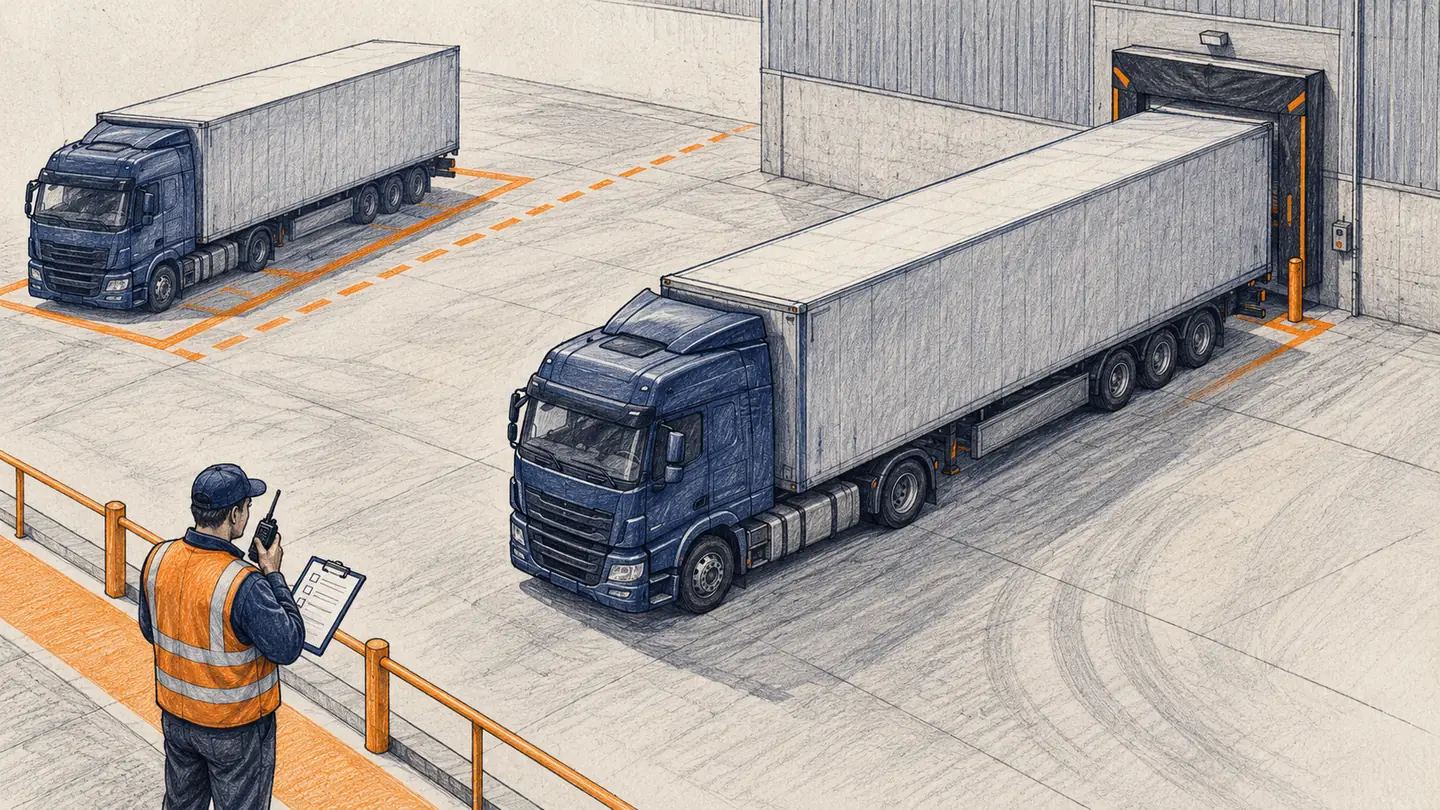
Imagine a morning in a dispatch office, where vehicles and deliveries are assigned. Loading is running forty-five minutes late. The truck has not left, but the consequences are already on their way: the first customer stops receiving goods at noon, the second has an occupied dock, the driver’s break is shifting, and another load is waiting for the return journey. Yesterday’s plan is still on the screen. Today’s work is already on the phone.
After rail, our exploration of AI in logistics takes to the road. We will follow an imagined delivery run through the actual functions of different systems: from quoting for transport and allocating loads to predicting arrival times, unloading and getting paid. Then we will look at the road ahead — driverless trucks, new powertrains and infrastructure that exchanges data with vehicles.
The run begins before the engine starts
Before an order reaches the dispatcher’s screen, someone needs to read the customer’s request, check the requirements and quote a price. At C.H. Robinson, AI agents already carry out some of this work — programs that find the information needed for a task and perform several connected steps. The company uses them to quote for road freight. For more complex international shipments, it brings together information about ports, charges and onward transport by truck, train or barge. Customers can use this to compare prices and transport options; once a quote is accepted, the work of organising the delivery begins.
Once the transport is agreed, the dispatcher matches what needs moving with the resources available. Two shipments may be close to one another yet need different vehicles: one needs a refrigerated truck, the other a hydraulic tail lift to lower the goods during unloading. The load has a weight and volume, the customer a receiving slot, and the driver available driving time and mandatory rest breaks. The shortest line on a map is only one part of the job.
LETA describes a system that takes orders from existing business software and allocates them according to vehicle capacity, load size, addresses, deadlines and priorities. The planner can see and change the delivery sequence. When conditions change, the updated route also reaches the driver’s app. Information entered in one place becomes part of a shared plan.
Different tools work together here. An AI model learns from previous journeys to estimate how long a trip will take; optimisation compares possible schedules and looks for the one that best meets the stated requirements. Mathematical route planning has been around for a long time. Connecting it with models that learn from previous journeys allows plans to draw more closely on what actually happens in traffic and during deliveries. The haulier chooses what matters: cost, reliable arrival times, fewer empty kilometres or a more even workload for people.
When the plan meets the working day
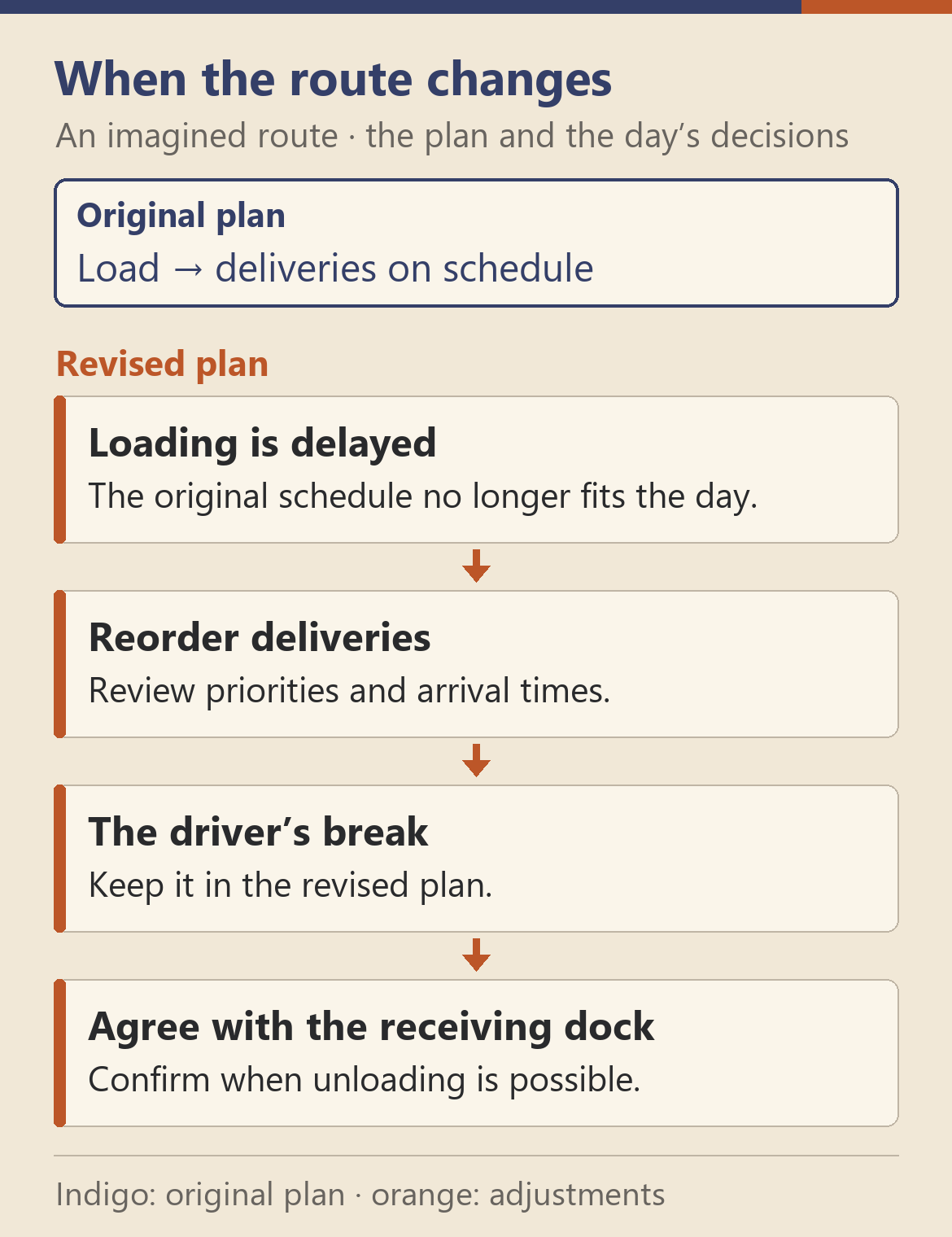
Back to our delayed loading. A forty-five-minute delay may be manageable if the first customer has a free dock. It can disrupt the whole run if it means missing an appointment and waiting again. A useful arrival estimate must account for what happens while the truck is standing still, too.
In its account of how it predicts arrival times, project44 explains how it combines vehicle location data with journey and waiting-time histories and other circumstances. A model adjusts the basic driving time by estimating additional delays. Fresh data from the road updates the prediction, giving warehouse staff more time to adjust dock and staffing schedules.
On our imagined run, this could open up several options: check whether the second customer can receive the goods first, offer the first customer a new slot, or move one delivery to another vehicle. A change in sequence also needs checking inside the trailer: the goods for the new first stop may be behind the other pallets. Moving goods to another truck takes time and adds handling costs. Software can compare options quickly, while the dispatcher checks whether they are practical and fit within the driver’s available time.
A new arrival estimate still needs to become an agreed unloading slot. The dispatcher also knows things that have not yet reached the system: one customer’s forklift is out of action today; another will accept the goods later if someone calls in time. Once the receiving team confirms the change, the agreement needs to go back into the plan so the driver, customer and warehouse all see the same schedule.
For this to work, the order number must link the order to loading confirmation, departure, arrival and proof of delivery, even when partners use different software. Clear permissions matter too: for example, the system may send an updated arrival estimate automatically, while the extra cost of transferring a load waits for approval. The dispatcher is left with an overview of what really needs a decision, together with the reasoning behind each suggestion.
A similar problem arises when cargo moves from the Danube onto the road. Through WATERBRIDGING, Science and Technology Park Novi Sad is developing a pilot to connect data from the port, terminal and other digital tools. The aim is for the driver, the freight forwarder organising the transport and the port operator to see the same cargo status. That connection provides a basis for timing a truck’s arrival to when the goods are ready for collection. This is the foundation being developed here: a shared flow of information between the people involved.
The dock is part of the journey
Our truck finally arrives. Two other vehicles are ahead of it. Now the unloading sequence, a free dock and somewhere for the trailer to wait all matter. Coordinating the road and the warehouse determines whether a well-planned run really makes for a good working day.
This is where robotics joins software planning. YMX and Outrider announced a five-year agreement on 1 October 2026, with their first joint deployments planned for that year. Outrider’s system covers finding and moving a trailer, coupling it, connecting its brake lines and positioning it precisely at a dock. Links to warehouse and transport systems give those movements a place in the schedule.
For the receiving team, the value is visible in a very concrete scene: the trailer that needs unloading arrives at the right dock, and the team knows when to expect it. For the haulier, this can be measured in the time from entering the yard to leaving it, and in whether the vehicle is ready for its next run.
The truck has arrived. The invoice has further to go.
The driver hands over the goods and sends proof of delivery. Back in the office, someone has to find the corresponding shipment, check the details and continue the billing process. The document may have a different layout from the previous one; the order number may be handwritten. The run now moves between paper, screens and people trying to reconcile their records of the same event.
On 18 September, Fr8Tech introduced a module for validating proof-of-delivery documents. It reads text, detects the presence of signatures and stamps, and compares the details with the shipment record. Alongside the result, it displays an explanation and a confidence score; documents that need review go to a person. Routine copying and comparison become a shorter review of the points where something does not match.
The next step already operates at the scale of everyday business. On 30 October, AWS published an account of a deployment at Worldwide Express: three AI agents match invoices to shipments, check contracted rates and examine additional charges against delivery records. If an invoice includes a tail-lift surcharge, an agent checks whether the delivery record and the carrier’s rules justify it. The agent explains its findings and sends them for human approval in the existing software. The company reports resolving around 10,000 billing discrepancies a week.
It is easy to imagine what this development could mean for a small transport office. Less time goes on finding attachments and comparing line items, leaving more for the conversation that actually resolves a disputed delivery. The goods have arrived; now the paperwork can catch up.

What comes next: vehicles, roads and energy
Three paths of development lie ahead of the next run: the vehicle takes on more driving tasks, its source of energy changes, and infrastructure supplies more useful data. Bringing these together could change how transport is contracted and organised. We can already see which parts are working and which are only beginning trials.
From driver assistance to trucks without cabs
The word “autopilot” covers very different experiences. A system can maintain following distance and lane position while the driver continually watches traffic and remains responsible for driving — that is Level 2 automation. At Level 4, the system can drive without a driver within the area and conditions it was designed for. That distinction determines what the person’s job involves and where the vehicle can be used.
In Marysville, Ohio, Einride and EASE described daily freight operations using two electric trucks without cabs on 6 October. They run between EASE facilities, across private property and local public roads, with a remote operator. Even this cabless operation has human support: the remote operator monitors the truck and can step in when needed.
A European example also shows how development proceeds. In September, Lidl presented its project with Einride in Edermünde, near Kassel: a truck without a cab carries goods from a distribution centre to a nearby store along an approved public-road route. Once that operation has been successfully validated, the plan is to move to a run with several stops at another location. A familiar road, a repeatable task and clear arrangements for receiving the goods provide a practical starting point for gradually expanding the service.
On longer routes, Aurora’s report of 28 October says it passed 500,000 commercial driverless miles in September. To expand operations, it is working with partners that manufacture trucks and install equipment, including Volvo, PACCAR and Roush. Its remote specialists provide information and support; according to its safety report, they do not drive the vehicles remotely.
On 5 October, Volvo and Waabi announced that their trucks were carrying freight for Warp between Dallas and Houston, with an observer in the driver’s seat. Their service covers the vehicle, software, fleet operations, servicing and freight terminals — places where goods are collected or handed over for the next stage of transport. Daimler Truck and Torc, meanwhile, set commercial introduction for 2027 in their September development plan. The clearest emerging pattern is transport between selected freight hubs, with gradual expansion of the network and the conditions in which vehicles can operate.
Electricity, fuel and time for a break
Powertrains have their own development path. On 14 September, Volvo announced the start of series production of its new generation of electric trucks, including the FH Aero Electric, with a stated range of up to 700 kilometres and megawatt charging. Actual range depends on the load, weather and driving. On 22 October, Milence opened a charging hub in Temse, Belgium, with eight truck bays, four of which support charging at up to 1.5 megawatts. Vehicles and infrastructure are already moving beyond announcements.
A hybrid powertrain provides a reserve when the battery cannot cover the entire run or a charger is unavailable. In May, DHL Freight described a joint pilot with BMW: an electric truck with an additional generator operated between Berlin and Munich and on shorter local runs. An electric motor drives the wheels, while a combustion engine generates electricity when needed. The role of this range extender is being tested through pilot freight operations.
For the dispatcher, this adds a new calculation: how much energy the load and route require, where the vehicle can recharge, and how charging fits with the driver’s break and delivery appointment. Choosing a powertrain and choosing the level of driving automation are two separate decisions. Electric trucks with drivers and autonomous vehicles with other powertrains may work in the same fleet. The route plan needs to accommodate their different capabilities, charging or refuelling locations, and available support.
A motorway that tells you what is happening
A “smart motorway” can already mean something very tangible: a warning about the back of a traffic queue or roadworks before the driver can see them from the cab. Austria’s ASFINAG reports more than 500 roadside communication units that send such warnings to compatible vehicles. The road becomes a source of information for the driver and the vehicle’s systems.
A charging network is being planned alongside this. AFIR is the EU’s Alternative Fuels Infrastructure Regulation. Article 4 requires public charging locations for heavy electric vehicles on the core TEN-T road network — Europe’s main transport corridors — to be no more than 60 kilometres apart in both directions by the end of 2030, subject to specified exceptions. This sets the direction for construction. Its value for logistics will be in allowing hauliers to plan reliable runs across several countries.
These developments suggest a possible picture: a traffic delay changes the arrival estimate, the new estimate shifts the charging slot, and that change reaches the warehouse too. AI could compare the options while people still have time to agree on a response. This is one possible direction of development, connecting applications that are separate today.
Who is driving the change — and whose time does it save?
Partnerships lead the programmes we are following: truck manufacturers provide vehicles, production and servicing; Aurora, Waabi and Torc develop autonomous driving; hauliers bring freight and everyday experience; road and charging operators provide the necessary facilities. Logistics software connects the transport order with all these resources. The advantage will go to those who turn that cooperation into a reliable service a haulier can use and afford.
We can already begin to picture how the working day might change. Some long-distance runs could move to autonomous corridors, with a different division of work across long-haul routes, local delivery, terminals, maintenance and remote support. Fewer people may be needed on some routes; new roles require training and a different organisation of work. For a small haulier, access to a shared platform could open up new business, but the cost of the service, who can use its trip data and how easily it can change suppliers will matter.
For a transport business, a first step could be to follow one regular run: how much time goes on planning and calls, how long the vehicle waits, how many kilometres it travels empty, and how long it takes to reconcile invoices. Alongside the cost of the software, integration and support, this provides a basis for assessing what introducing the tools actually achieves. There is also a decision about how to use the time gained. An extra hour can become another delivery, more careful problem-solving or an earlier end to a shift. That depends on the goal people set for the system.
Back to the morning in our opening scene. Loading can still run late. Progress would mean the change reaches everyone affected in time, the proposed new schedule is practical, and people can understand and adjust it. A good run leaves fewer empty kilometres, fewer urgent calls and more room for everyone to know their next step.
Sources and deployment stages checked on 3 November 2026. Numerical results are attributed to the companies and operators reporting them. The imagined run is used to explain how things work; the look ahead brings together documented applications, pilot projects and announced plans.
Sources / Provenance
Following AI in logistics; sources and deployment stages checked on 3 November 2026. Primary sources: C.H. Robinson (26 October 2026); WATERBRIDGING/STP Novi Sad (19 October 2026); Lidl/Einride (15 September 2026); LETA; project44 (2 October 2025); Fr8Tech (18 September 2026); YMX/Outrider (1 October 2026); AWS/Worldwide Express (30 October 2026); NHTSA; EASE/Einride (6 October 2026); Aurora Q3 (28 October 2026) and Safety Report 2025; Volvo/Waabi (5 October 2026); Daimler/Torc (13 September 2026); Volvo Trucks (14 September 2026); Milence (22 October 2026); DHL Freight/BMW (27 May 2026); ASFINAG (30 March 2026); AFIR, Article 4. An imagined run explains different documented functions. Operational results, pilot projects and plans are distinguished in the text; the implications for future development are an editorial synthesis.