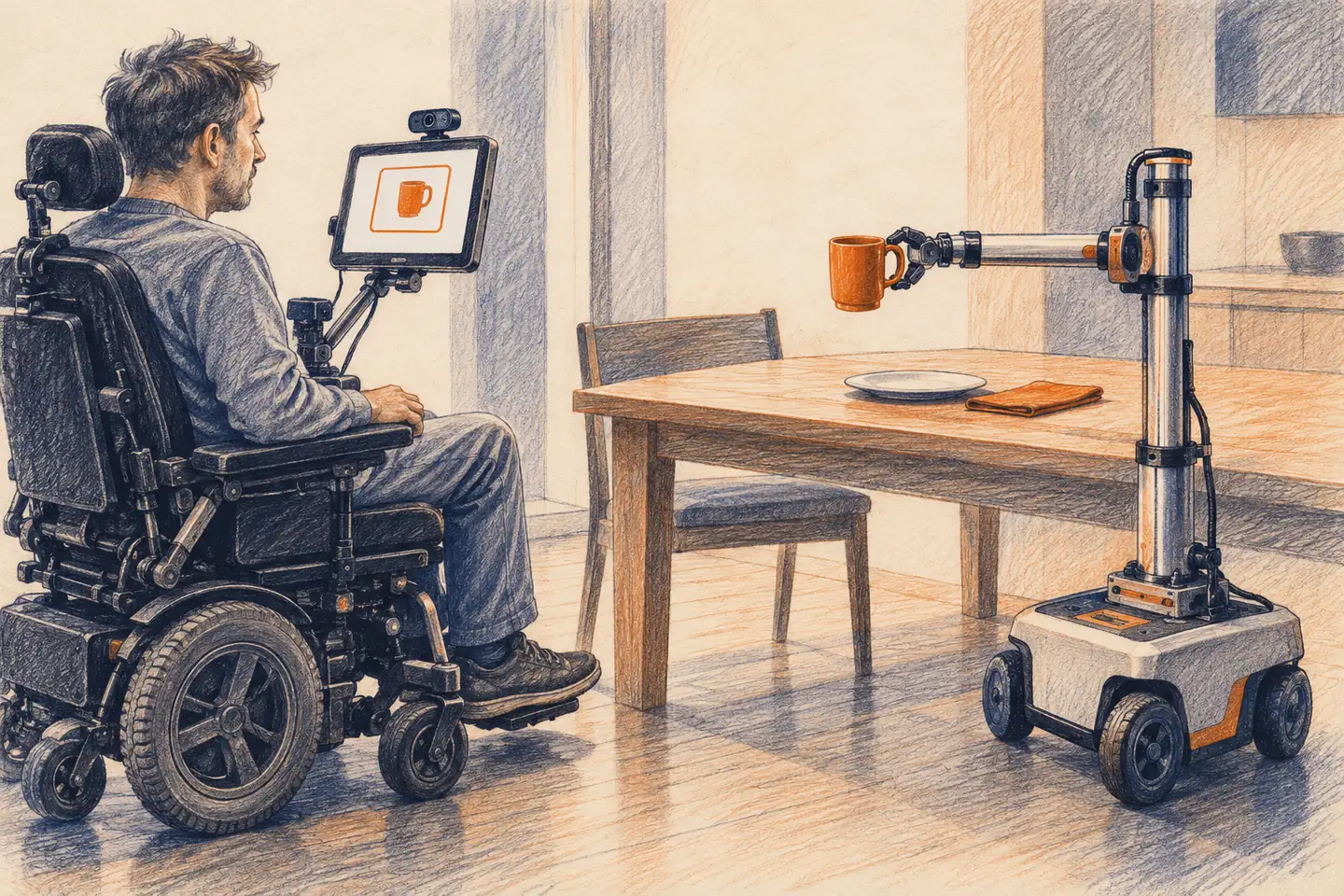
Henry Evans plays poker with Jane and their friends. He used to be part of her team or someone else’s; with Stretch and an adapted card holder, he can play his own hand. Others help him put the cards in and take them out, while he uses the robot to turn the holder and position them in front of him. This change is described in a study of home robot use published in 2024.
Your own cards mean your own move. You can make a mistake, surprise someone, try again. There is room for your choices in the game, and the outcome is still unknown. Taking part in this way gives an ordinary evening the liveliness that brings us together around a table in the first place.
A day at your own pace
Henry has tetraplegia and does not speak; he controls a computer through head movements and an adapted mouse. Over four weeks, an occupational therapist and an engineer worked with him and Jane to adapt the robot to their home. With the equipment prepared, he ate at his own pace and carried items needed for a shared meal.
There is something in these actions we can easily overlook when we do them without thinking: the chance to choose the moment for ourselves. Another bite, a short pause, something we want to pass to the person across the table. The day takes on our rhythm. The care we feel can reach another person through what we do for them, too.
Henry also helped change the tool itself. When the robotic arm blocked his view of the controls on the screen, he worked with the team to rearrange them so he could access them on the right. His experience became part of the solution he would use.
This opens up another kind of independence: recognising what gets in your way, thinking of a change and helping to make it. Family members and specialists bring their knowledge; Henry brings his understanding of his own day. Together, they look for ways to make his next idea possible.
Help we can change
In home trials at the University of New Hampshire (UNH), a robot helps people with dementia through reminders and support for daily routines. In a report from November 2025, researchers describe a participant who initially wanted a reminder to put on suitable footwear for a walk. Later, the reminder bothered him: he felt the device was nagging him about something he could already do for himself. The team uses this example to emphasise making decisions together with users about how to use the robot and what to use it for.
The man changed his mind about the help he needed. His wishes should remain part of the agreement beyond the initial setup. Henry’s story shows how much it means to be able to start an action himself. The UNH example adds another important choice: to say — I no longer need this.
A home has its own rhythm
At home, help takes another form: a reminder, a conversation and contact with family. Two Chinese reports from July 2026 show how that works in everyday life. Legal Daily profiles Zhou Qing, a 71-year-old Beijing resident whose device gives reminders, supports conversation and allows remote contact with her daughter. The report also mentions a function that alerts the family after a fall.
In Economic Observer, 73-year-old Zhou Huilan of Chengdu describes a robot that struggles with fast speech and dialect, then answers a different question. The report mentions disturbing reactions at night and unnecessary reminders. Her daughter once stopped receiving data because her mother had switched off the router to save money.
In these homes, the robot takes on some everyday reminders and monitoring. Its usefulness depends on how well it fits the person’s life. The device needs to understand how the person speaks to it, while reminder times, volume and the timing of conversations should be easy to adjust. This kind of help can make the day easier and keep people connected with family.
Help in two directions
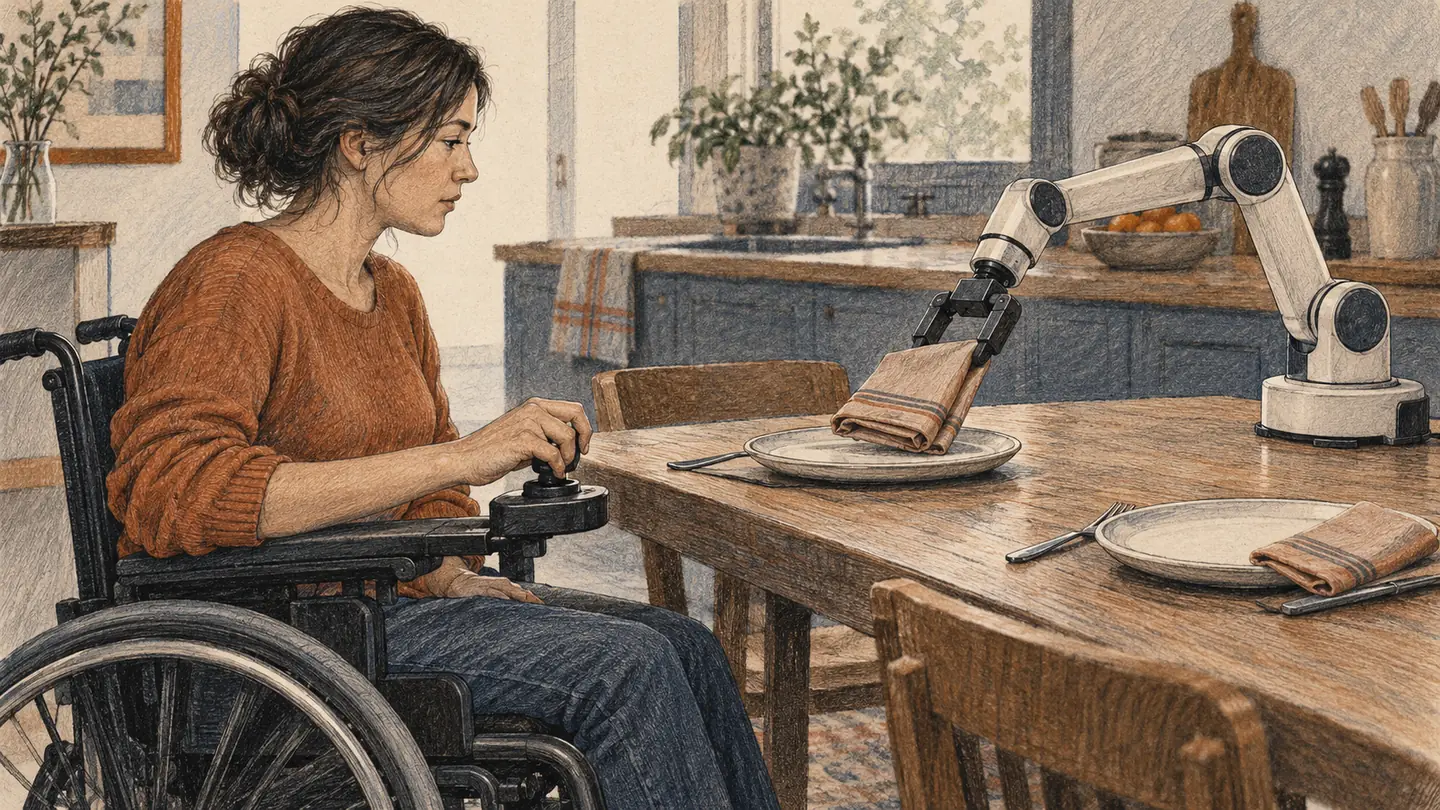
In these stories, help moves in two directions. In one, a family arranges support for one of its members: reminders, easier contact and an alert when someone’s attention is needed. The robot takes on some of the everyday care. For the family, this can mean less strain; for the person using it, greater security and easier contact with those close to them. Their habits, wishes and consent determine how this help fits into the home.
In the other direction, the person starts with an intention of their own: I want to reach for an object, prepare something, help someone else. With as much support as they need, they adapt the way they use the robot and choose what to do with it. The machine gives them room to take the initiative, explore and take part in life with others.
The same robot can serve both needs. Henry’s example shows how they connect: help from his family and specialists makes it possible for him to help Jane. Care becomes mutual. Asking whose intent the robot turns into action leads us straight to the relationships between people.
What else could I do?
When you have to wait for someone else’s hands to do an everyday task, some of what you want to do has to wait, too. Perhaps you want to move an object, change the game or pass something to someone right now. Being able to start that action yourself gives you back some say over your own day. What you want to do takes shape in the world.
Henry’s satisfaction at being able to help Jane with meals carries that weight. In a shared task, care goes both ways: I can do something for you, too. At the table with friends, he has a move of his own. Through conversations with the people developing the robot, his ideas can change the tool itself. These are different ways of being present, contributing and having a say in what happens.
This also makes room for hope. A success that is barely visible from the outside can feel enormous within: I imagined it, I tried, it happened. The next idea now has something to build on. A person can explore, practise, suggest changes and work with others to find a way to do something still beyond their reach.
Progress in assistive technology can take on a deeply personal meaning. Better controls, easier adaptation or a new robot skill can make another independent action possible. There is room for curiosity and anticipation: what could I try next? The future once again becomes something we can help shape.
A move of our own changes today. The hope that we can do more tomorrow gives us a reason to make plans.
This story brings together a study of home robot use, UNH reports and experiences documented by journalists. Core sources were checked on 21 October 2026; details of Henry’s participation and the additional UNH material were checked on 2 November 2026.
Sources / Provenance
Sources checked on 21 October 2026: the home-use study with Henry Evans and Jane (2024) and Chinese reports from July 2026. Additional material checked on 2 November 2026: University of New Hampshire reports on home trials of a robot supporting people with dementia, published on 20 November 2025 and 8 September 2026. Study findings and reported experiences are attributed to their sources. Details of poker, eating at his own pace and Henry’s participation in adapting the interface were checked again on 2 November 2026 in the same 2024 study. The closing reflections on participation and hope are editorial analysis.