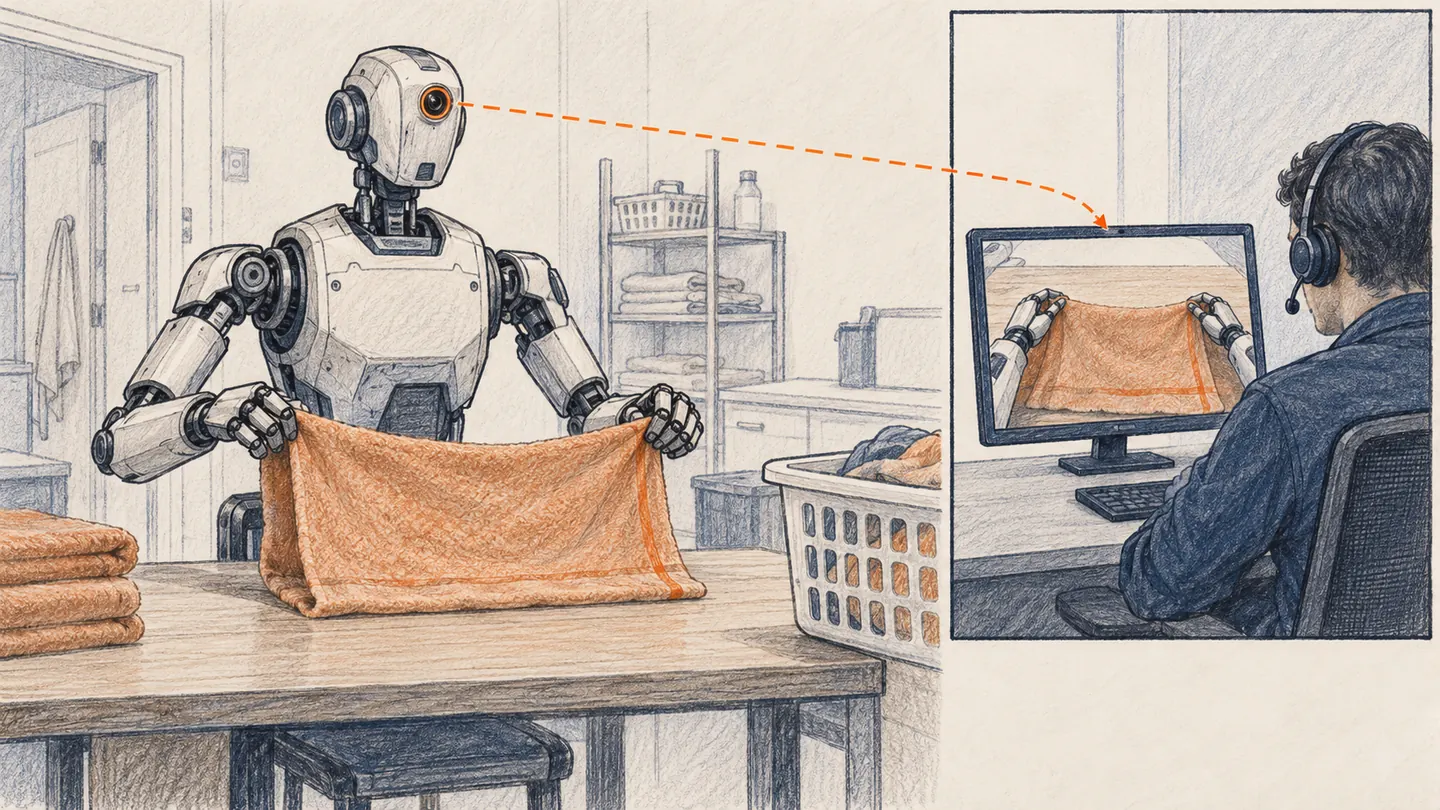
Imagine the end of the day: dishes waiting, a full laundry basket, and a spare pair of hands would be welcome. A home robot enters that scene with a simple promise—to take on some of the work. To judge the help, we first need to understand how it is meant to work.
NEO, Tau and Mobo represent different relationships with a home and its occupants: help with everyday chores, a cleaning service and a companion that remembers. Optimus raises the same questions through the ambition to develop a home humanoid. First, let us look at what is offered and what is being developed, then at who handles the data and decisions.
NEO: sometimes the helper needs help
Imagine leaving a robot a list of household jobs and a time to finish them before you head out. That is how 1X presents NEO: a helper that takes on everyday chores. The early version has basic autonomy. For a task it does not yet know, the owner can schedule a 1X Expert to guide it remotely. Laundry is one of the examples offered for that mode.
At that point, the scene changes. The robot is in the room, but a person elsewhere is helping it work. What can that person see, and when may they connect? According to 1X’s FAQ, owners schedule and accept access, while the rings on the robot’s head change colour during an operator session. Accepting help therefore also means deciding to let someone see into the home.
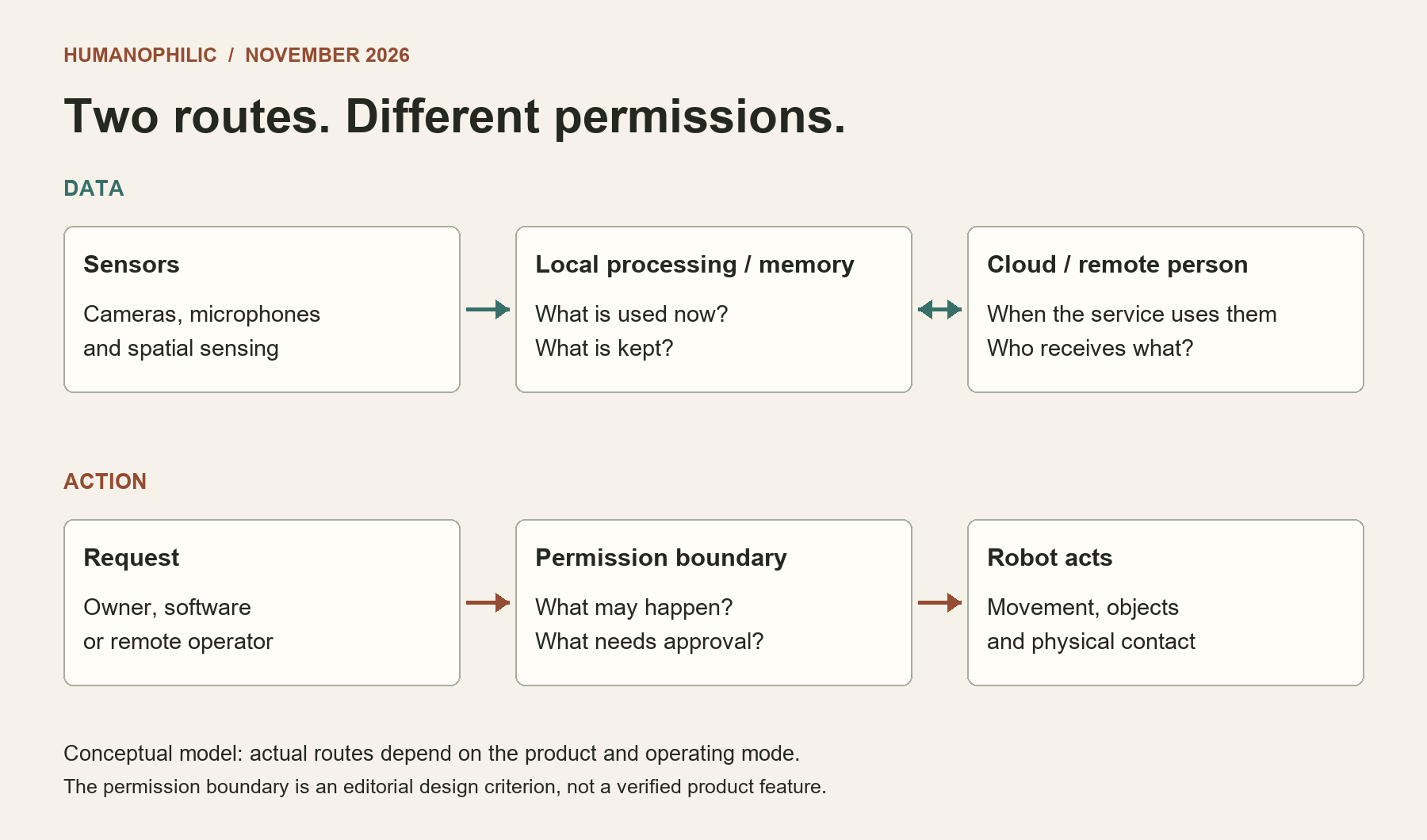
1X says data sharing for improvement can be switched off. Limited sensor data may still reach its servers to fulfil a request in autonomous mode, without being stored. Refusing training use does not necessarily mean nothing leaves the room. Processing, recording and learning from data are three separate parts of the arrangement.
The pre-order agreement says Terms of Sale will be presented at purchase; the linked privacy policy covers the website, accounts, orders and communications. Before buying, read the final rules for operation in the home: operator access, retention, deletion and which functions remain when sharing is declined.
Tau: book a clean, invite a camera
The living room needs cleaning, so you book a visit. Under the service described in Tau’s terms, updated on 24 October, its team brings a humanoid robot to your home. A person at Tau’s facility controls it live, seeing the space through its cameras. This is a scheduled cleaning service: the customer defines the working area and an operator guides the machine through the job.
The recording of that job has a second life. Tau’s privacy policy says microphones are disabled, but video is recorded and used to train future autonomous models. Recording is integral to the service. Footage is kept indefinitely unless deletion is requested. Tau then removes the raw data and training-set entries, but says it cannot undo their influence on an already-trained model.
There is also a smaller, everyday flow of data. If the customer chooses contact by text message, Tau may send a photo from the robot’s camera during a visit to ask what needs cleaning. The messaging provider, mobile carrier and recipient’s phone all take part in that exchange. A copy of the received photo may remain on the phone under the recipient’s control. [1] The question “Where does an image from my home end up?” therefore includes a brief message to clarify the task, as well as a large training dataset.
Bedrooms and bathrooms are excluded unless the customer opts in; other areas can also be placed off limits. Anyone present can ask for the session to end. These are concrete boundaries a household can consider before the robot arrives.
NEO and Tau thus offer different exchanges: the former describes improvement-data sharing as optional; in the latter, cleaning also produces training material. Understanding that difference comes first. The label “AI-powered” alone does not tell us who does the work or what remains afterwards.
Mobo: a companion that remembers you
Imagine a home companion that an older household member asks to set a reminder, while a child asks about an object they are holding. At the next encounter, the robot is meant to recognise who is speaking and remember their preferences. That everyday familiarity is central to the offer behind Mobo, AiMOGA’s family companion robot. Chery’s 21 October announcement describes family recognition, spatial awareness, long-term memory and a combination of local processing and the cloud—computers outside the home.
AiMOGA’s launch release lists conversation, questions and answers, and user-defined reminders. Face ID connects memories to users; MogaCloud supports remote task assignment and software updates. For data intended for cloud learning, the company describes on-device de-identification and security checks. These are capabilities announced as pre-orders opened, rather than findings from a household test by us.
Here, remembering is part of the benefit. You would not have to introduce yourself and your habits every time. But a habit can change, and a robot could mix up two people’s preferences. Inspecting, correcting and deleting a memory should therefore be as accessible as creating one. A visitor or child who did not choose the device also deserves a clear way to decline being remembered. A guest mode and a way to pause collection are our criteria for a good product here.
Optimus: a helper at home, but where does the data go?
Imagine Optimus clearing away cups after dinner. For some people that would be a convenience; for someone who struggles to stand up or carry objects safely, it could mean much more. While the robot looks for a free spot on the table and a route to the kitchen, the household carries on talking.
This is an imagined use scenario, not a confirmed capability of a model already delivered to households. Tesla is developing Optimus as a general-purpose humanoid robot intended to take on dangerous, repetitive or boring tasks. [1] The path from that aim to reliable work in someone’s kitchen involves much more than lifting a cup: navigating a changing space, behaving safely around people and having clear rules for data.
A story about an imminent waiting list also appeared in late October. On 30 October, the San Francisco Standard reported investor Modar Alaoui’s claim that reservations were expected to open in early December. An update to the same article says Elon Musk replied “No” to that announcement. [2] We therefore do not count a December waiting list as a confirmed opening of sales. An announcement, a reservation and a home robot that has been delivered are three different stages.
For this discussion, what matters more is what should accompany the product when it actually reaches a home. Which sensor data stays in the house? What is sent to the manufacturer, and for what purpose? Can a remote operator access the robot, with whose permission and with what indication of their presence? How long are records kept, how are they deleted, and what does the robot do when it is offline?
The sources reviewed do not give us enough specific information about a consumer Optimus to answer those questions. That does not establish that safeguards are absent. It means we cannot yet explain how they work to a reader, or assume that the rules for Tesla’s cars apply.
That is why Optimus belongs in this story: the same questions apply to every brand. A home helper becomes more valuable when it gives people back time and the ability to do things. Trust grows when it is equally clear who can see their kitchen.
What a helper sees, remembers and may do
We have already given the robot vacuum a map, the home camera a view and the smart speaker a voice. A more capable robot can combine those functions and add hands. These examples show why “Who can see this?” is only the first question. What remains in memory, and what may the machine do as a result?
A camera may help a robot avoid a chair without saving a recording of the room. A conversation may be processed to produce an answer, stored as a transcript, turned into a personal memory or used for training. Each step needs its own explanation. The presence of a camera does not tell us where the data ends up; “human in the loop” does not tell us when that person has access.
Permission to look is not permission to act
Consider another hypothetical situation: a robot recognises someone outside the front door. Recognition supplies information. Unlocking the door is a separate action. The same distinction applies to moving a fragile object or approaching a person with something hot. A successful perception result cannot, by itself, settle who authorised the next movement.
A good interface would make these boundaries understandable before a task begins. It could show whether the robot is acting autonomously or under remote guidance, what requires a fresh approval and how to stop the task. A readable activity log would help establish whether an instruction came from the owner, an operator, a schedule or the robot’s own software.
Software updates belong in this conversation too. When software directs a physical machine, a changed feature may alter how it moves or responds. Buyers should be told about meaningful changes in permissions and behaviour, and what happens if connectivity or support disappears. Neither a reassuring face nor an impressive demonstration answers those questions.
Before a robot becomes a housemate
Ask for answers that describe the particular model, subscription and operating mode. “Secure”, “private” and “human in the loop” are starting points for questions.
- What leaves the home? Separate live processing, recordings, maps, transcripts and personal memories. Ask which functions work locally.
- Who can connect? Ask how an operator is admitted, how everyone present can recognise a session and how it ends.
- What becomes training material? Ask whether refusal changes the service, and whether deletion covers raw files, derived profiles and future training.
- Whose preferences count? Ask about other household members, guests and children, private rooms and temporary pauses.
- What can it do without asking? Check doors, appliances, objects and physical contact, along with stopping behaviour and an intelligible action history.
- What changes later? Ask about software updates, account recovery, support ending and clearing data before resale or return.
If an answer is missing, record “not explained”. That still helps when comparing devices, without guessing what lies behind the gap.
The rules come home too
In that opening scene, the laundry basket may no longer be waiting for us. But decisions about the camera, memory and access by other people remain our job.
A good helper leaves us able to check what is happening, change our minds and stop an action. That ability is part of what makes it useful.
Core sources checked on 27 October 2026; sources for the Optimus supplement rechecked on 3 November 2026. Product capabilities and policies above are attributed to their providers. The scenarios, diagram and review criteria are Humanophilic’s editorial analysis. No hands-on product test is claimed.
Sources / Provenance
Based on the MonkMagazin editorial seed dated 26 October 2026. Primary sources checked on 27 October 2026: 1X NEO FAQ, pre-order terms and privacy policy; Tau service terms and service privacy (24 October 2026); Chery (21 October 2026) and the AiMOGA announcement. Links appear in the article. Manufacturer claims are attributed; imagined scenarios, diagram and review criteria are editorial analysis. No hands-on test. Original AI cover illustration and editorial diagram. Optimus supplement rechecked on 3 November 2026: Tesla SI & Robotics and the San Francisco Standard, published and updated on 30 October 2026, including its report of Musk's response. Home use is presented as an imagined scenario; a December waiting list is not confirmed.