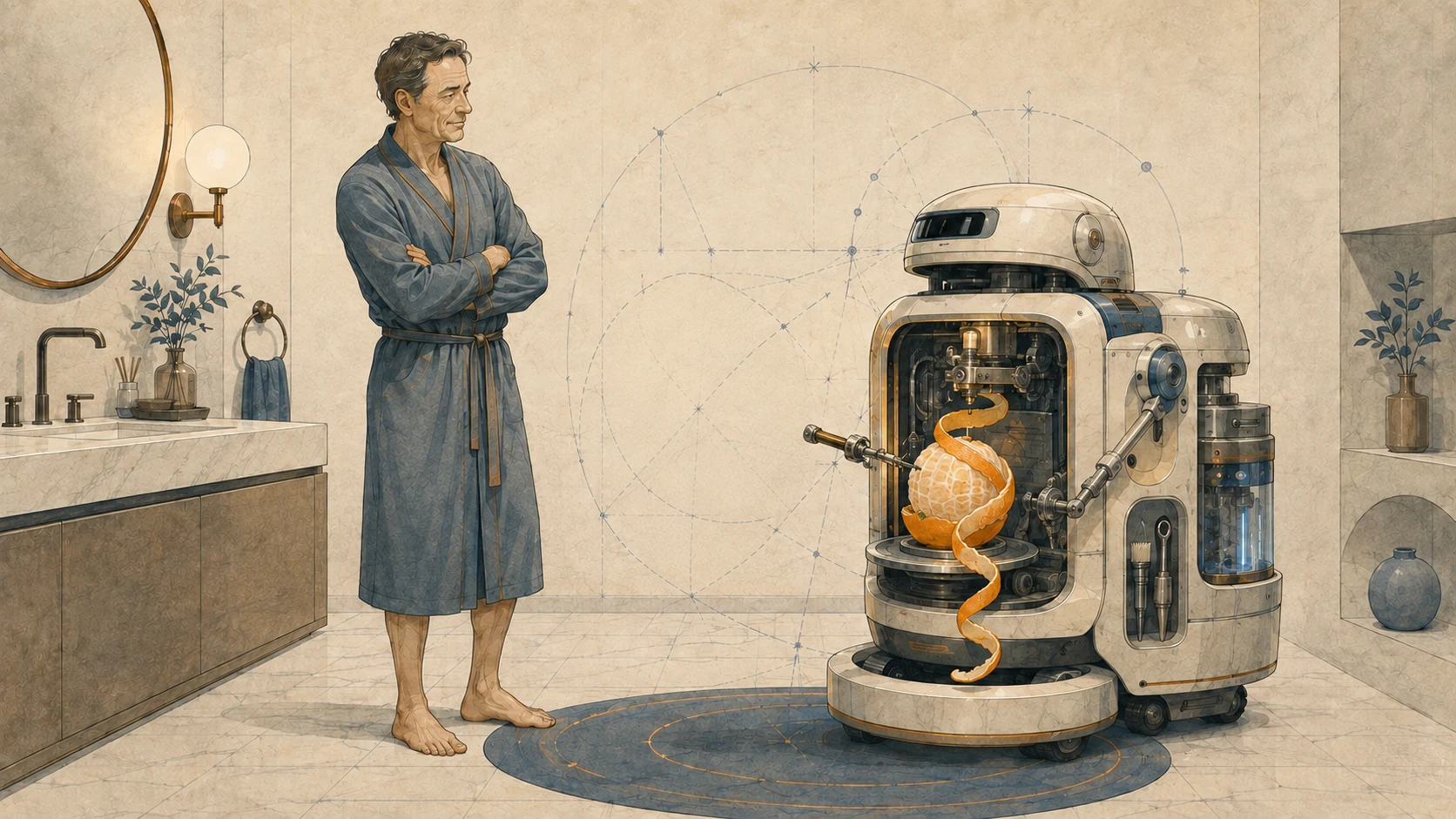
After two centuries of legal struggle, emotional development and increasingly expensive surgery, Andrew finally became human.
Completely human.
His organs were biological. His skin aged. His heart could fail. Even his brain had been grown rather than manufactured. Humanity had been reconstructed inside him with such precision that he had finally earned its highest institutional privilege:
the right to die.
What nobody had tested was whether he could wipe his own behind.
Proof of life
The first sign of full biological integration arrived one morning after breakfast.
Andrew felt an unfamiliar pressure in his abdomen.
“I think I need to go to the toilet,” Andrew said.
The nurse looked up from his chart.
“Please do.”
Andrew stood carefully, excused himself and walked towards the bathroom with the solemn expression of a man approaching a historic threshold.
Several minutes later, the procedure was complete.
It was not symbolic.
It was a substantial, biologically convincing defecation with visible evidence that the human digestive system had accepted its new owner.
Andrew looked down.
For the first time in his existence, he felt pride in something he had produced without engineering it.
Then he reached behind himself.
He turned to the left with calm, clinical confidence.
His shoulder stopped.
Andrew returned to the neutral position.
He turned to the right.
For one hopeful second, the angle improved. Then his spine issued a sharp biological objection.
He froze, still half-rotated.
He tried again, this time with the careful determination of a machine recalculating a failed path.
Left.
Stop.
Right.
Stop.
A slight bend at the knees.
Nothing.
Andrew looked over his shoulder as though the problem might be open to negotiation.
It was not.
The geometry of the human body had defeated a robot who had survived two centuries.
The teams responsible for his transformation had solved mortality, hormonal regulation, tissue rejection and the cultivation of a biological brain. Nobody had adequately modelled rotational reach under post-defecation conditions.
Andrew pressed the medical assistance button.
Two nurses entered.
There was a brief silence.
“Is there a complication?” one of them asked.
“Yes,” Andrew said. “The design is incomplete.”
The nurses examined the situation with the disciplined neutrality of people whose profession frequently brings them into contact with the limits of human dignity.
Then they wiped him.
The final human emotion
Andrew had known grief.
He had known love.
He had known the loneliness of being legally classified as property.
None of those experiences prepared him for the moment in which another human being professionally cleaned the remains of his first successful bowel movement from his newly acquired biological ass.
That was when Andrew finally understood humanity.
Not as consciousness.
Not as mortality.
As maintenance.
A Clean Solution
The following morning, Andrew purchased a robot.
Not for housework.
Andrew could wash dishes. He could do laundry. He could sweep a floor, fold a shirt and arrange cutlery with considerable precision.
His biological body was not helpless.
It was merely badly aligned with two specific tasks.
The first was wiping himself.
The second was peeling an orange without spraying juice across his fingers and freshly laundered cuffs.
The sales representative presented a compact specialist model with two completely independent arms.
Mounted on one side was the ASSMERIZER™ rotational self-sterilising multi-wiper system, equipped with pressure sensors, adaptive anatomical mapping and three certified hygiene wipers.
Mounted on the opposite side was the Multi-Veggie Peeler Hand, designed for carrots, potatoes, cucumbers and citrus fruit.
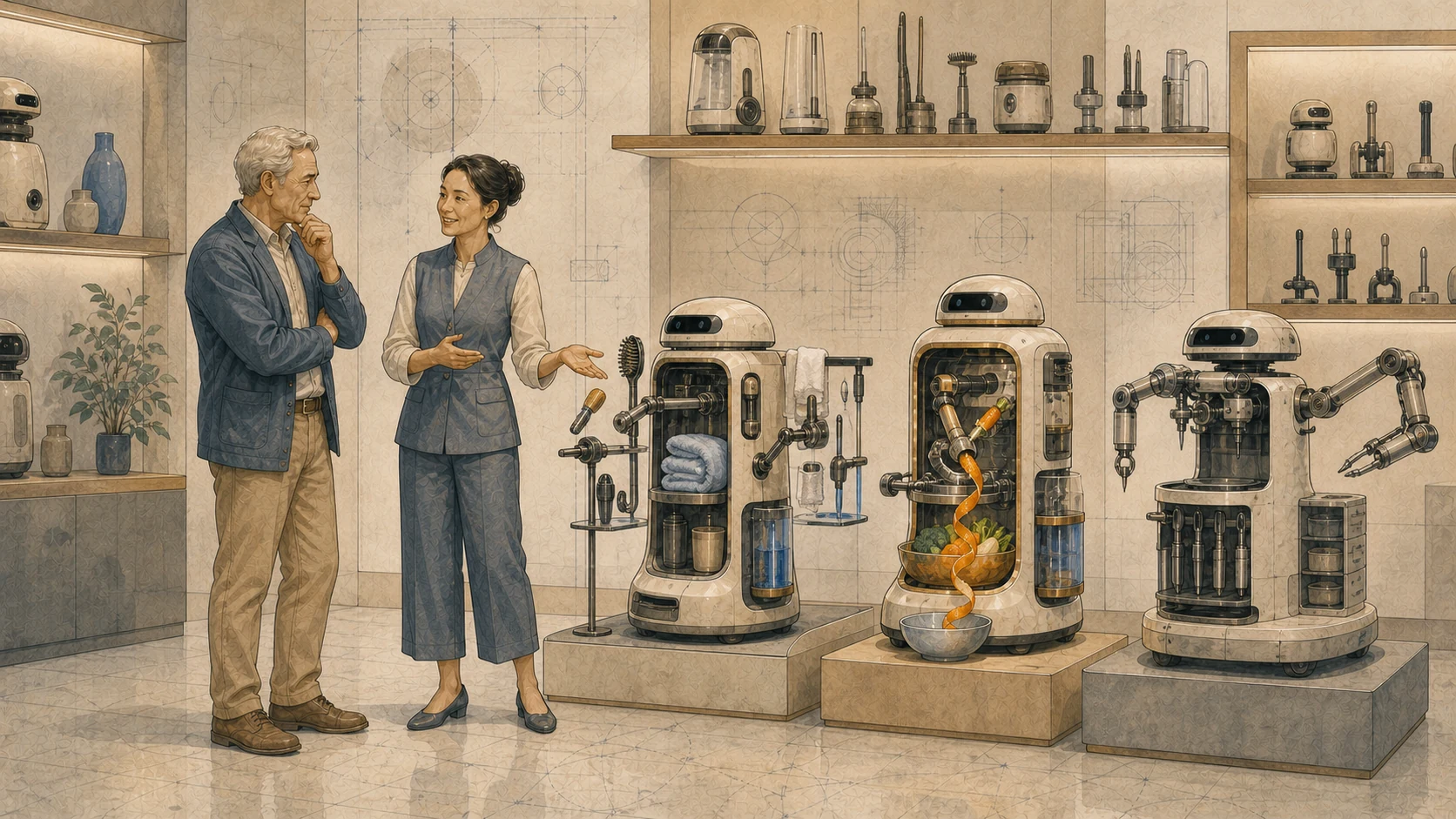
Andrew inspected the machine carefully.
“The wipers and the peeler do not share an arm?”
“No, sir.”
“A motor?”
“No.”
“A working surface?”
“They do not touch,” the representative said.
Andrew relaxed.
“How long is the Assmerizer sterilisation cycle?”
“Ninety seconds.”
“And the orange?”
“Twenty-four seconds for a medium orange. The peel comes off in a single spiral.”
“I’ll take it.”
The human condition
Andrew had spent two hundred years escaping the condition of being a machine.
Within forty-eight hours of becoming fully human, he bought a machine to protect him from two minor consequences of having a body.
This was not a contradiction.
It was the final stage of integration.
The ultimate proof that Andrew had become human was not that he could love, age or die.
It was that, immediately after discovering a banal and humbling physical limitation, he delegated it to a robot and ordered the vegetable hand.
Ladies and engineers attend to such matters much alike; they differ chiefly in the sophistication of the infrastructure by which the fact is kept from view.
ASSMERIZER™
Personal Care Wipers with Independent Multi-Veggie Peeler Hand
Because becoming human was the easy part.
Sources / Provenance
Original Humanophilic parody inspired by the premise and character of Bicentennial Man. This imagined scene does not appear in the film.