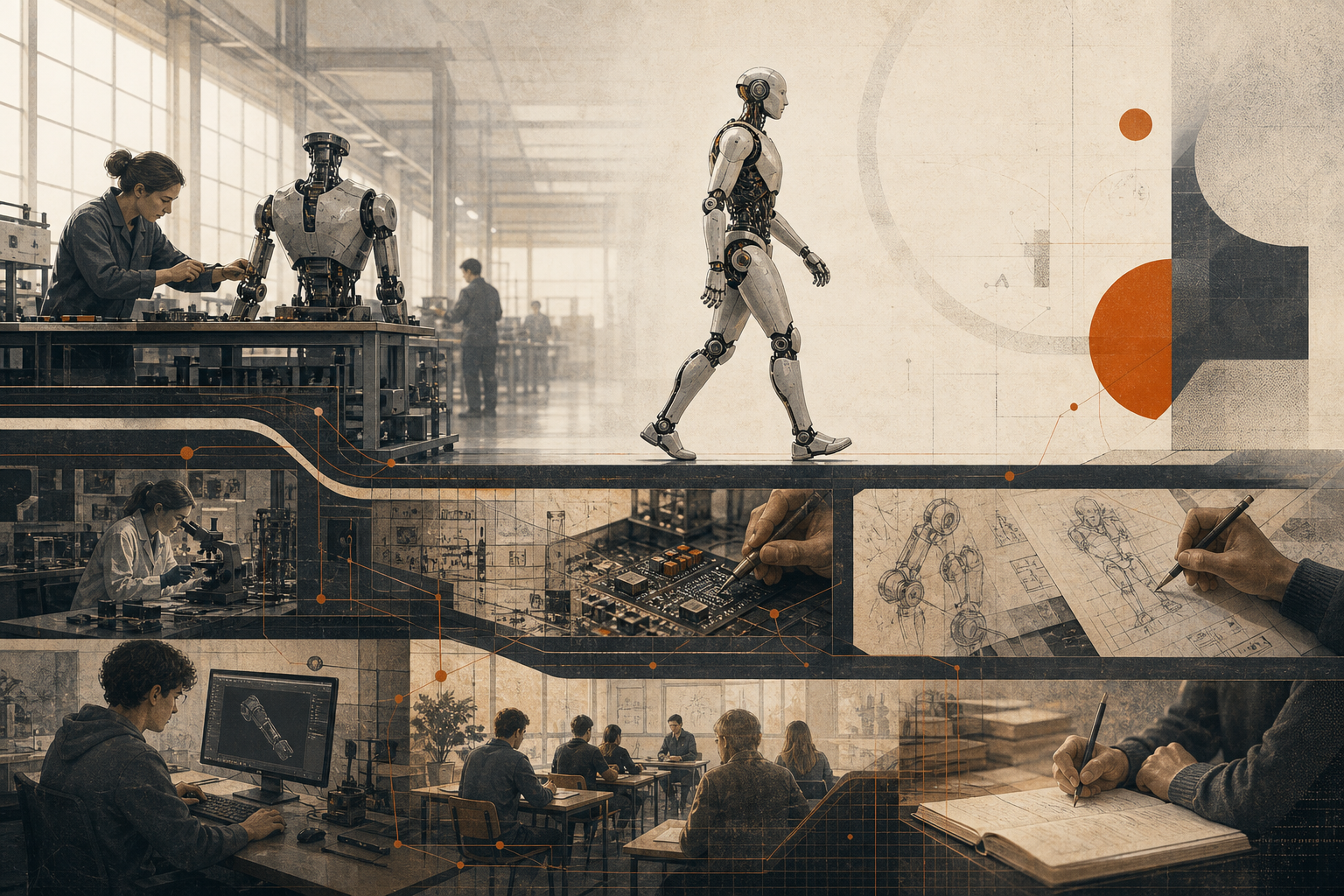
Minth Group and AGIBOT opened the first phase of a production base for humanoid and quadruped robots in Šabac on 29 August. The reported investment is €20 million, and the partners describe it as the beginning of Europe’s first mass production of humanoid robots.
At the opening, a ribbon was cut and a humanoid robot kicked a football. Both moments photographed well.
Behind the ceremony, something materially important did happen. The facility begins with assembly, calibration of motion and vision systems, and performance testing. These are real industrial capabilities: they require process control, trained workers, quality systems and responsibility for the finished machine.
That is the news. The deeper question begins where the cameras stop: how much robotics will remain in Serbia when the finished machines leave Šabac?
But assembling a robot is not the same as possessing the knowledge from which the robot emerges.
A specification, not a dismissal
Professor Kosta Jovanović of the University of Belgrade School of Electrical Engineering drew the boundary clearly:
“The development of robotics does not emerge from a single plant, but from an ecosystem.”
He is right. The sentence is not an argument against the factory. It is a specification for what must happen around it.
A robotics ecosystem includes faculties and technical schools, research groups and doctoral programmes, local component makers, systems integrators, software teams, testing facilities, service technicians, application designers and companies capable of turning a platform into useful work. It includes contracts through which knowledge circulates, and intellectual property through which some of that knowledge remains.
Without those relations, a country may host production while the technology continues to live elsewhere.
The layers of “Made in Serbia”
“Made in Serbia” can describe several very different realities.
It may mean final assembly. It may include locally manufactured frames, housings or wiring. It may extend to motion control, sensors, battery systems, integration, safety engineering, software, artificial intelligence, training data, application development and ownership of intellectual property.
Every layer has value. The problem begins when they are compressed into one triumphant phrase.
The information available today does not establish how much of the robot’s hardware or software is Serbian, which components arrive complete from China, whether domestic researchers will participate in development, or who will own the operational data produced by robots deployed in Europe. Minth and AGIBOT have announced localised manufacturing and future cooperation. That is an opening, not yet an outcome.
The difference matters because a label can travel with the product while capability does not.
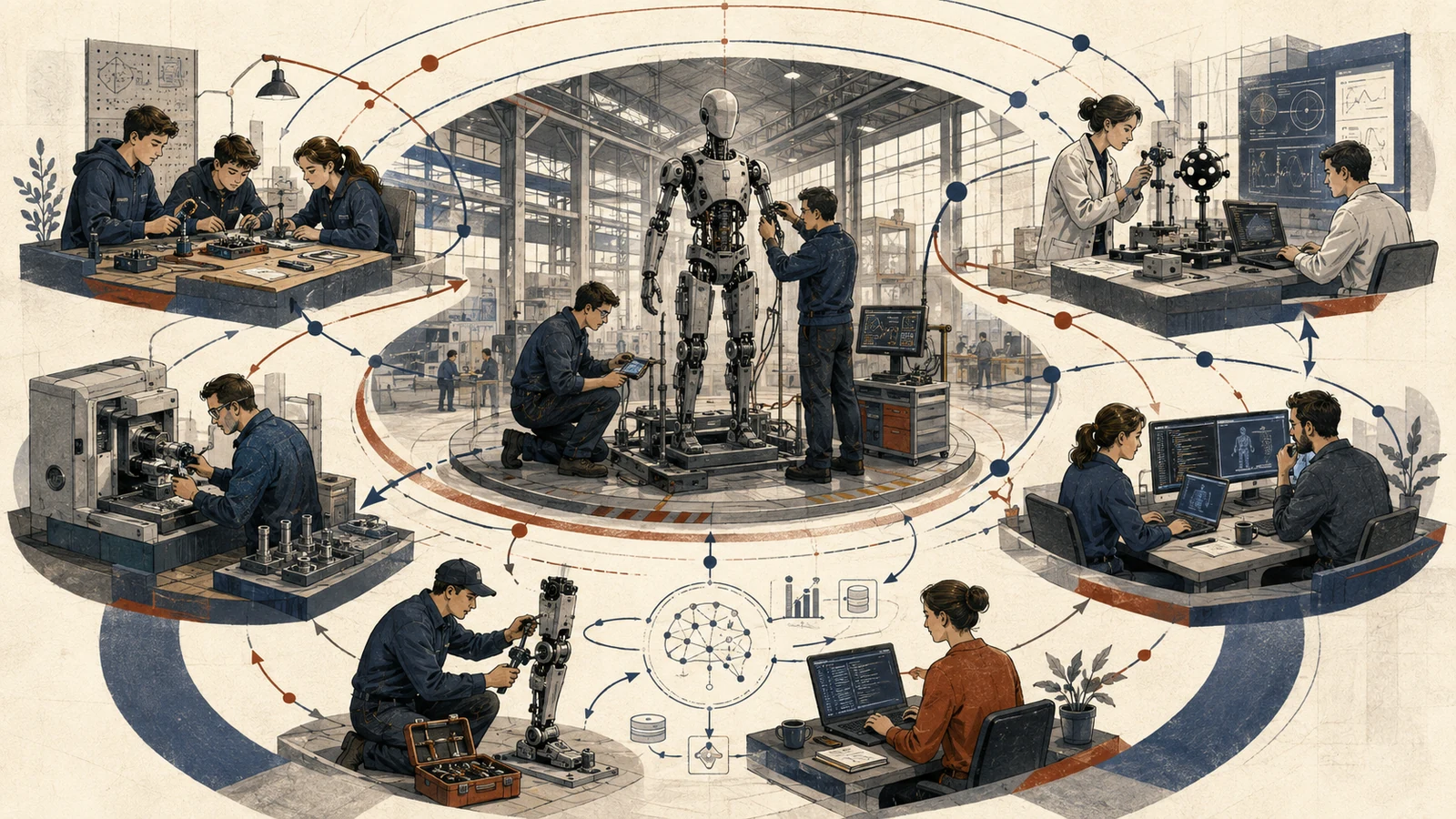
A humanoid is not automatically the better robot
Jovanović also makes a less glamorous but more technical point: industry normally chooses the machine that performs a task most safely, reliably and economically.
A pallet does not need to be carried by a machine with two legs. Welding does not become more advanced because the robotic system has a face. Wheels are often better than walking, and a purpose-built arm is often better than a general-purpose body.
Humanoid form becomes valuable where the environment was built for human bodies, or where communication and social interaction are part of the task. Doors, stairs, tools, reception desks, museums, classrooms and care environments create a different equation from a fixed production line.
Resemblance to a person is not evidence of usefulness. A demonstration shows that a movement is possible. Deployment shows that the work can be repeated when the cameras have gone.
The factory is real. The developmental effect is still open.
The announced numbers belong to different moments and should not be placed in the same present tense.
The €20 million first phase exists now. More than 200 jobs have been discussed as the operation expands. A robotics industrial park in Inđija and total investment of €200 million belong to the next phase. The projected annual capacity of up to 20,000 humanoid robots and robotic dogs belongs to the completed project, not to the current Šabac output.
AGIBOT itself is not a paper company. It has an established product portfolio, production experience in China and significant reported shipments. Minth is an experienced automotive supplier with an existing Serbian manufacturing base. The partnership therefore has more substance than a technology memorandum accompanied by a stage demonstration.
The unanswered question is what kind of substance Serbia will add.
The ecosystem test
Within a year, the project should be measurable through questions more useful than the number printed on a capacity announcement:
- How many robots were actually completed and delivered from Šabac?
- What share of their components and production value originated in Serbia?
- How many jobs are in engineering, integration and research, not only assembly?
- Which Serbian faculties, laboratories, schools and companies have signed concrete development contracts?
- Which applications were developed locally, and who owns the resulting software, data and patents?
- Can the robots perform useful work safely, repeatedly and at a defensible cost?
These are not hostile questions. They are the questions that turn an inauguration into industrial policy.
Serbia opened a robot factory yesterday. Today begins the slower construction: the relations that allow knowledge to circulate, accumulate and stay.
The real question is not how many robots will leave Šabac.
It is how much robotics will remain in Serbia.
Referenced sources
- Minth Group launches Europe’s first mass production of humanoid robots — Development Agency of Serbia
- Europe’s first humanoid robot mass-production base begins production — Global Times
- Minth Group Annual Report 2025
- Kineska fabrika robota u Šapcu: srpska prečica ka tržištu EU — Radio Free Europe
- Profesor ETF-a o fabrici u Šapcu — N1
Sources / Provenance
Reported from the Development Agency of Serbia, Global Times, Minth Group’s 2025 Annual Report, Radio Free Europe and N1; Kosta Jovanović is cited as the central expert voice.