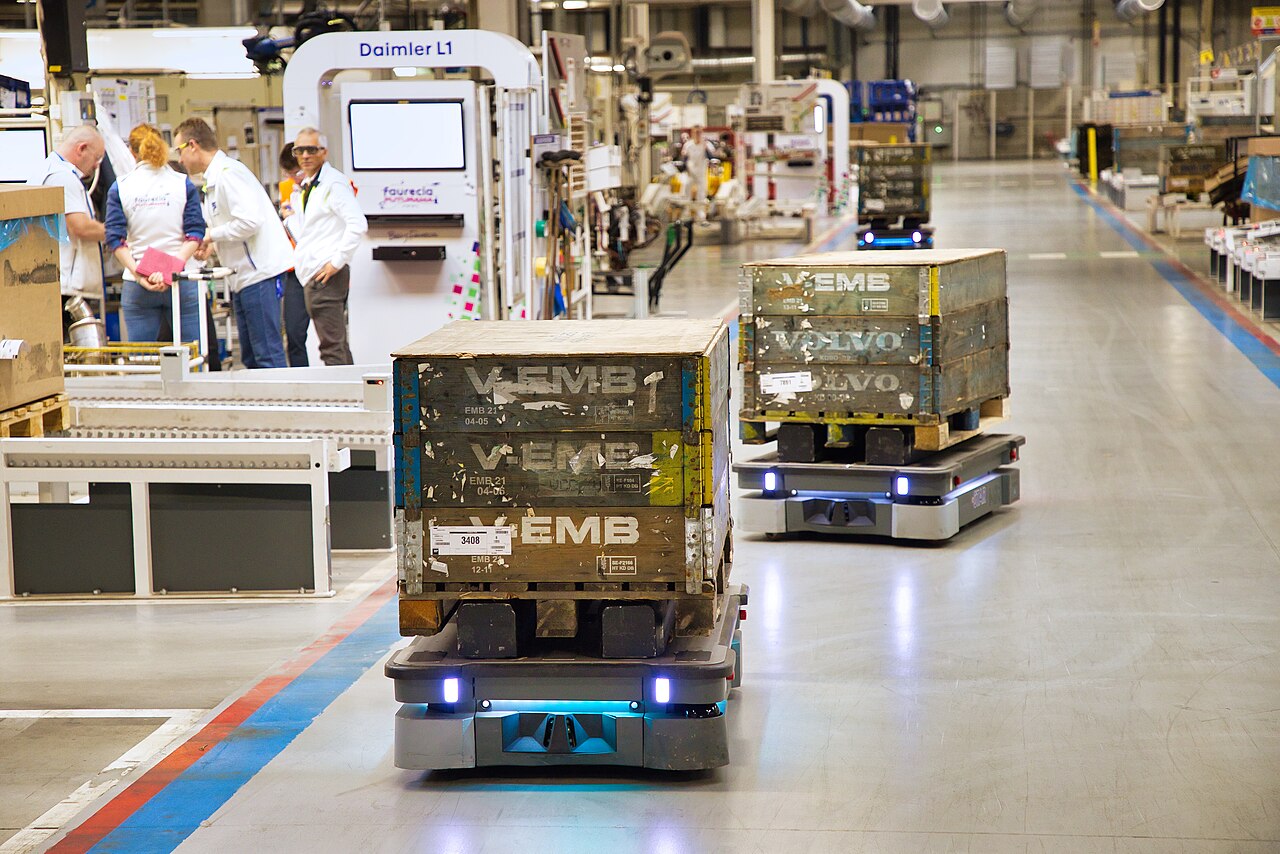
A robotics demonstration shows that a motion can happen. A deployment shows that a relationship can hold.
The difference is larger than it appears. A robot may lift the object, cross the room or finish the prepared sequence and still be far from useful work. Work brings interruptions, mixed traffic, damaged packaging, changed schedules, tired people, maintenance, handovers and responsibility when the expected action fails.
This does not make demonstrations dishonest. It makes them one layer of evidence. The problem begins when a striking layer is presented as though it contained all the others.
Humanophilic uses four questions to keep the layers visible.
1. What is the bounded task?
“Works in a warehouse” is not a task. Moving a tote from a collaborative robot to a conveyor is a task. “Helps in a hospital” is not a task. Carrying supplies between a department and a destination is a task.
Specificity matters because it lets us see what the robot must actually sense, decide and survive. It also prevents a successful routine from expanding rhetorically into a general intelligence claim.
The commercial Digit workflow described by GXO is interesting for precisely this reason. It is narrow enough to examine. The robot’s humanoid form is not asked to prove every prediction about humanoid robots. It is asked to join one existing material flow.
2. What changed around the robot?
There is no autonomous machine without a supporting system. The building, software, traffic rules, doors, elevators, charging routine and recovery procedure all participate in the result.
The MiR deployment at Blum-Novotest makes this visible. The robots are the moving layer, but the integration includes gates, an elevator, fleet coordination and safety acceptance. If we describe only the vehicle, we miss much of the engineering that turned movement into infrastructure.
This is not a technical footnote. It changes the social meaning of the project. A system that removes repetitive transport can return human capacity to production, maintenance or judgment. A badly integrated system can instead add monitoring and recovery work while merely moving the burden to another person.

3. What is the denominator?
Large numbers are powerful and incomplete. A hundred thousand movements may represent a breakthrough, a long endurance test or a modest total accumulated across many machines and many months. Without the operating period, fleet size, availability and comparison point, the number has no stable scale.
This is why attribution is part of editorial practice. When Agility Robotics reports that Digit has moved more than 100,000 totes, the milestone belongs in the record—and so does the fact that it is vendor-reported and publicly missing some denominators needed for a complete productivity comparison.
The same rule protects promising non-humanoid systems. FILICS presents a compelling architecture for moving pallets through constrained space. Customer-side testing and implementation signals are meaningful. They do not automatically become a quantified return-on-investment result.
A boundary is not an insult to the achievement. It is the frame that lets the achievement remain credible.
4. Who remains responsible?
Robots are often described through the work they take over. Mature reporting must also identify the person or institution that remains responsible when the machine cannot complete the work.
Who clears the blocked corridor? Who confirms a hospital delivery? Who assesses the complete collaborative application rather than the robot arm in isolation? Who can stop the system, inspect a near miss or explain a decision to the affected person?
Responsibility is not the residue left behind after autonomy. It is part of the design of autonomy.
That is particularly important when the promised benefit is human attention. A hospital delivery robot has humanophilic value only if its logistical independence truly returns attention to care, rather than creating an invisible layer of supervision elsewhere. An assistive robot becomes meaningful through a similarly concrete relation among the user, the machine, the environment and the people supporting it.
Evidence has a shape
We do not need to choose between enthusiasm and suspicion. We can ask evidence to keep its shape.
A demo can establish possibility. A pilot can reveal friction. A deployment can show repeatability in one setting. A comparative study can begin to tell us whether the result travels. Each layer deserves recognition, and none should impersonate the next.
This is the method behind SHOWBOTS. The strongest cases are not necessarily those with the most dramatic bodies or the largest numbers. They are the cases in which the task, system, measure and responsibility can be seen together.
The robot is never the whole story. The relation is the evidence.
Sources / Reading
- Featured image: MiR250 at Forvia — AnnaEbdrup / Wikimedia Commons — CC BY-SA 4.0
- Humanophilic — SHOWBOTS
- SPIE Automation — MiR fleet at Blum-Novotest
- GXO — commercial deployment of Digit
- Agility Robotics — 100,000-tote milestone
- FILICS Streamliner — official product information
- Universal Robots — safety FAQ

Evidence note
This article is an editorial method note based on the September 2026 Humanophilic Robotics research dossier. Vendor and integrator claims remain attributed; missing public denominators are treated as limits, not silently filled by inference.
Sources / Provenance
Editorial method note derived from the September 2026 Humanophilic Robotics research dossier. Companion to “The Robots That Don’t Need a Stage.” Vendor and integrator claims remain attributed; missing public denominators are stated as limits.