MAINDREAM / News from the Unconscious
America acquired superintelligence before superintelligence was invented.
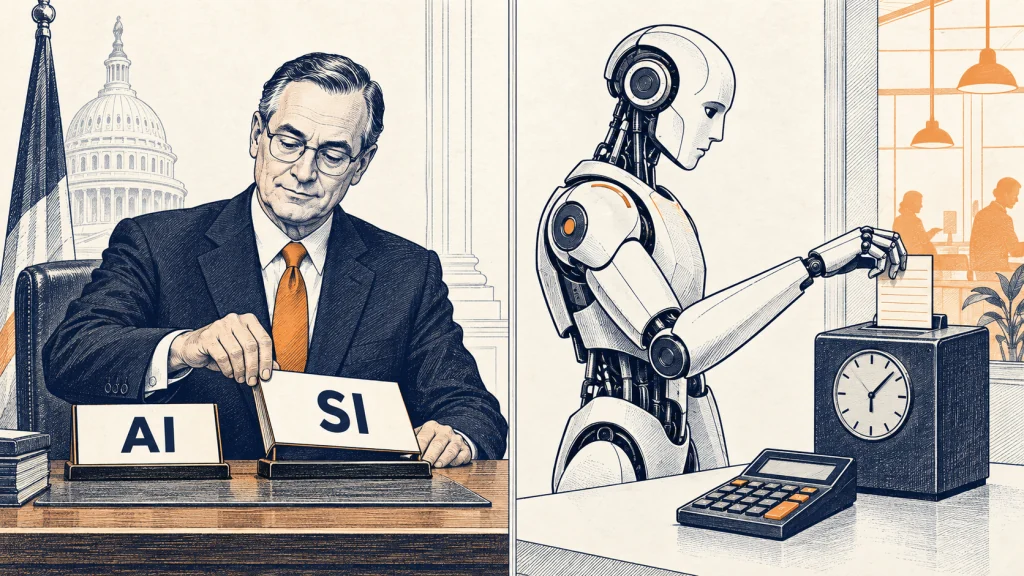
As reported by Danas, citing the original Politico story, Donald Trump signed an order under which “artificial intelligence” becomes “super intelligence” in the communications of the US executive branch. It sounds like a software breakthrough, except that no model became any more capable overnight.
New name, same definition
The White House order directs executive departments and agencies to use “Super Intelligence” and “SI” instead of “Artificial Intelligence” and “AI” in future public communications and other non-statutory documents. Existing laws, contracts and historical records remain unchanged. Better still, for now the order defines SI through the same statutory definition already used for AI.
The machine was not upgraded. The adjective was.
In technical literature, “superintelligence” already names a hypothetical system that would greatly exceed human cognitive performance across almost every important domain. Today’s models are not that. Politics, however, has found a shortcut: when reality is late, rename it.
On the same day, six major technology companies signed a voluntary agreement on internal controls, external assessment and board oversight. A useful beginning, but one without prescribed deadlines, penalties or mandatory publication of findings. The world’s most powerful technology has received a safety belt woven from good intentions.
A precise decimal with an unknown denominator
Meanwhile, Bankar.me calculates the hourly cost of a humanoid robot. In its clearly labelled illustrative example, a €98,000 robot, plus an assumed €6,000 a year for electricity, service, software and human supervision, would cost €12.80 per productive hour at 2,000 hours a year, or €8.53 at 3,000 hours. A worker costing an employer €15,000 for 1,600 useful hours comes to €9.38 an hour. The robot would have to deliver roughly 2,730 genuinely productive hours to reach the same hourly cost.
The hinge is the word “genuinely”. The manufacturer still describes the €98,000 figure as an estimated price, with availability expected at the end of 2026. Public evidence on failures, downtime, servicing, task quality and required human intervention does not yet exist at the scale needed to establish a reliable hourly cost. A robot falling during a demonstration does not prove that the technology is useless. Investor applause does not prove that it is ready for an eight-hour shift either.
The real comparison is therefore not a robot against one worker’s wage. It is between two ways of organising the same process: equipment, integration, the people who program and maintain it, those who handle exceptions, output quality and the cost of a stopped production line.
The Humanophilic conclusion is not that we should smash the robots, but that we should retire the calculator that sees a human being only as a cost. If a machine takes over dangerous and exhausting work, the gain should return to people through greater safety, shorter working hours and a more dignified life. If profit remains private while risk becomes public, that is not superintelligence.
It is the old inequality — only now it has a battery.