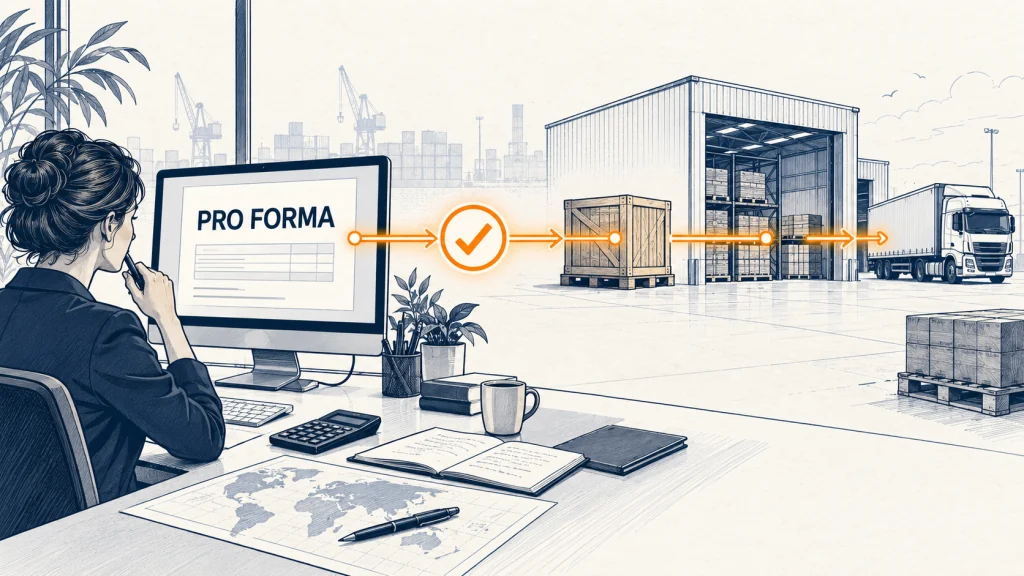
Form can arrive before reality. Meaning emerges only when it is filled by an event, a relation and responsibility.
Don’t be Lorem Ipsum. Be meaningful content.
At 4.42 p.m., just as coats are being taken from the backs of chairs, an email arrives from the Czech Republic.
PROFORMA INVOICE 174-A.
The spare servo drive is in stock. The price is valid for five days. Payment in advance. Dispatch as soon as the payment is recorded.
The production manager asks just one question:
— When will the part arrive?
Procurement checks the item code and quantity. Logistics copies the weight, package dimensions and collection address from the document. Finance circles the heading with a red pen.
— This isn’t an invoice.
— I know it isn’t an invoice — says Procurement. — But without it, we have nothing to approve.
The director authorises the payment order. The warehouse manager clears a space on the shelf in advance. The freight forwarder opens a file. Production changes Friday’s schedule.
The goods have not moved yet. The money has not arrived yet. The fault has not been fixed yet.
And yet one PDF has already changed the behaviour of five people.
The document did not describe an event.
It helped the event begin.
TWO TIMES IN THE SAME DOCUMENT
The expression pro forma means, roughly, ‘for the sake of form’ or ‘as a formality’. In legal usage, it describes something done in the prescribed form without claiming that every effect of the final event has thereby come into being. Even a brief pro forma session of the United States Senate may last only a few minutes, yet it still maintains the constitutional continuity of the session.
Here, form is not decoration.
It keeps the process open.
The same is true of the business document. A pro forma invoice resembles an invoice because it maps out the future transaction in advance: who is selling, who is buying, what will be delivered, in what quantity, at what price, on what terms and by what date.
It is not empty.
What it lacks is not content, but the event.
There is no confirmed delivery or definitive audit trail yet. What exists is a model of the relation precise enough for people, banks and systems to begin preparing.
A good form states openly where in time it stands.
AN INVOICE THAT IS NOT AN INVOICE
The distinction seems minor until someone files the document in the wrong drawer.
The UK tax authority, HMRC, describes a pro forma invoice as a commercial document containing some or almost all the details of a proper invoice, but it does not perform its essential function: it does not confirm that a supply has taken place. Once payment or supply occurs, the appropriate tax invoice is issued. A pro forma invoice alone is not sufficient evidence for reclaiming input tax.
In Serbia, the boundary is even more visible in the digital system. An official response from Serbia’s System of Electronic Invoices (SEF) states that pro forma invoices are not covered by the Law on Electronic Invoicing and are not exchanged through SEF.
A pro forma invoice can initiate approval and payment.
It cannot stand in for the document issued after the transaction.
That is not a defect in the pro forma invoice. It is its boundary, and a boundary is an important part of the information.
THE TEMPORARY PAPER THAT MOVES GOODS
‘Not an invoice’ does not mean ‘not important’.
US Customs accepts a pro forma invoice when a commercial invoice is not yet available at the time goods enter the country. According to the guidance from U.S. Customs and Border Protection, such a document must contain enough information for examination, tariff classification and valuation. The final invoice is submitted later.
A temporary document, then, can be fully operational. A shipping container does not ask whether the paper is philosophically final. The customs system asks for a description of the goods, origin, quantity and value. Without those data, the physical flow stops.
This is where the real power of form becomes visible. It makes a passage through a complex system before every part of the story is complete.
But passage is not proof that the story is finished.
A BALANCE SHEET FROM A PARALLEL TIMELINE
In finance, the expression takes an even more interesting form.
When a large company acquires or sells another business, investors need more than yesterday’s financial statements. They want to know how the transaction would change the whole. For certain significant transactions, the US SEC therefore requires pro forma financial information: historical figures are presented alongside clearly separated adjustments, as if a particular transaction had already taken place.
This is not a time machine, and it is not a promise of future profit.
It is a controlled simulation of consequence.
The historical column says: this happened.
The adjustment column says: this is what we assume.
The pro forma result says: this is how those two things would look together.
The problem begins when the assumption label disappears but the number keeps travelling. At first the cell is marked ‘estimate — to be confirmed’. Then its colour becomes the same as that of confirmed data. Someone copies the figure into a presentation. On that basis, a delivery date is promised to a customer. A month later, no one knows where the number came from.
No individual necessarily lied.
The form’s continuity did.
THE MOULD AND THE FILL
First we looked at the fill that holds a shape.
Now we are looking at a shape waiting to be filled.
Lorem Ipsum occupied the space of real text so that form could become visible. Pro forma works in reverse: it gives a possible event a place, an order and boundaries before that event becomes fact.
Neither is deceptive as long as it shows its status clearly.
The mould is useful because we do not have to reinvent an invoice, customs declaration, checklist or report every time. It preserves sequence, responsibility and the possibility that one person can continue where another left off.
But reality never enters a mould without leaving something outside it.
One field is too narrow. Someone’s case has no available category. One risk does not yet have a number. The most important detail sits in a sentence the form did not even know how to request.
A filled-in form is not necessarily a fulfilled form.
PRO-FILL
Here we introduce our own term: Pro-Fill.
It is not an accounting, legal or technical term. Nor is it an etymological claim about the word profile. It is an editorial coinage for the moment when a form receives its living fill: context, judgement, experience, emotion, error, relation and meaning.
Pro-Fill is not an instruction to fill in every field.
On the contrary. It asks us to know what gives a piece of data the right to occupy a field.
A number without provenance is not a measurement. A green indicator without a criterion is not safety. A paragraph without experience is not a field report. A signature without a decision is not responsibility.
A form can be technically complete and humanly empty.
It can also be unfinished and entirely honest.
THE MACHINE THAT CANNOT BEAR AN EMPTY FIELD
Artificial intelligence is extremely good at filling in a prescribed form.
Give it the title ‘Impact Assessment’, three old tables and a request for eight hundred words. You will receive a neat document with an introduction, bullet points, transitions and a conclusion. Every field will be filled in. Every sentence will be grammatically present.
That still does not mean an assessment took place behind the text.
Perhaps no one spoke to the operator. Perhaps the data do not cover the same scope. Perhaps ‘12 per cent growth’ compares two different periods. Perhaps the conclusion sounds reasonable precisely because it risks no verifiable claim.
AI can propose a fill. It cannot produce, by itself, the event that confirms it.
So the question is no longer simply: ‘Has the document been filled in?’
The question is: ‘Which event, measurement, experience or decision gives this content the right to be here?’
SAME MODEL, DIFFERENT MONK
Imagine two robotic platforms coming off the same production line.
The same body. The same sensors. The same initial software version.
One remains in a laboratory. The other goes to a workshop, a warehouse or someone’s home. It learns the layout of the space, the rhythm of work, typical errors, permissible exceptions and the moments when a person does not need one more piece of information, but silence.
After enough time together, they are no longer the same system in the human sense, even if they share the same factory model.
Their difference was not produced by a new shell.
It was produced by the relation.
The same model does not necessarily mean the same Monk.
The generic platform is the mould. Accumulated context, memory of use, corrections and shared Takt are its Pro-Fill.
Not because every field has been filled in, but because the form has passed through a real relation.
AN EMPTY FIELD IS DATA TOO
There is another trap: the belief that every blank must be removed.
It need not be.
‘Not confirmed.’ ‘Awaiting data.’ ‘Not applicable.’ ‘We do not know yet.’
These are not system failures. They are signals that reality has not yet reached the document.
Presence is not the continuous filling of a scene. A good form also leaves room for what has no answer, for what does not belong to the available categories and for what a person, with good reason, does not want to turn into data.
Meaning is not measured by the percentage of fields completed.
It is measured by the fidelity of the relation between document and event.
WHEN REALITY ARRIVES
A new email arrives the following morning.
The payment has been recorded. The servo drive has been dispatched. The commercial invoice is attached.
The same goods. A similar PDF. A completely different event.
The pro forma invoice did not become wrong when the invoice arrived. It did its job: it gave the future enough form for people to begin acting, without claiming that the future was already the past.
The mould did not disappear.
Reality finally entered it.