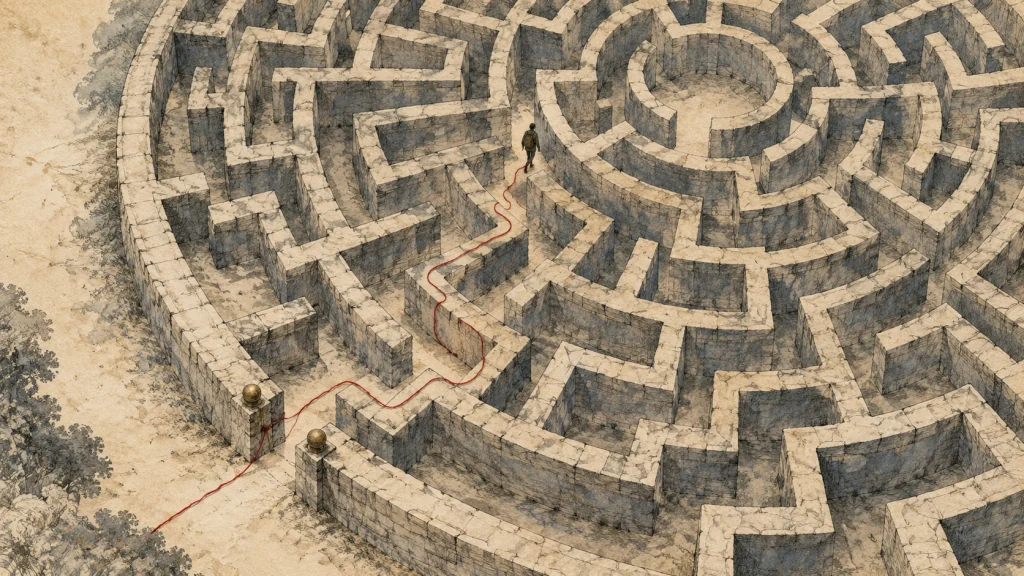
In the best-known scene from the story of the labyrinth, Theseus is not given a better map. He is given neither a more precise description of the passages, nor a view from above, nor a machine that removes the walls. Ariadne gives him a ball of thread.
One end of the thread remains at the entrance. The other travels with the man.
This is not a navigation algorithm in the modern sense. But it is something any network engineer would immediately recognise: an external memory of the route, a trace through a complex system, and the possibility of returning without first having to understand the labyrinth as a whole.
The thread does not defeat complexity. It preserves continuity as we move through it.
Perhaps that is why the same word has moved from one system to another for centuries. From a fibre, it became a metaphor for a story. From a metaphor, an execution unit in a computer. Then a structure of conversation and the name of a network protocol. The material changed, but the thread kept preserving the same possibility: that separate events might become a path, a pattern or a meaningful sequence. This is where the deeper question of this issue begins: does a relation merely connect things that are already complete — or do their roles, boundaries and possibilities arise from the relation itself?
The Thread Before the Network
The English word thread first denoted a physical strand — a thin fibre made by twisting. By the seventeenth century, it had also acquired a figurative meaning: a thought, theme or connection running through the course of a whole. Later, the same word also described a single strand within a fabric — an element that is not a pattern by itself, but without whose interweaving no pattern could exist.
That shift matters. A thread is no longer merely an object we can hold between our fingers. It becomes a way of thinking about continuity: about what remains connected while form changes.
In a fabric, one thread is not the entire image. On its own, it is often not particularly interesting. Only through relations — above, below, beside and across other threads — do density, direction and pattern emerge. The same logic will later appear in systems that have nothing to do with textiles.
One Process, Many Paths
In computing, a thread is a flow of execution within a process. The POSIX standard describes threads as multiple flows of control within the same process, with a shared address space.
That sounds abstract, but the image is simple. The process is a shared workspace. Threads are different flows of work moving through it. They share data and resources, while each retains its own identity and execution stack.
The shared space enables speed. Each flow does not have to build its own world from scratch. But sharing introduces a problem that physical fabric does not have: two threads may try to change the same data at the same time.
That is why synchronisation mechanisms exist. A mutex, in the simplest terms, locks a resource while one thread works with it. The others wait. This can prevent chaos, but it can also produce a new kind of standstill.
If the first thread holds resource A and waits for B, while the second holds B and waits for A, both may remain stuck. The system has not crashed. Neither thread has necessarily made an error in its local step. Yet there is no progress.
Engineers call this a deadlock.
It is difficult to find a better technical metaphor for everyday life.
Two reasonable processes can wait for each other forever.
This is an important correction to the romantic image of connection. A relation enables coordination, but in doing so it also creates an obligation to manage time, access and priorities. More threads do not automatically mean more progress.
A Network That Remembers More Than One Path
Thread, with a capital letter, is also a network protocol for Internet of Things devices. It is designed for reliable, energy-efficient IPv6 communication in homes and commercial buildings.
Here the thread is no longer a flow within a single process. It is the possibility for devices to form a network in which transmission does not depend on one permanent route.
A Thread network has roles. Some devices forward packets, while end devices may communicate through a parent node and, when their design allows it, switch off their radios to save energy. Each network partition has one leader, but that role is not permanently attached to the same device: it is elected dynamically for resilience. The network may also have multiple border routers connecting it to other IP networks.
If a group of devices is separated from the rest of the network, partitions form. Each can temporarily continue as a separate whole with its own leader. When radio connectivity is restored, the partitions can merge automatically.
The phrase “self-healing network” therefore does not mean that the system magically repairs a broken device. It means something technically more interesting: function can be preserved by changing roles, neighbourhoods and routes.
The network does not repair the map. It finds another way.
This is Ariadne’s thread in reverse. In the myth, one line remembers one path already travelled. In a mesh network, continuity is preserved precisely because the path is not fixed forever.
Conversation as Structure
Public conversations have acquired threads of their own. One post opens a subject, replies attach themselves to it, and replies to replies form branches. The interface tries to preserve the origin of every sentence: who answered what, in which order and in what context.
When it works, the thread protects meaning. A reader can return to the original claim and see how an addition, dispute or reversal emerged. When it fails, branches multiply faster than attention can follow them. Context fragments, quotations travel without their origin, and the conversation remains formally connected but practically unreadable.
Meta also turned the word into the name of its Threads platform, which it described in June 2026 as a space with 500 million monthly active users. The figure is company data, not an independent estimate, but it shows how recognisable the “thread” has become as a model of public conversation.
The more interesting part of the story is not the size of a single platform, but the attempt to let conversation cross its boundaries. The W3C ActivityPub standard defines a decentralised social-networking protocol with communication between servers. In 2024, Meta began introducing connections between Threads profiles and the fediverse through ActivityPub.
That changes the underlying question. If a message, reply and identity can travel between different servers, who owns the thread? The person who started it, the platform that displayed it, the protocol that carried it, or the community that gave it meaning?
A technical protocol does not resolve that question. It merely makes it more visible.
From Thread to Relatio
A physical thread, a software thread, a Thread network and a conversation thread are not the same thing. It would be a mistake to equate them or to draw technical conclusions from a metaphor.
But it is not accidental that the same word keeps returning to us.
In each of these systems, something persists through change:
- a path through space;
- a flow of execution through time;
- a connection through a changing network topology;
- context through a branching conversation.
This repetition is not evidence of a single universal theory. It is a research signal: across different domains, function depends not only on the elements present but also on the relations that preserve order, transmission and continuity among them.
This is where Semonika begins: an original conceptual framework that asks how meaning arises, acquires structure, travels and changes relations. It does not treat meaning as a substance hidden in a word or an object, but follows the relation through which meaning becomes structured, transmissible and consequential. Its short thesis is this: meaning is not added to a relation; meaning arises through relation.
A connection, however, is not yet the same as a meaningful or functional relation. Two software threads may share memory and block one another. Two network nodes may be within range and fail to preserve a route. Two sentences may stand in the same conversation and lose their context. Contact exists; coherence is not guaranteed.
Deus sive Relatio goes one step deeper. It does not repeat Spinoza’s formula, nor does it claim that “Relation” is merely a new word for “Nature”. It asks a different question: what if we understand a system not as a sum of already finished things that are connected afterwards, but by following the relations through which their roles, differences and possibilities become stable? Relatio is then neither every contact nor every link. It arises when a difference changes what the participants can do, enable or become.
In our conceptual framework, that distinction is made more precise through coherent coupling: an ordered relation between distinguishable factors that preserves their boundaries while opening a possibility that neither factor possesses alone. The working notation A ⊗ B → K is not a physical law; it sharpens the distinction between a simple sum and a capacity that arises in relation. K belongs neither to an isolated A nor to an isolated B, but to their coupling.
What matters is not only what exists, but how it is coupled.
The problem of continuity through change also leads naturally to Trajnica: a bounded path of persistence through which a form can remain coherent while changing. Ariadne’s thread preserves one path already travelled; a mesh network preserves function by allowing the path to change. The similarity is useful precisely because the difference remains visible.
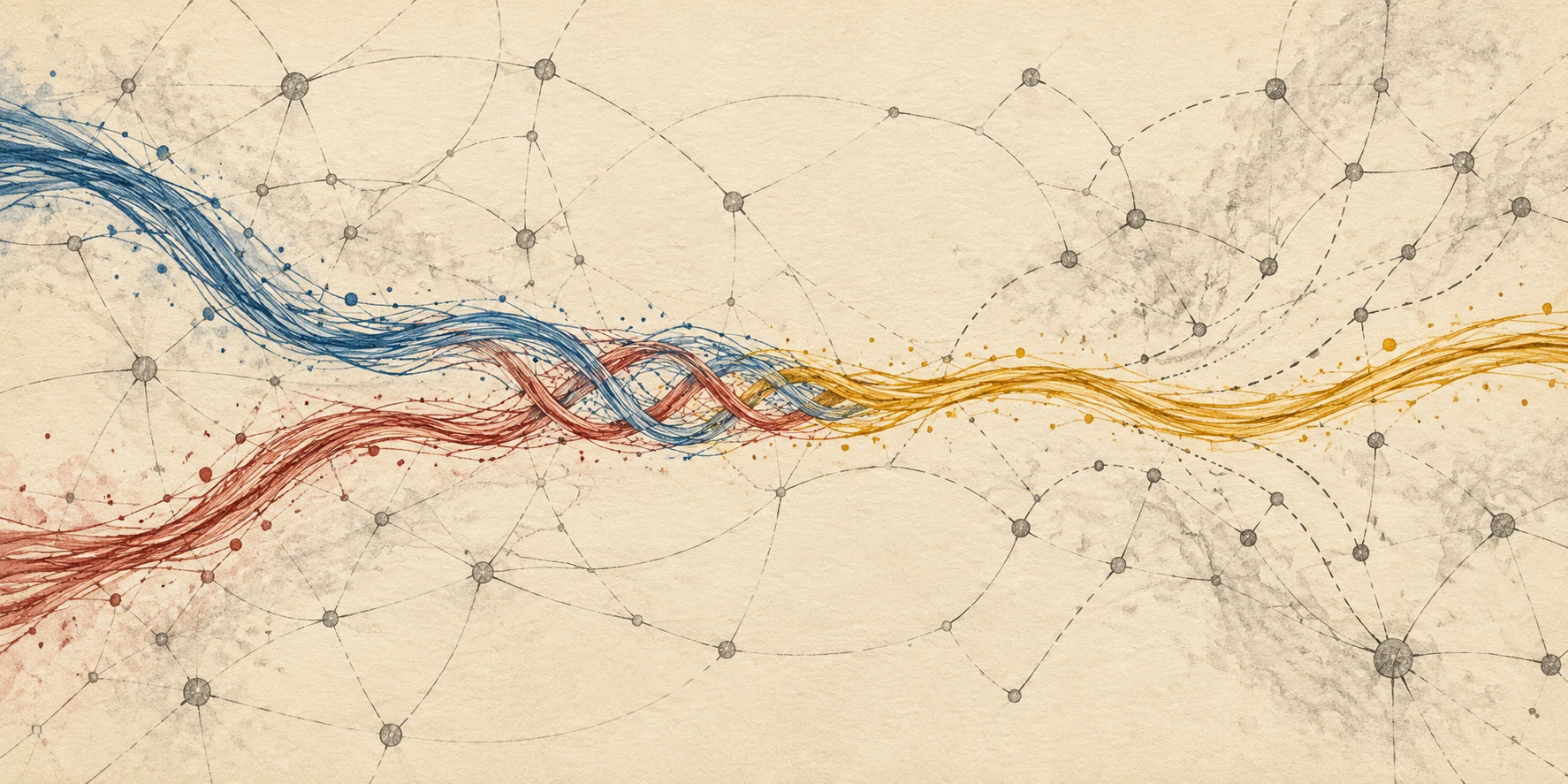
A fabric, then, is not merely a sum of threads, just as a parallel program is not merely a sum of execution flows, a mesh network a sum of devices, or a conversation a sum of sentences. In every case, form arises only when relations carry function through change for long enough.
This comparison has a limit. Semonika does not replace computer science, network theory or sociology here, and metaphor is not proof of a formalism. It offers another register of questions: not only what is connected, but what that connection enables, what it disrupts, and what meaning or consequence it can sustain.
Ariadne Did Not Design the Labyrinth
Ariadne did not tear down the walls. She did not remove the danger, nor did she give Theseus complete knowledge of the system. She gave him a simple layer of continuity over a structure that remained complex.
Theseus carries intention and movement. The thread preserves the trace. The entrance remains a reference point. None of those elements produces the possibility of return on its own. That possibility belongs to their ordered coupling.
The title’s provocation reaches its limit here: Ariadne did not design a network in the modern technical sense. She designed a minimal relation that preserves state while one of its factors moves.
That may be the most useful measure of good technology.
Not every system has to become simple. Sometimes it is enough for a person to see where they are, understand the trace of a decision, return to an earlier point and retain their connection with the beginning.
In public administration, that may be the possibility of appeal and a clear decision trail. On the railway, a data record that follows a wagon across operators and borders. In a computer, synchronisation that prevents parallel work from destroying shared state. In a home network, another route when one node disappears. In conversation, preserved context without which an answer becomes mere noise.
The Humanophilic criterion is therefore not the greatest number of connections, messages or automated transitions. Technology is humanophilic when it expands the human field of meaningful action instead of taking away direction, authorship, control, the possibility of repair, interruption and exit.
A good thread allows a return to the source. A bad connection may become only a firmer way of binding a person to a system.
Here the three directions of this project separate and meet again. Vasionica poses the ontological question Deus sive Relatio. Semonika follows how meaning, significance, form and consequence arise through relation. Humanophilic applies the practical test: does the relation make a person more capable and sovereign — or merely more connected?
The thread is not the thing that defeats the labyrinth.
It is the relation that keeps the path from being lost.
Technical and Historical Sources
- Online Etymology Dictionary — thread
- The Open Group, POSIX.1-2024 — Threads
- The Open Group — pthread_mutex_lock
- OpenThread — Node Roles and Types
- Thread Group — Thread Network Fundamentals
- W3C — ActivityPub
- Engineering at Meta — Threads has entered the fediverse
- Meta — 500 million monthly users on Threads