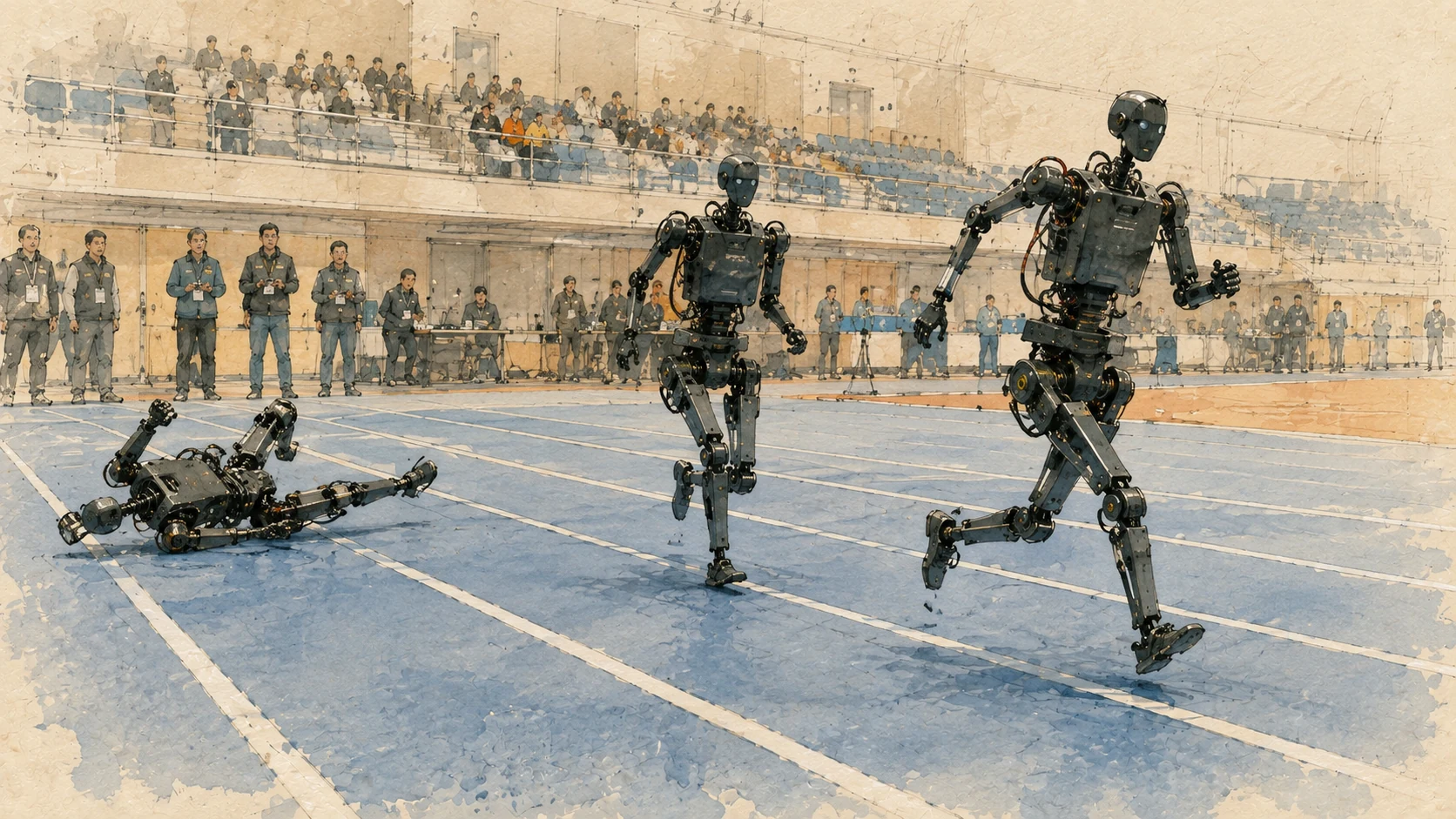
Tiangong Ultra ran 100 metres in 8.64 seconds at the second World Humanoid Robot Games in Beijing.
Usain Bolt’s human world record is 9.58.
The arithmetic is irresistible. The robot was 0.94 seconds faster. The headline writes itself, puts on spikes and leaves the newsroom before the editor can catch it.
Husenoid Bolt has arrived.
There is only one problem. He has not yet learned to stop.
Several robots, including the winner, crashed into the padded barrier beyond the finish. Sparks appeared. Fire extinguishers appeared. Almost every runner was eventually carried away on a stretcher.
This does not make the result fake. It makes it precise.
The machine solved one sharply defined part of running: covering a straight 100-metre track very quickly. It did not demonstrate the complete human event, and it certainly did not demonstrate useful autonomous work.
That distinction is not an insult to the robot. It is the beginning of understanding what the robot actually achieved.
The same distance is not automatically the same event
The Beijing Games were much larger in their second year: 666 teams, 2,056 robots, 51 events and 1,301 competition sessions. The organisers also tightened autonomy requirements.
But not uniformly.
Official event information says that competitive and track events required full autonomy except the 100-metre and 400-metre hurdle races. The fastest and most shareable number therefore came from one of the explicit exceptions.
This matters. A stopwatch measures elapsed time, not the topology of the task behind it.
A human sprinter must perceive the start, generate force through a biological body, remain inside a lane, preserve balance and decelerate without external steering. A robot can use a different body, a different control arrangement and a sacrificial stopping strategy. If both cross the same line, the times are comparable as numbers. The performances are not yet equivalent as systems.
Tiangong Ultra beat Bolt’s time.
It did not run Bolt’s race.
Why robot sport is not merely theatre
That does not reduce the Games to a stunt.
Sport is an artificial environment, but usefully artificial. It fixes the distance, marks the boundaries, exposes failure and produces a result that another machine can try to beat tomorrow. A demonstration is allowed to choose its best moment. A competition allows the clock, the opponent and the floor to interfere.
At high speed, every unresolved problem becomes louder: actuator power, impact loading, balance recovery, thermal management, latency, traction and mechanical robustness. A fall is no longer hidden behind a product video. It happens in public and enters the engineering record.
That makes robot sport a compressed laboratory with an audience.
The football field is even richer. An autonomous player must find the ball, locate itself, distinguish teammates and opponents, choose an action, kick while moving and recover when another body disrupts the plan. RoboCup has built an entire research programme around those relations, with the long-term goal of a humanoid robot team defeating the human world champions by 2050.
The goal is theatrical. The work underneath it is not.
The finish line is part of the task
The funniest image from Beijing is also the most informative: a machine faster than the fastest human reaches the end of the track and immediately requires a padded wall, an extinguisher and a stretcher.
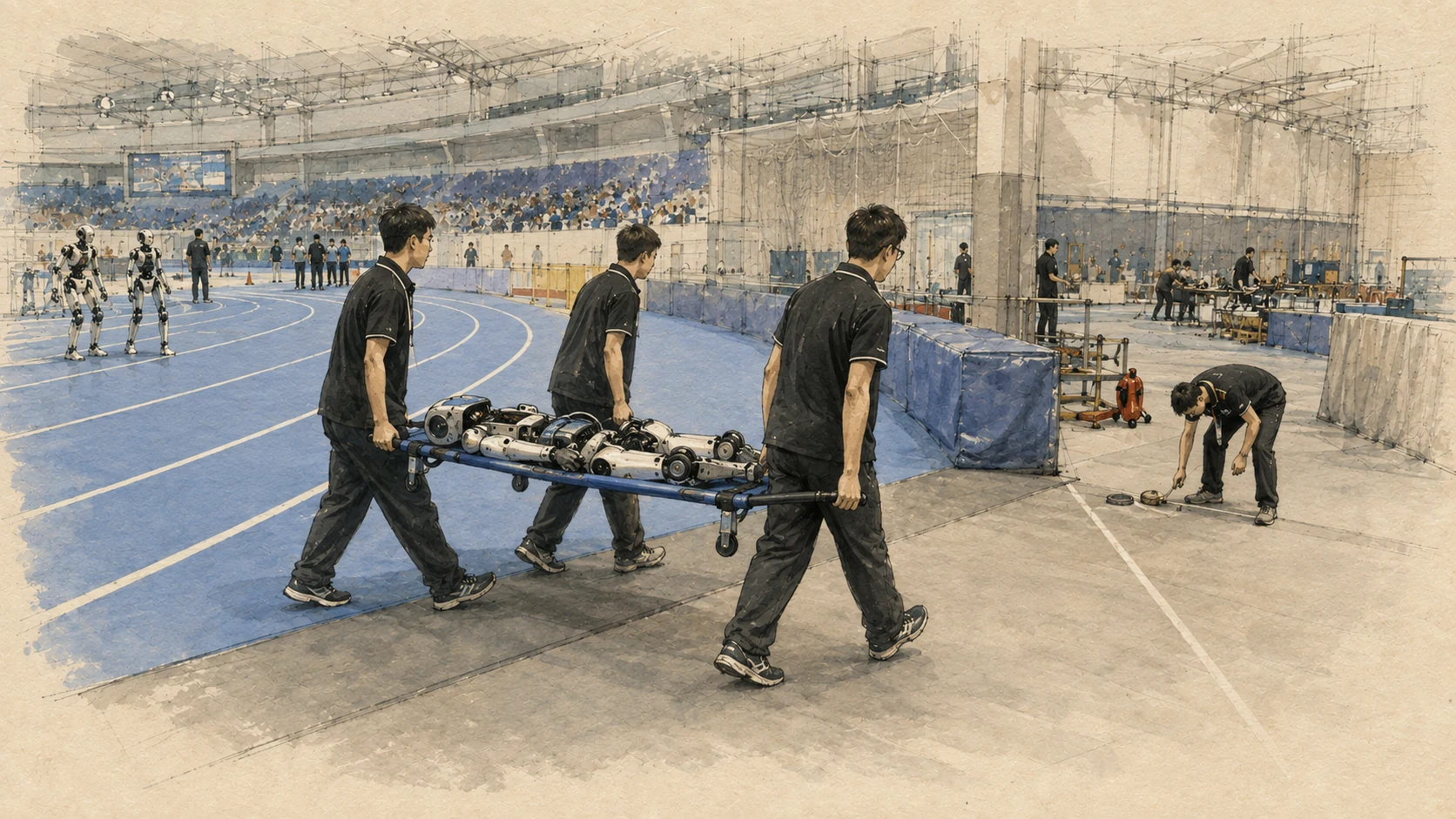
In human sport, that would be a medical emergency. In robot sport, it is a roadmap.
Acceleration has advanced faster than situational closure. The robot can produce the movement, but the surrounding system still carries responsibility for what happens after the movement succeeds.
This is the same question that appears in factories, hospitals and public space. Can the machine detect that the task has ended? Can it reduce force safely? Can it recover from an unexpected object? Can it fail without transferring danger to the nearest person?
A robot that reaches the target and then becomes the target of a fire extinguisher has completed the metric, not the mission.
FUTUREVIEW 2046
Spark from the Future
SHIT, STOP! TEAMS BEGIN PREPARATIONS FOR SURČIN 2046
Fast-repair specialists are training at factories in Šabac, Loznica and Majur
SURČIN, 2046 — Specialist teams responsible for the rapid repair of robots competing at the Surčin 2046 Olympic Robot Sports Games have begun their final preparations at factories in Šabac, Loznica and Majur.
The national service team is showing a high level of readiness across all official disciplines: dual-wield screwgun operation, rapid limb replacement, battery replacement while wearing protective gloves and sprint fire extinguishing.
Sensor operations specialists are refining their technique with the latest cotton lint-free cloths from Arilje. Early results show that the time required to remove dust, oil and traces of the safety barrier has been reduced by almost two seconds.
Thanks to the exceptional training conditions and the number of available screwdrivers, the factories are also hosting Shit, Stop! service competitors from around the world.
Our Shit, Stop! team is showing enormous enthusiasm, although most attention remains focused on the robots themselves.
The entire delegation is cheering for Dragutin in the 100 metres and for Milutin, who will attempt to break his own record for making it to the end.
The same race also included Jusein R. Bot, a robo-sprint star who suffered premature combustion.
Organisers remind spectators that results are measured only to the finish line.
Everything that happens afterwards is recorded as technical support.
The less photogenic events may matter more
The Games included football, boxing, running, dancing and table tennis. They also expanded scenario-based events from six to 21: emergency response, hotel service, industrial work, handling medicine, picking up small objects and tightening screws.
Those tasks will rarely produce an eight-second headline. They are slower, less elegant and more revealing.
Running down a clear track rewards one highly optimised relation between body and ground. Closing a medicine package requires perception, dexterity, force control, sequencing and correction when an object is not exactly where the model expected it to be.
The stadium measures performance under rules. The world measures performance under interruption.
We need both.
A better scoreboard
The next generation of robot records should report more than distance and time:
- Was the machine fully autonomous?
- How much external computation and communication did it require?
- How many attempts were made?
- Did it finish safely without a barrier or human intervention?
- Can it repeat the result after a disturbance?
- How long can it operate before maintenance, battery replacement or thermal shutdown?
- Which part of the system failed when it failed?
Those questions do not drain the joy from the race. They turn spectacle into knowledge.
Tiangong Ultra’s 8.64 seconds are real, astonishing and worth celebrating. The robot compressed a year of visible progress into less than nine seconds.
But the most humanophilic reading is not that machines have defeated people.
It is that a public game has given engineers a clean place to see which relations now work — and which still end in foam padding.
Husenoid Bolt has beaten the clock.
Next season, let us see whether he can beat the need for someone waiting with a fire extinguisher.
Referenced sources
- A robot sprinter shatters a 100-meter record again — AP
- 2nd World Humanoid Robot Games: highlights, scale and rules — Beijing municipal government
- Robots break multiple records at the Games — Beijing municipal government
- RoboCup Humanoid League: research goals and competition model
Sources / Provenance
Reported from AP, official Beijing event information and the RoboCup Humanoid League; comparisons distinguish elapsed time from autonomy, task equivalence and safe completion.