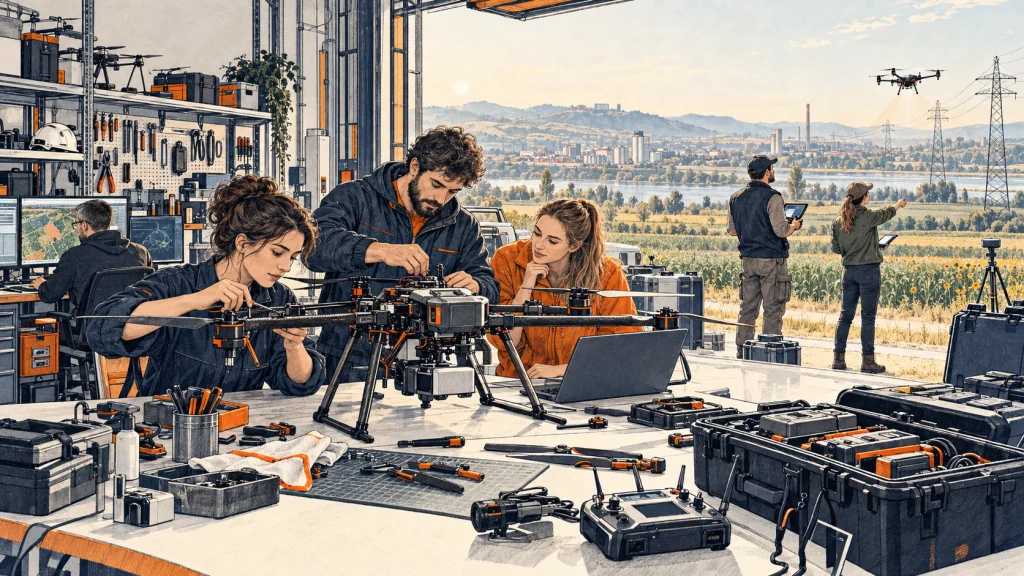
A factory in Makiš, domestic systems on Pešter, foreign drones over fields and a software team in Belgrade. The same word — drone — conceals several different industries.
On 17 September, a facility for assembling Israeli-designed drones opened in Belgrade; BIRN subsequently located it in Makiš. Journalists were not allowed inside because the process is confidential. The public received footage of the aircraft, an announcement of around one hundred jobs and one big word: factory.
Within minutes, that word had done the work of an entire industrial chain. In a single breath came assembly today, production tomorrow, domestic components later, the Serbian Armed Forces as the principal user and exports as the plan. Between those verbs lies everything the footage does not show: the design, ownership of the software, the origin of the electronics, test flights, quality control, servicing, training, permits and an actual delivered production run.
The facility exists. The drones have been displayed. But a domestic industry does not begin with a ribbon-cutting and end with the first propeller turning inside a hall.
One drone, five passports
Every aircraft has more than one address.
The platform is designed at one. The motor, electronics and optical payload are made at another. The code is written at a third. At a fourth, the parts are assembled and tested. At a fifth, the drone actually works — with a military unit, in an orchard, above a power line or in the hands of a student team.
The technology chain runs like this: the airframe carries mass and withstands vibration; the propulsion system turns energy into thrust; the avionics connect sensors, GNSS and an inertial measurement unit, while the flight computer estimates state and stabilises the aircraft; the link carries commands, telemetry and imagery. Above that, autonomy plans or corrects the route, while user software turns a flight into a mission that an operator can assign, supervise and abort. After landing, the data remain — a map, a recording, a report, a trace of a decision — as does the service system that determines whether the same aircraft will fly tomorrow.
Each layer is a different location of knowledge and dependency. A domestic airframe with an imported flight computer is not the same as domestic avionics; domestic image processing is not ownership of the autopilot; assembly without diagnostics, spare parts and documented repairs is not operational independence.
A connection to Serbia may therefore mean a domestic design built with imported components, a foreign airframe assembled in a Serbian facility, software work in Belgrade for an aircraft manufactured in America, or an imported drone that a domestic operator turns into a serious service. All are real forms of domestic contribution. They are not the same claim, and not all justify the label “made in Serbia”.
Assembly is not worthless either: it can bring quality control, maintenance, training, domestic suppliers and a gradual transfer of knowledge. But the word “factory” alone reveals neither the origin of the intellectual property, the depth of local content nor the number of systems delivered.
Makiš is not Šimanovci
BIRN’s investigation located the new facility in Makiš, on the premises of SDS Technologies. That is an important correction, not merely a change of address. Šimanovci was an earlier public lead for the planned site; today it is primarily the address of PR-DC.
SDS Technologies is the new name of CUPA Enterprises. Its owner is the London-based Liberty Blue International, which was called CUPA Limited until 21 September 2026. BIRN found neither Elbit Systems nor Jugoimport-SDPR among the owners in the company register. The Israeli Embassy spoke of cooperation with Elbit; in a response reported later, Elbit said that it was neither an owner nor a partner in the factory and denied a formal link to SDS.
That does not rule out Elbit-designed systems inside the hall. The three aircraft shown occupy different niches: LANIUS-X locates a target in an urban environment, but engagement requires human approval; FireFox-X carries its signal through an optical fibre without radio emissions; Magni-X is a reconnaissance micro-platform. The legal entity, facility owner, technology supplier, state customer and user are not the same address.
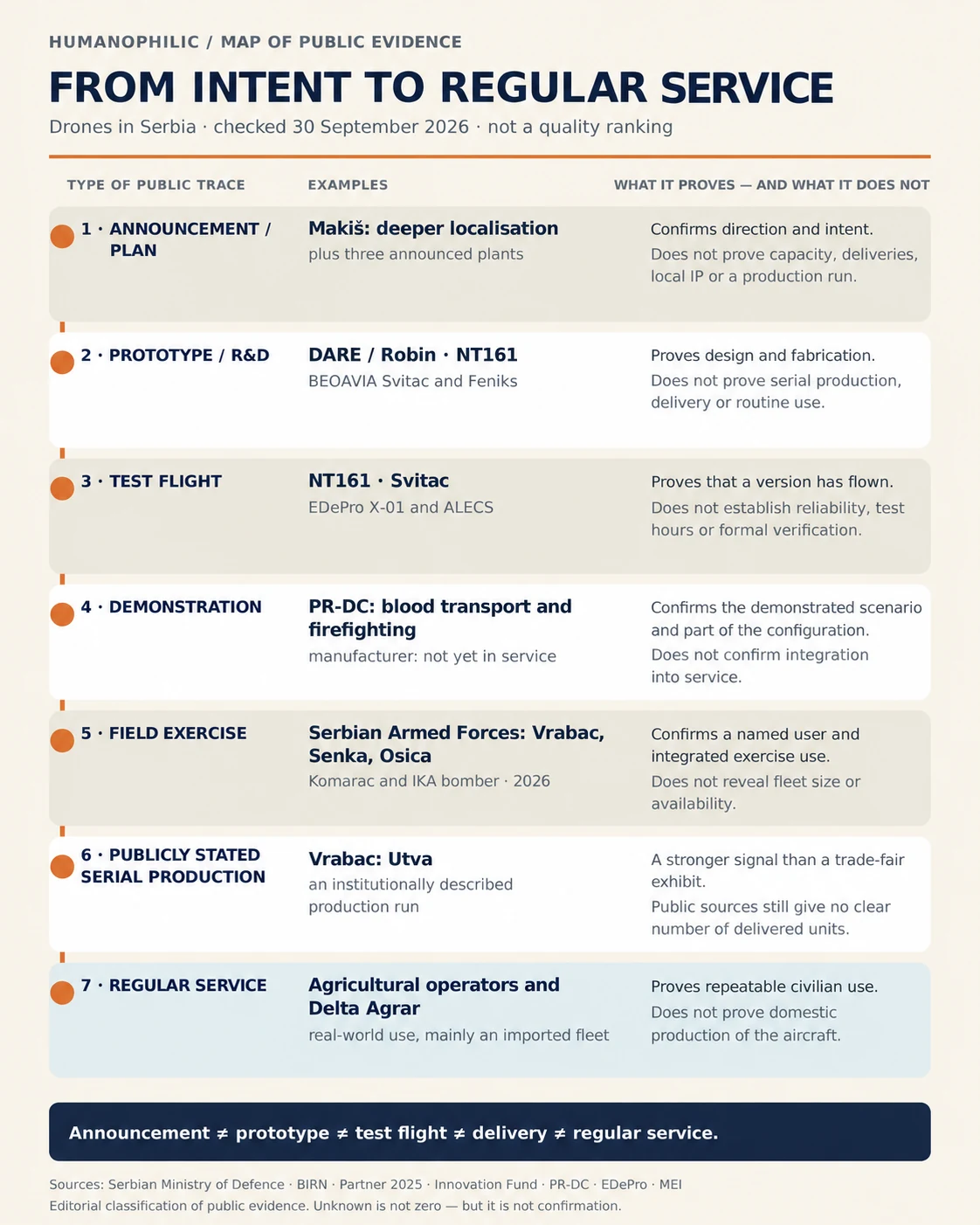
The opening produced a more precise formulation than most headlines: assembly now, production later. Around one hundred jobs do not mean one hundred development engineers. Krušik as a future supplier of part of the payload does not prove a domestic platform, electronics or software. An export announcement is not a delivery.
Makiš is a real industrial event: a facility for assembling foreign systems has opened, with a plan for deeper localisation and a publicly identifiable direct owner. The contractual and technological division of roles among SDS, Elbit and state actors is still not publicly clear.
There are no PR renders on Pešter
A few days before the facility opened, during the “Winner 2026” exercise, the Serbian Armed Forces used Vrabac and Senka for reconnaissance and surveillance, and Osica, Komarac and the IKA bomber in other tasks supporting forces on the ground.
The exercise documents that the systems were brought into the field, integrated into a joint scenario and deployed before a named military user. That is a stronger trace than a trade-fair mock-up, but it is not public evidence of the size of a production run, formal acceptance or fleet availability.
Yet even a military exercise does not reveal how many systems have been delivered, how many are available at the same time, how many hours they fly between failures, or how much of the electronics and software is created locally. Operational integration and industrial depth remain two separate questions.
The Partner 2025 catalogue assigns the roles more concretely: the Military Technical Institute designs Vrabac, while Utva in Pančevo produces it in series; Teleoptik Žiroskopi presents the Komarac family, while the Institute displays Osica and its own flight computer. That already resembles a chain rather than one company with one product. Even the catalogue, however, gives no public figure for units manufactured and handed over.
PR-DC is a different kind of story. The company says it develops the airframe, propulsion, electronics and software, while the Ministry of Defence describes IKA-20 as a product independently designed and manufactured by PR-DC. The IKA bomber has publicly documented use in a military exercise. By contrast, the blood-delivery and firefighting configurations on the manufacturer’s own pages remain labelled as demonstrations that are not yet in use.
At Pasuljanske Livade in June, Vihor and Gavran 145 were displayed alongside an official announcement that they would enter serial production. That future tense is precisely what keeps them at the level of a public demonstration and an announced series rather than a proven delivery.
The same company can therefore have a military system in the field and a civilian scenario on hold at the same time. A model name is not a maturity level.
How a “first flight” can happen twice
EDePro’s Štršljen/Hornet X-01 neatly shows why a development chronology should not be read as an advertising slogan. The company dates the first prototype to 2018, while its own announcement calls the event in Vojka on 18 May 2024 the “first flight”. Armada International, however, reported as early as 2018 that flight testing had begun.
These may have been different configurations, a different kind of test, or simply different language in the two announcements. The public sources do not resolve the matter. The honest formulation is therefore this: in 2024, the first autonomous hover of the version that the manufacturer then presented as its “first flight” was documented. The gap between the two announcements does not prove six years of uninterrupted testing.
ALECS I and II likewise remain in a publicly visible development and prototype phase. EDePro has a serious propulsion and engineering base, but serial production of engines does not automatically mean serial production of a drone. A company can be industrially mature in one subsystem while the platform as a whole remains in development.
The civilian sky is already at work
Serbia’s most mature civilian use may not involve a domestically made aircraft at all.
Delta Agrar says it uses drones for crop-protection treatments. On the same page it separately describes soil mapping, variable-rate sowing and fertilising, and combine-harvester telematics. The domestic service provider Agro Drone reports that it treated several thousand hectares in 2024 and, with a partner, raised capacity to 700 hectares per day in 2025. These are the operator’s own figures, not an independent verification, but they describe a real organisation of work: the team, water transport, refilling, batteries, trailer, maintenance and flight schedule.
In August 2026, a team from the Faculty of Agriculture in Novi Sad demonstrated the use of an imported DJI Mavic 3M in a commercial sour-cherry orchard. The aircraft is foreign. The research question, method and processing of multispectral data originate here, with the aim of giving the grower a better decision.
That is domestic value that an inventory of factories can easily miss. In agriculture, the user is not buying a propeller. The user is buying a treated hectare, a map of low-vigour zones, fewer empty passes and a decision made in time.
The new AInspec project adds another layer. The Faculty of Technical Sciences in Novi Sad, Vojvodinašume and Croatian partners are developing a system to detect and selectively treat invasive plant species using AI, remote sensing and drones. The project began in January 2026 and plans field pilots in protected areas. It is a serious institutional route towards application, but it is not yet a pilot result or a regular service.
The Regulation on Geographical Zones for Unmanned Aircraft Systems applies from 29 October 2026. In some restricted zones, an exemption to fly also depends on active remote identification. Separate rules on operations and systems, and on remote-identification add-ons, apply in full from 1 March 2027. A drone can be technically ready while the mission still does not exist, because the route is not yet legally and operationally possible.
A civilian prototype is not an empty promise
Domestic civilian development exists; its public trail simply ends more often at the prototype than at the customer.
DARE/Robin brought together Belgrade-based Konelek and the Faculty of Mechanical Engineering. The Innovation Fund gives the project value as €602,821, including €300,000 from the Fund. The goal was a light agricultural aircraft with a tank capacity of up to 50 kilograms. Composite Technology Team’s NT161 had a budget of €428,052, including €299,624 in Fund support; its first flight was documented on 4 February 2021. For neither project does the public trail yet show a production run, delivery or operational fleet.
At the Faculty of Mechanical Engineering, BEOAVIA designs, builds and flies its own student aircraft. Svitac was built for the Air Cargo Challenge, and Feniks for a competition scenario involving the transport of blood to hard-to-reach terrain. That is not a health service. It is proof that, within the same team, knowledge passes through aerodynamics, structures, propulsion, electronics, programming, manufacturing and a test flight.
A student prototype is therefore not a small version of a factory. It is the place where a future factory acquires people capable of understanding the whole aircraft in the first place.
The civilian line exists. What the public trail still shows poorly is the route from a funded prototype to a named user who employs the system every Tuesday — and has someone who can repair it on Wednesday.
A team in Belgrade, a factory in America
Easy Aerial is Makiš’s mirror image. The company is currently advertising software and commissioning-engineering positions in Belgrade, while explicitly labelling its systems as made in the United States.
The correct classification, then, is not “a Serbian factory”, but nor is it “nothing to do with Serbia”. The job advertisements show that the company is seeking software engineers and commissioning staff in Belgrade. They do not reveal how much of the code or integration is created here, for which models, or who owns the intellectual property.
In Makiš, we have assembly in Serbia with an unclear depth of local knowledge. At Easy Aerial, we have a visible engineering node in Serbia and American manufacturing. Together, the two cases demolish the most convenient industrial shortcut: the assumption that the address of the hall is also the address of the knowledge.
An industrial map must therefore record separately what is designed, manufactured, programmed, tested and maintained in Serbia.
The most important drone is the one somebody orders twice
Once Serbia leaves the frame, the regional map does not simply show who has drones and who does not. It shows where the chain of evidence is most visible. The numbers should not be turned into a league table: a Slovenian reconnaissance system, a small Croatian FPV aircraft and the Czech One 150 are not the same unit of production, do not cost the same and do not require the same logistics.
Slovenia’s Ministry of Defence contracted C-Astral for 16 Belin-V systems: ten for the Slovenian Armed Forces and six for Montenegro. The package for the Montenegrin user included documentation and training, and the procurement was conducted between the two states. The most important figure here is not 16. It is the visible relationship among the manufacturer, the domestic user, the state opening an export channel and the foreign user taking delivery of a supported system.
Croatia shows a different kind of industrial depth. Orqa in Osijek develops FPV aircraft, control electronics, radio links, video systems and other parts of the same technological assembly. In July 2025, Croatia’s Ministry of Defence said that the company had produced around 150,000 FPV systems the previous year, that key components were developed and manufactured in Croatia, and that Orqa aircraft were being supplied to the Croatian Armed Forces. That does not mean the military took delivery of all 150,000 units. It means that the state publicly connects domestic development, production volume and a named user.
Czech manufacturer Primoco shows what happens when a company regularly publishes contracts, deliveries and business results. In an investor presentation accompanying its audited financial results for 2025, the company reports 42 aircraft contracted and 16 delivered during the year, and more than 250 delivered in total. Factory, company-owned airfield, training, handed-over serial numbers and revenue now describe the same product. That is a more measurable stage than a prototype or an announced production run.
On a larger European scale, the unit of measurement changes too. In 2026, Poland signed executive contracts for more than 400 WARMATE sets, with ten aircraft each, and 190 FlyEye sets, with four each. That amounts to more than 4,000 WARMATE and 760 FlyEye aircraft. These are not yet completed deliveries, but nor are they an outline wish: the public trail contains a quantity, a value and a signed deal.
The civilian–dual-use market provides a different signal. Austria’s Schiebel has won a multi-year contract for the third consecutive time from the European Maritime Safety Agency and reports more than 1,780 operational days since 2018. During 2025, EMSA ran nine drone operations simultaneously in 11 countries for more than 20 public authorities. Here, production is no longer the end of the chain. The system must survive the schedule, the ship, the coast, different users, maintenance and the next contract.
That is why the strongest signal is not the first flight, the largest hall or the longest catalogue. A first flight shows that a system can take off. A first contract shows that someone has accepted the risk. A second order — or a renewed operational service — shows that the system worked well enough for the user to invest again.
By that measure, Serbia is not at the beginning. The MTI–Utva–Serbian Armed Forces connection, domestic systems deployed in a named exercise and civilian operators repeating work across thousands of hectares are stronger evidence than one more model on display. Less visible are the public size of accepted production runs, repeat orders, named export users, fleet availability and long-term maintenance. Serbia therefore does not lack another aircraft in a photograph. It lacks the public trail that would turn its next take-off into a repeatable industrial fact.
Radar for 2028: what to watch
By autumn 2028, six verifiable signals will be worth tracking: the number of systems contracted, manufactured and handed over; a second order from the same user; flight hours or operational days; the percentage of the fleet ready for a mission; return-to-service time after a failure; and the named domestic share of the airframe, propulsion, avionics, code and maintenance. For exports, the evidence is a named foreign user, handover, training and support; in civilian use, repeated missions for the same customer. If a production run, a returning customer and a maintenance trail appear, the system has matured. If only new models and hall capacities remain, the catalogue has changed.
The drone is the least autonomous part of its system
The box may say: autonomous. In reality, someone chooses the mission, checks the weather, charges the batteries, secures the airspace, establishes the link, assesses risk, replaces a propeller, safeguards the data and answers for the result when the plan falls apart.
In agriculture, the system includes water, chemicals, a trailer, an agronomist and the timing of entry into the field. In inspection, it includes the sensor, calibration, detection model and repair order. In the military, it includes the link, command, logistics, maintenance and the unit that turns information into a decision. In a student team, it includes the mentor, workshop, sponsor, safe zone and the next generation that takes over the project.
The drone industry is therefore measured not by the number of models in a photograph, but by the ability to repeat the same mission safely tomorrow.
When the next headline says “domestic drone”, seven questions are enough: who designed it, who made the key components, where it was assembled, who owns the software and IP, who signed off the test, who accepted it and who maintains it after the camera crew goes home.
If the answers are not public, that does not mean the value is zero. But an unknown value cannot automatically be counted as domestic.
Serbia today has institutes, factories, private development teams, student workshops, software nodes, operators and users. Almost all parts of the system exist; what remains insufficiently visible is the thread connecting them from prototype to repeatable service, and from assembly to genuine ownership of knowledge.
A drone can take off from a field and remain grounded as an industry.
For the whole system to take flight, design, components, software, testing, regulation, operator, service and user must all move together. The most important part of a drone may therefore be not the part that flies, but the path by which knowledge reaches real use.