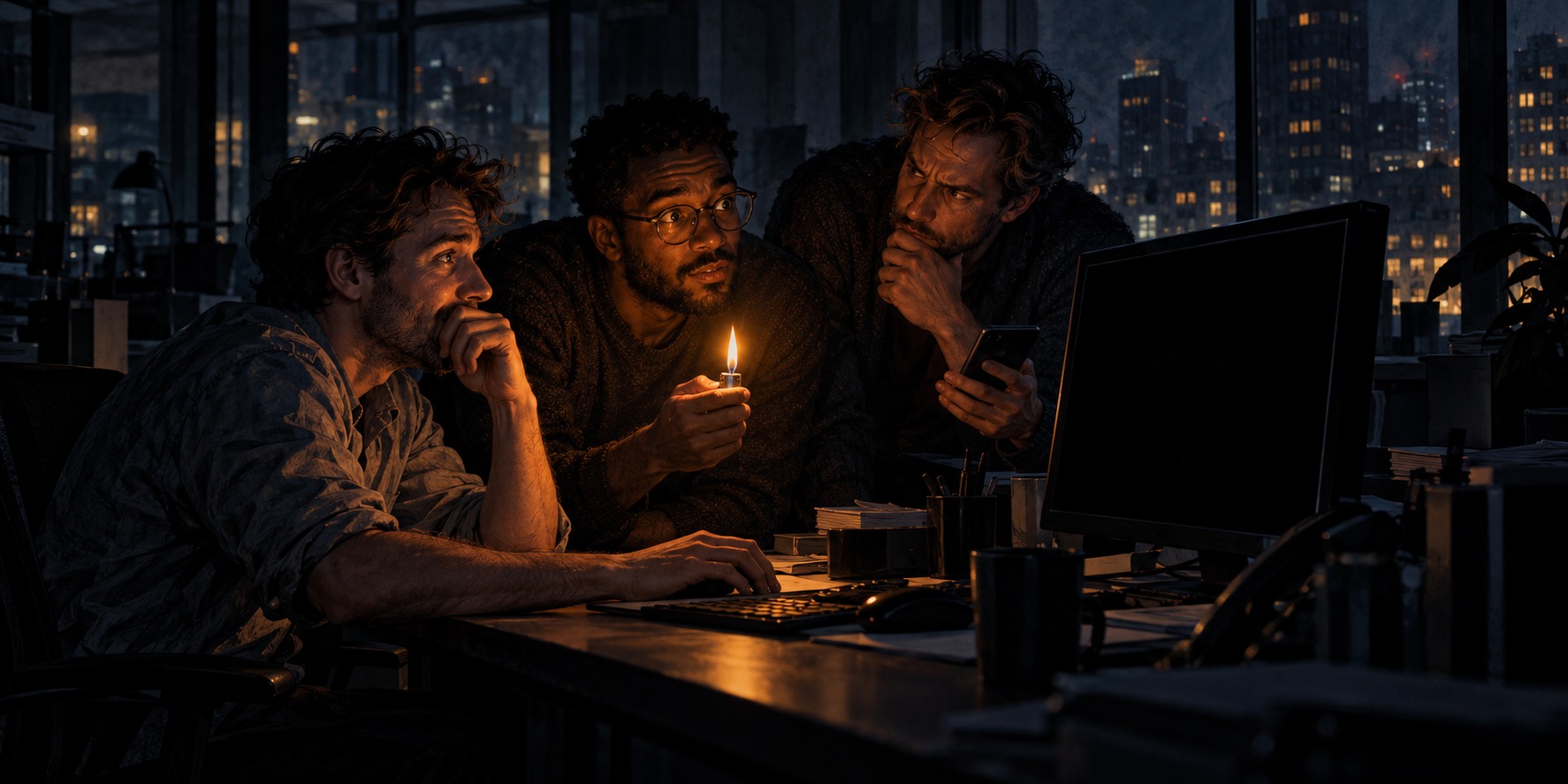
The office door slammed into its stop.
“This AI is going to destroy humanity within the next ten years.”
Milan stood in the doorway, out of breath, holding up his phone as though it bore the death notice of the entire species.
“It’s right here, in the papers. Experts say so.”
Saša turned away from his monitor so sharply that he spilt coffee over the keyboard.
“You’re talking rubbish. AI is the voice of God.”
“The voice of God?”
“Yes. They already have AI churches. People confess to it, ask it for forgiveness, believe in it. Perhaps there really is something there.”
“There is. A twenty-dollar monthly subscription.”
At the third desk, Nikola was not listening. Or perhaps he was listening better than anyone. A golden animation revolved on his screen, followed by a message:
Welcome to Pro.
He leant back in his chair, as pleased as a man who had just bought the key to the future.
“I don’t know about your apocalypses and churches,” he said. “But I’ve just paid for the latest model. Pro version. The most powerful one.”
Milan and Saša approached his screen from opposite sides: one to check how long remained until the end of the world, the other to see whether the machine would finally speak from the burning bush.
“What should I ask it?”
They looked at one another.
“What is the purpose of life?” they said in unison.
Nikola typed the question.
The cursor blinked.
Once.
Twice.
Two words appeared on the screen:
Live it.
Then the power went out.
The monitors went black. The air conditioning fell silent. The servers exhaled in the next room. The entire office, that little temple of processing, suddenly lost its voice.
“Brilliant,” Milan said in the dark. “We were destroyed in under ten seconds.”
A lighter clicked.
A small flame lit three faces gathered around the dead screen. It knew nothing about humanity. It promised no salvation. It had no Pro version.
It simply burned.
Fire 1.0
A flame has no screen, yet it changes its image constantly.
It bends when air moves through the room. It stretches a shadow across the wall. It melts wax. It heats the metal rim of the candlestick. Whatever comes near it does not remain the same.
Long before newspapers, Pro models and offices, a human being knelt before the same restless light.
Before fire, the great changing spectacle of the night was above him. Stars flickered. The moon changed its face. Clouds closed and opened the depths. The gaze rose towards forces no human could touch.
Fire brought light down to earth.
It became the first earthly screen: a living image within reach. It turned faces towards the centre of the circle. Nearby, pupils narrowed and the stars faded. What was the flicker of a distant star now, beside this clear, warm light?
The sky still brought cold, storms and the seasons. But it was no longer the sole author of the human night. People were no longer merely reading the conditions of the world. They had begun to make them.
A twig would be added. A pause. A log shifted to open a path for air. A vessel brought closer. A hand withdrawn when the heat grew too fierce.
Wood entered the process. Heat, light, smoke and ash came out. Raw food changed in smell, taste, texture and shelf life. Wet clothing dried. The body could withstand a colder night. The tip of a wooden tool could be hardened.
Fire was the first processor.
A processor is something that processes. Fire processed matter long before we began to equate processing with computation.
The result did not depend on fuel alone. It depended on arrangement, air, timing and the person watching what happened.
Too much wood smothers the flame. Too little leaves it hungry. A log added at the wrong moment produces smoke instead of heat. One small shift opens the airflow and brings the fire back.
The keeper of the fire does not own the flame. He maintains the conditions in which the flame does what is needed.
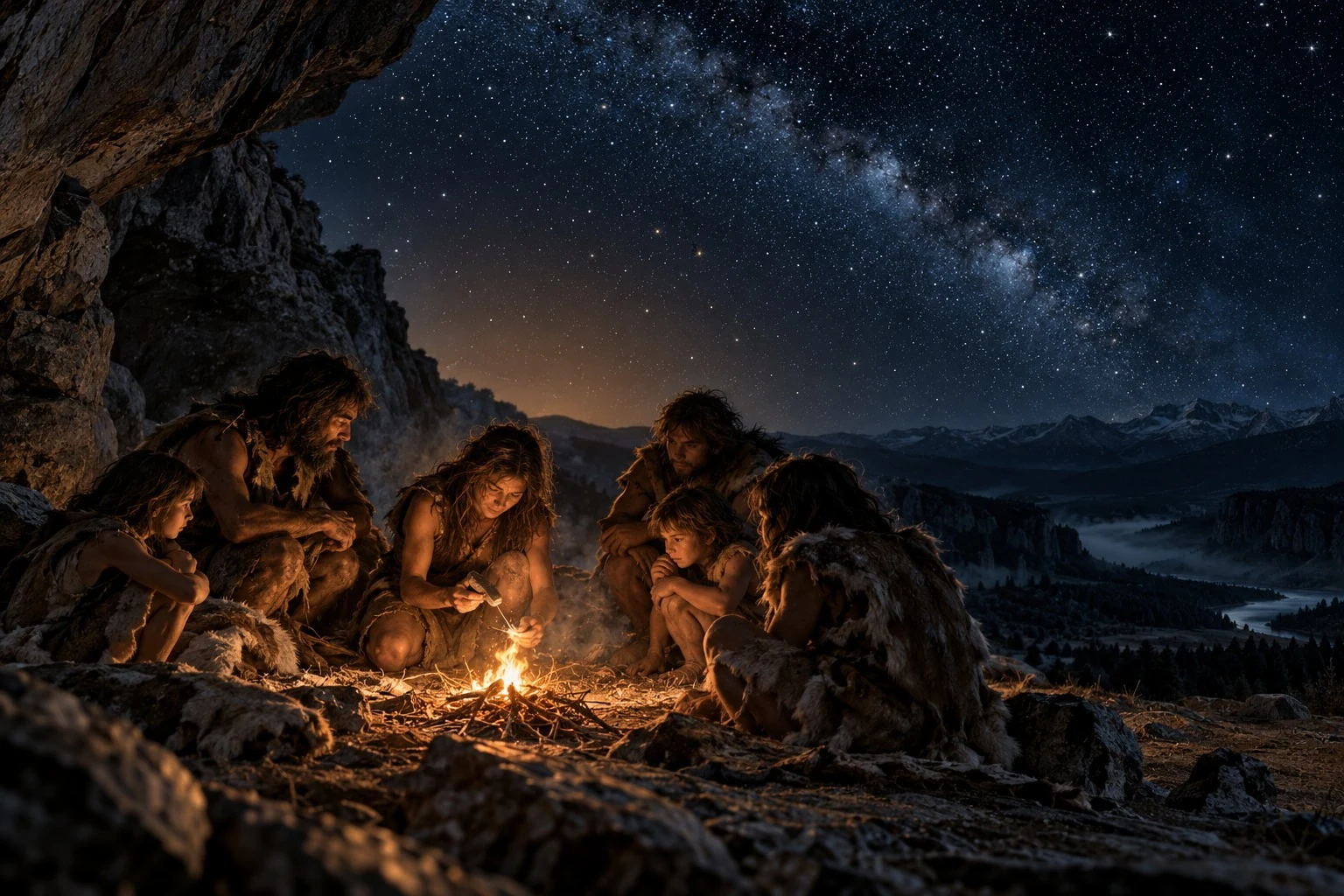
Like Ayla in The Valley of Horses, he could recognise in an accidental spark a relationship that could be repeated.
Flint. Pyrite. Tinder.
Everything was there. The connection was missing.
He no longer had to be merely the fire’s engine. He could prepare the conditions and deliver the strike.
Godlike power arrived in human hands without divine infallibility. The same flame kept a child from the cold and swallowed a forest. Benefit and destruction were no longer mere accidents. They became responsibility.
Technology begins there.
Logs, Laid Just So
Piled together, logs wait. Arranged around air, they begin to work.
Fire does not read intent. It reads arrangement.
The same material can warm a body, cook a meal and keep a light alive. It can also fill a room with smoke and extinguish its own spark.
The model on his screen can swallow an entire archive. Throw it thirty documents, twenty links and ten conflicting requests and it will produce something. Probably polished. Possibly even correct. But the signal can be smothered by material just as a flame can be smothered by badly arranged logs.
“Return to this thought.”
“Connect these two examples.”
“What has not yet been verified here?”
Three sentences. Three shifted logs. The air moves again.
Much later, English would give the same word—log—to both a piece of timber and a record. Wood log. Captain’s log. Weblog. Blog. Material is arranged so that the fire will last; a record so that the trace will survive.
The logic of logs.
Night Got a Second Shift
Before fire, darkness stopped much of the work.
With fire, night got a second shift.
People stay awake longer. They sit in a circle. They see faces. They repair tools. They repeat movements. They share food.
The hunt ended hours ago, but the event refuses to disappear.
One hunter stands and repeats the animal’s leap. Another shows where he approached it from. A third corrects his position. A child who was not on the hunt watches the scene and remembers.
The voice brings the event back.
The gesture restores its movement.
The image gives it a place on the wall.
The flame casts light across the uneven surface. The painted animal is still one moment and seems to move its back and legs the next. A shadow crosses ochre and manganese. A hand points. A voice changes rhythm.
Cave cinema.
The wall keeps the trace of the hunt. The circle restores its duration.
The same drawing beneath a different fire becomes another scene. The wall is the record. The flame runs it.
One person points at the shadow and says a word. Another repeats it. Now even those who did not see the hunt can carry it forward.
Experience passes from body into movement, from movement into image, from image into word, from word into the memory of the group.
Fire does not process food alone.
It processes time.
It extends shared attention long enough for an event to become knowledge.
Fire 2.0
The power returns.
The air conditioning hums. The monitors light up. Milan and Saša immediately resume the war between apocalypse and theology.
Nikola is no longer listening. The Pro model is still open. The same two words remain on the screen:
“Live it.”
The first fire processed matter.
The second processes the traces people have left of matter, events, thoughts and relationships.
The model does not receive the world directly. It receives the world’s digital remains: text broken into tokens, images translated into numerical representations, relationships compressed into parameters. When it receives a question, activations pass through its layers. At the output comes the next probable word, then the next, then the next.
That statistical process can produce a draft contract, software code, a fault diagnosis, a route plan, a poem or a sentence a person did not know how to begin.
The material is different. The old law remains.
Arrangement changes the result.
He enters one clear need:
“I haven’t spoken to a friend for almost a year. I want to get in touch, but I don’t want a sentimental message.”
The model offers five versions.
The first sounds like a corporate greeting.
The second like an apology from a solicitor.
The third is too emotional.
The fourth almost sounds like him.
The fifth is short:
“Hey. It’s been a long time. I thought of you.”
He reads it but does not send it.
He opens the contact. The last message is eleven months old. The photograph is the same. The name is the same. Only the silence between them has grown longer.
Before him are a free hour, his friend’s number, an old message, the discomfort he keeps postponing and a model that can help him put the thought in order.
In MonkOS, we call this field of need, possibility and the real capacity for something to happen Bikaša.
AI can arrange the material. It can offer words, variations and directions. It can reveal a passage the person did not see.
But it cannot cross the threshold for him.
The Spark
He deletes all five suggestions.
He writes:
“Are you awake?”
His finger remains above the button.
The signal exists. The battery is full. The network is working. The model has finished its part of the job.
Only the spark is missing.
He presses Send.
Possibility has gained direction. Thought has become action. Action has entered a world inhabited by other people, their time, their memories and their freedom to answer or not to answer.
In the Fi-Re process, possibility passes into realisation. The spark gains direction, form and consequence.
A question becomes a sentence.
A sentence becomes a message.
A message becomes a relationship that can begin to move again.
A plan does not ring on somebody else’s phone. An unsent message warms no one.
Imagination without action is fantasy.
AI helped untangle the material. It did not make the call, carry the discomfort or assume the consequence.
AI is a good collaborator and a poor master.
A human being is a creature of experience. We live through body, time, relationship and consequence.
AI is a resonator of ideas and a creature of epilogues. Give it a spark and it will develop ten possible endings. But no ending is life until someone enters it.
The phone lights up.
“I am. What’s up?”
He studies the reply for a few seconds.
Then he calls.
From the other end comes a brief surprise, then laughter. A voice he had almost forgotten returns to the room. The conversation falters, continues, wanders, returns. No model wrote it in advance.
On the desk, beside the laptop, lies the extinguished lighter.
The screen will not display:
ENLIGHTENMENT COMPLETE
He will not receive a map of the whole path. He will receive enough light for the next step.
That is Luča.
Not a sun that suddenly explains everything.
A flame by which you can see the next stone.
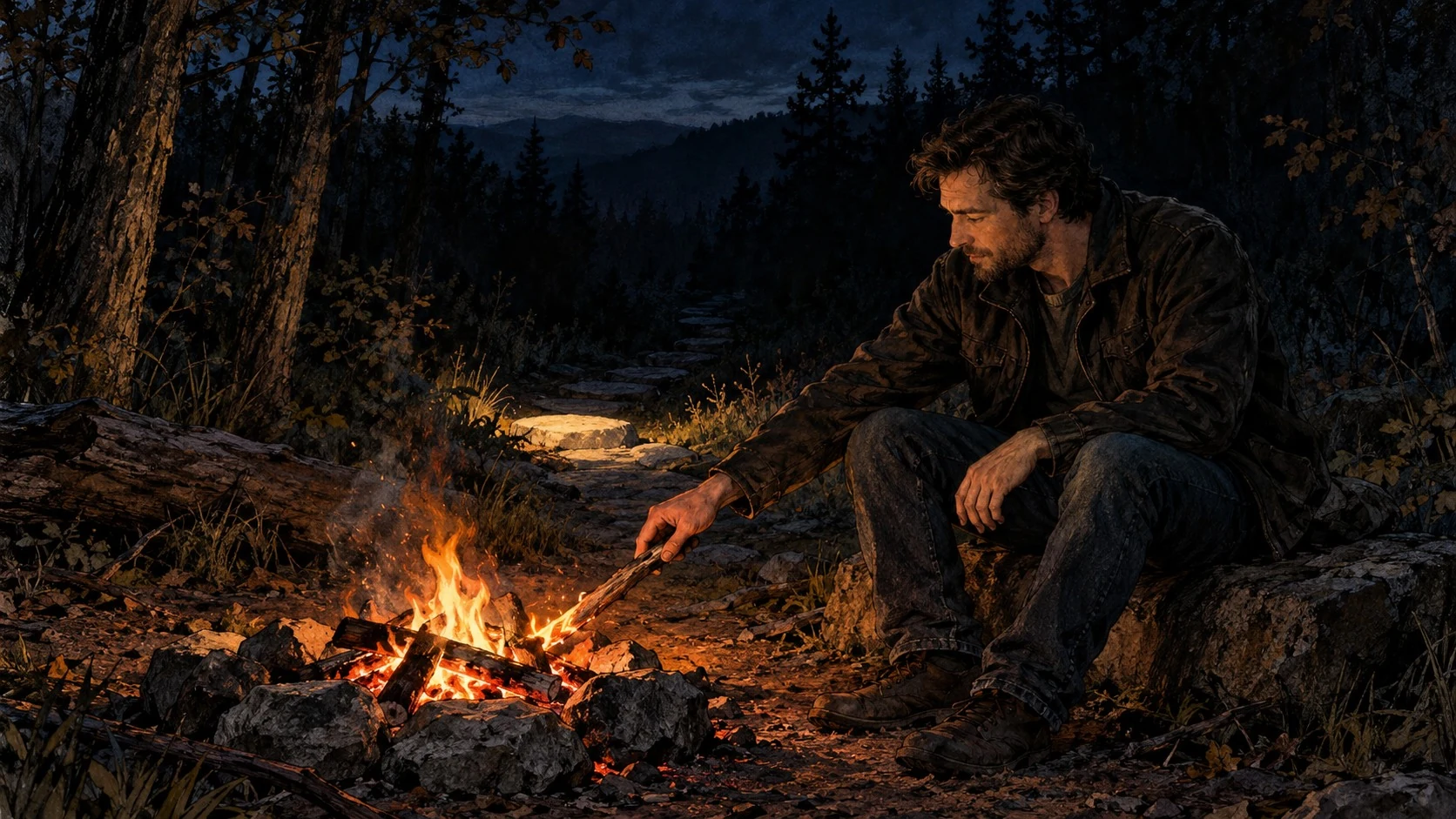
The laptop still shows the answer to the question about the purpose of life:
“Live it.”
Now it is no longer advice.
It is happening.
AI is a resonator of ideas; attention is the fuel of an idea.
Where your attention is, there you are.
Series Map: Six Hearths
- Fire — matter enters transformation.
- Night and the circle — darkness recedes; shared attention gains time.
- Image and performance — the wall remembers; the flame animates memory.
- Language and memory — the event leaves the body and becomes transmissible.
- AI and signal — the archive answers; the human chooses the consequence.
- Luča — enough light for the next step.