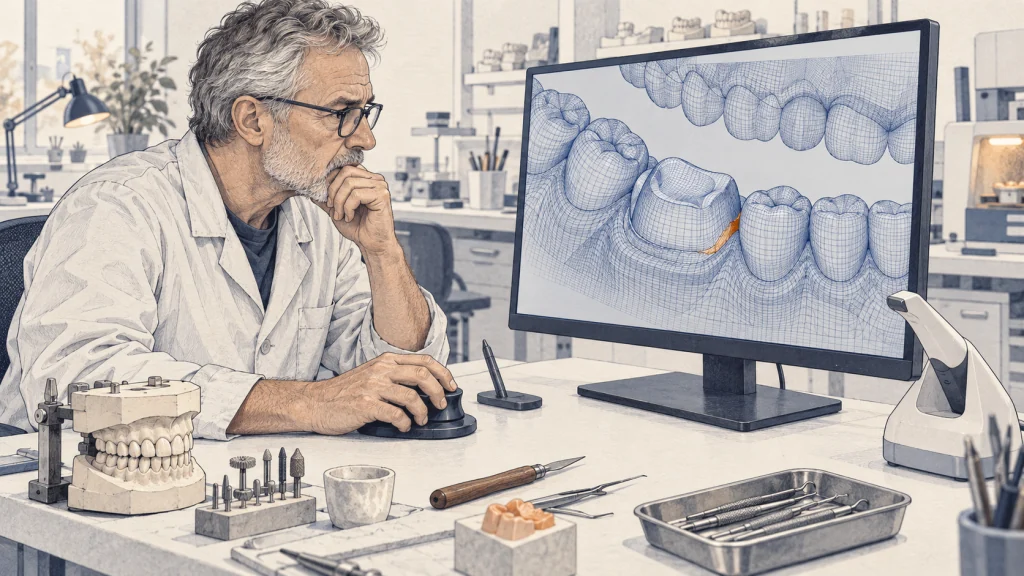
An algorithm can propose a shape in seconds. But between a digital impression and a tooth that remains in a patient’s mouth still stand the preparation, occlusion, material, post-processing — and the person who accepts the consequence.
Part one of the “AI in Medicine” series. State of play: 1 October 2026.
At 9:07, the dentist finishes preparing a lower first molar. There is no crown yet. There is a prepared tooth, soft tissue trying to return over the margin, and a space that must be rebuilt so that it withstands pressure, does not harm the neighbouring tooth and does not alter the bite.
Four minutes later, a scanner passes through the mouth. The tooth becomes a point cloud, then a surface mesh. From that moment, the case exists in two places: in the patient’s mouth and as data travelling among the surgery, software and laboratory.
This is where artificial intelligence enters today.
Not as one machine that “makes a tooth”, but as a series of narrow systems: one checks the scan, another proposes the crown geometry, a third registers images and proposes the implant position, and a fourth looks for deviations between the digital model and the manufactured restoration.
The scanner records a surface. The algorithm proposes a geometry. The technician checks whether it can be manufactured. The dentist decides whether it may become part of the patient’s body.
THE FIRST FILTER: A SCAN IS NOT THE SAME AS THE TRUTH
An intraoral scanner does not capture a “tooth” in the full clinical sense. It records visible surfaces. Moisture, blood, soft-tissue movement, insufficient gingival retraction, reflections and a hidden preparation margin can leave a hole or artefact in the mesh. If the edge has not been recorded, the best model in the world has nothing from which to reconstruct it without making an assumption.
Here, AI can be a good gatekeeper. It can flag an unclear margin, an insufficiently captured surface or problematic occlusal clearance while the patient is still in the chair. It cannot decide whether the preparation should be deepened, whether the tooth is biologically safe to restore, or whether further tissue removal would approach the pulp. Data quality, preparation geometry and tooth biology are not the same thing.
In October 2025, Dandy introduced Dandy Vision, with immediate issue detection and crown-preparation analysis during scanning. The company says that the scanner works 24.9 per cent faster than leading devices and that the system draws on experience from more than 11.5 million scans. These are manufacturer figures; neither the comparison method nor independent clinical validation has been published.
The detail “Live Scan Review in under 60 seconds” can also mislead. What begins in under a minute is a review with a Dandy technician. This is not AI completing a clinical analysis on its own, but an interesting combination of algorithmic checking and a human in the laboratory.
Medit and OraQ announced a partnership in November 2025 to connect scanning with real-time clinical intelligence. The important word is “announced”. The release describes a joint initiative, not an already proven routine benefit in the surgery.
The signal is nonetheless clear: errors are increasingly being sought while they can still be corrected without asking the patient to return.
WHAT CHANGES ON THE NEXT SHIFT
For the technician, the new system begins not with a robot but with a notification that a case has arrived in the laboratory portal. Instead of an impression tray and a paper work order, they open upper and lower scans, the bite registration, photographs, shade and the dentist’s instructions. Before the first click on “generate”, they must do what they once did over a model: check whether the information deserves to become a restoration at all.
On screen, this means several very concrete questions. Is the mesh closed, or is surface data missing distally? Can the preparation margin be followed around the entire circumference, or has the software merely bridged a hole neatly? Are there double surfaces caused by tongue movement or by scanning the same area again? Is the bite registered stably? For an implant: does the scan body match the library, and is it fully seated? If the answer is not satisfactory, the case goes back while the patient is still available.
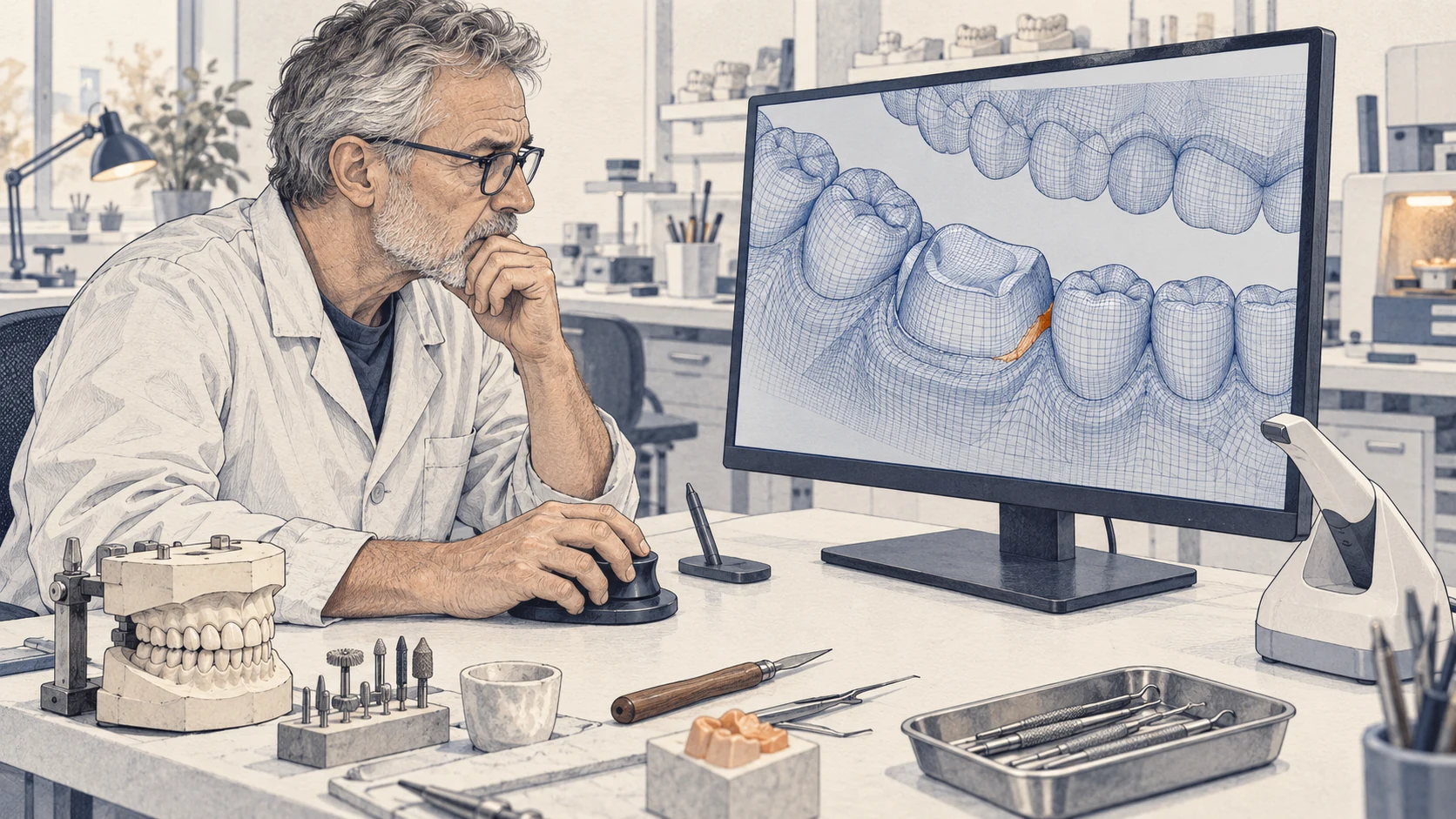
The greatest saving is not a crown drawn faster, but a wrong start prevented. Only after the input has been checked does AI offer anatomy. The technician selects the material and tooth library, then checks the path of insertion, margin, cement space, minimum thickness and contacts. A colour map on the screen shows geometric intersection or clearance; it does not measure the actual force in the mouth. The proposal can be accepted, edited locally, or rejected and begun manually. The difference is that the process no longer starts from an empty screen. The decision does not disappear — some of the repetition does.
WHEN A POINT MESH BECOMES A CROWN
Design follows the scan. The software must propose tooth anatomy, a path of insertion, cement space, contacts with adjacent teeth and the relationship to the antagonist. In most routine digital workflows, bite registration primarily provides a static relationship between the jaws. It does not automatically record the path of the mandible, the timing of contact or force during chewing. Static occlusion is not the same as function.
The most interesting new signal appeared almost as this article was being closed. The DentalGEN paper was published on 29 September 2026 in npj Digital Medicine. The model generates a patient-specific crown subject to morphological, functional and aesthetic constraints. In a blinded assessment, its designs received clinical scores statistically equivalent to those of expert designs and achieved a 70 per cent improvement over earlier methods in Hausdorff distance — the metric for the greatest deviation between two surfaces.
In a supervised proof-of-concept workflow, active design time was reduced by more than 90 per cent.
That is not the same as treatment that is 90 per cent shorter. It does not include preparation, tissue control, scanning, material selection, manufacturing, post-processing, try-in or follow-up of the restoration. DentalGEN is strong evidence that a generative model can produce a serious initial design. It is not yet evidence that such a crown lasts longer in the mouth.
A study of implant-supported crowns published in the Journal of Prosthodontics reveals a similar boundary. AI designs showed a smaller overall contour deviation from the technician reference: 438.6 ± 169.4 micrometres, compared with 679.5 to 705.1 micrometres for two conventional automated software systems. Occlusal morphology and emergence profile were also closer to the technician’s work.
But of 311 cases, 291 were used for training and only 20 for validation. Proximal contacts remained weaker in every automated group. The technician’s design was the reference, not a long-term clinical outcome.
In commercial software, the change is less spectacular but operationally important. DentalCAD 3.3 Chemnitz supports AI proposals for up to three adjacent posterior crowns or a posterior bridge of up to three units. The service runs in the cloud, uses exocad credits and is available in selected markets. For a laboratory, that means less repetition of the same CAD operations. It does not mean work without a technician.
IMPLANTS: A PROPOSAL IS NOT A TREATMENT DECISION
With implants, the digital chain becomes longer. CBCT shows bone and anatomical structures. An intraoral scan provides the surfaces of teeth and soft tissues. Software registers and segments them, then proposes the position of the implant, abutment, provisional crown and surgical guide.
In October 2025, Relu announced that its automatic implant-planning module had received CE marking under the European MDR. That is more important in regulatory terms than a trade-fair demonstration: the system has undergone a conformity-assessment procedure for its declared intended purpose.
CE marking, however, is not an award for a “better” plan and does not transfer responsibility to the algorithm. It neither proves superior clinical outcomes nor turns the system into an autonomous implantologist.
The clinician still checks the nerve, sinus, adjacent roots, the quantity and quality of bone, soft tissues, the prosthetically driven position and patient factors. An error can arise during imaging, data registration, implant selection, guide design and printing, guide seating, or drilling itself. AI can connect more steps. It cannot make the chain shorter than safety allows.
MANUFACTURING: MILLING, PRINTING AND EVERYTHING BETWEEN
Here, three different things are especially easy to confuse: who created the geometry, how the object was made and how it behaves in the mouth.
AI design is not 3D printing. A file generated by a model can be milled from a block, printed in resin or ceramic, or used as the basis for another manufacturing process.
One 2025 study found substantially lower surface deviation in AI-designed zirconia crowns than in conventionally digitally designed crowns. But the crowns in that study were milled and then sintered. The result concerns design, not additive manufacturing.
A direct comparison of manufacturing methods produces a more measured picture. In a 2025 in vitro study of printed and milled zirconia, printed crowns had a larger marginal gap — 87.7 ± 7.4 micrometres versus 57.5 ± 7.0 for milled crowns — and a larger internal gap, 107.4 ± 4.9 versus 86.6 ± 7.6 micrometres. The authors rated both groups clinically acceptable.
That is the real signal: printed zirconia has crossed the threshold of technical demonstration, but milling still produced a more accurate fit in this controlled comparison. One typodont and 24 specimens are not evidence of long-term equivalence in the mouth.
Additive manufacturing is already much more mature for models, surgical guides, provisional restorations and resin dentures. Even there, the process does not end when the printer stops. Resins are washed and post-cured. A ceramic “green body” undergoes cleaning, debinding, sintering with shrinkage compensation, finishing and inspection. Milled zirconia is followed by sintering, staining, glazing or polishing.
The geometry can be excellent in the file and wrong after shrinkage, poor support, inadequate polymerisation or finishing.
Accessibility also demands precise language. Dandy’s 2025 programme quoted a laboratory price of $119 to $199 per arch for practices working with certain low-reimbursement US programmes. That is not the final price to the patient, nor a universal price for a “3D-printed denture”. The current Fusion system starts at $259 and combines digital design, a 3D-printed mould and manually poured acrylic.
Democratisation does not come from one cheap machine. It comes when the entire workflow requires fewer visits, fewer repetitions and less lost data — without lowering standards for materials and control.
WORKING WITH THE DEVICES: A NEW SCREEN, THE SAME MATERIAL
AI changes the first part of the job, but it does not calibrate the scanner, replace a worn bur or know that a vat of resin was stored at the wrong temperature. After the design has been approved, the technician still sends the file to CAM, selects the disc, block or resin, nests the restoration in the material, checks the milling strategy or print supports and monitors post-processing. With zirconia, the technician allows for shrinkage and furnace behaviour. With resin, they track the material batch, washing and post-curing. With every method, they check whether what came out of the machine is the same thing that was approved on screen.
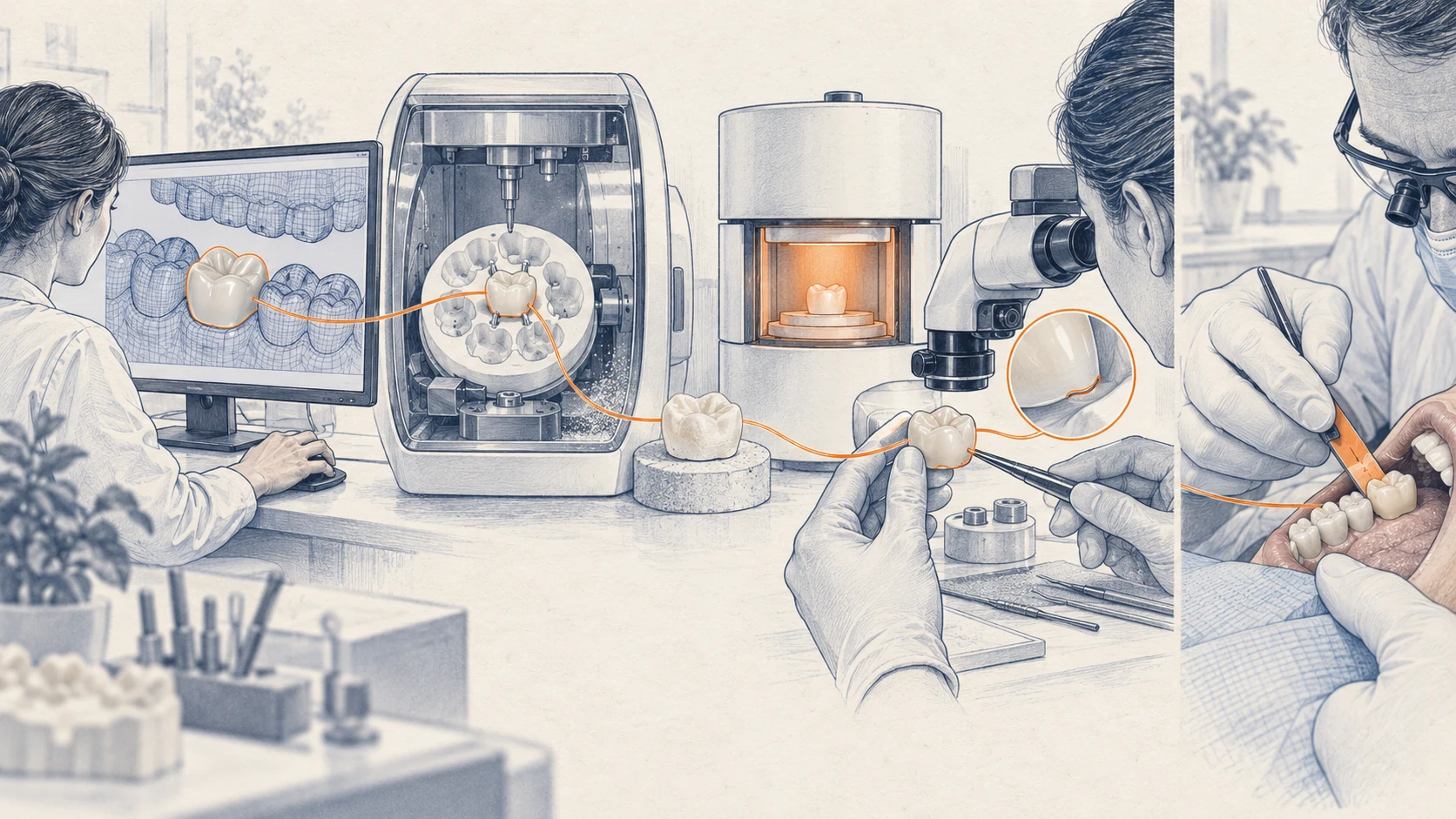
The new skill, then, is not “working with AI” as a separate form of magic. It is the ability to locate an error in the chain. Did it arise in the scan, bite registration, automatically traced margin, CAD proposal, material library, CAM strategy, tool, printing, sintering or finishing? The system accelerates a good workflow. A bad workflow merely reaches a bad restoration faster.
THE TECHNICIAN DOES NOT DISAPPEAR. THE LOCATION OF THEIR SKILL CHANGES
In an analogue workflow, the technician was largely the motor: shaping every transition, building each contact and correcting the anatomy by hand. In a good AI workflow, the technician becomes the architect and controller of exceptions.
They check the preparation margin, path of insertion, cement space, minimum material thickness, connectors, proximal and occlusal contacts, emergence profile and manufacturability. After fabrication, they check the margin, internal fit, surface defects, sintering or post-curing, finishing and material traceability.
The dentist then checks the intraoral fit, contacts, occlusion, aesthetics, access for hygiene and the patient’s response. No green mark on a screen can confirm in the dentist’s place that the restoration may remain.
AI does not abolish the craft here. It shifts it from drawing every point to recognising the point that must not be wrong.
The most realistic fear is not that a button will replace the technician tomorrow. The more dangerous scenario is that the technician retains responsibility for the restoration while losing the time and the right to reject a proposal marked green on the screen. If a laboratory measures only the number of completed units, AI becomes an accelerator of pressure. If it measures remakes, contact adjustments, margin errors and the trace of decisions, AI can become a quality tool.
For an experienced technician, the benefit is clear: less repetition of the same CAD operations, earlier detection of a poor scan and more time for demanding margins, emergence profiles, function and characterisation. For a younger technician, there is another danger. The interface can quickly provide an acceptable shape without ever teaching them why that shape is acceptable.
Training must therefore cover more than “where to click”. It must include anatomy, occlusion, materials, the limits of the system and deliberate practice with cases that AI does not solve well. Someone who cannot recognise an error does not become safer because the software has polished it neatly.
A TRANSITION WITHOUT FREE FALL
A smart laboratory does not switch on a new system on Friday and shut down the old one on Monday. It begins in parallel, with routine single posterior crowns: AI produces an initial proposal, the technician compares it with the existing workflow and records what they changed — margin, contacts, occlusion, thickness, anatomy. Try-in results, adjustments made in the surgery and every remake are recorded. Only when local results show that the process is stable is it extended to more complex indications. Full arches, complex implant restorations, severely worn dentitions and non-standard jaw relationships should not be the testing ground for a first encounter with the software.
A fallback workflow must exist before the first patient. The original scan and work order are kept in a format the laboratory can reopen. It is clear who may alter the automatically traced margin, who approves the final design and how the case proceeds when the cloud, licence or connection is unavailable. The software version, library used, technician’s changes and material batch are retained. If the system fails, the work must not lose its history or start again from the beginning.
A technician does not need faith in the new system. They need test cases, measurable criteria and a back button.
WHO PROTECTS THE DATA WHILE THE TOOTH TRAVELS THROUGH THE CLOUD?
A digital case is not merely the surface of a crown. It may contain an intraoral scan, CBCT, photographs, patient data, a treatment plan and an edit history. When an AI service runs in the cloud, the clinical question becomes an infrastructure question too.
Where are the data processed? How long do they remain? Who can access them? Is the case used to train a new model, and can the practice refuse? What happens when the algorithm version changes between planning and fabrication? Can we later see which model made the proposal, who changed it and who approved it?
Pseudonymisation is not the same as anonymity. An open file format is not the same as genuine case portability. If changing supplier cuts off access to a patient’s history, technical efficiency has been bought with a new dependency.
WHAT WE KNOW ON 1 OCTOBER 2026
Strong signal:
- Generative models can substantially reduce the active time required for an initial design and, in controlled assessments, produce morphology close to expert work.
- Commercial systems already offer scan checks, AI proposals for several adjacent units and automated parts of implant planning.
- AI can catch an error earlier, before poor data become a poor restoration.
- Under controlled conditions, printed zirconia can achieve a clinically acceptable fit, but there is not yet a basis for calling it more accurate than, or equivalent to, milling over the long term.
Not yet established:
- that AI-designed definitive restorations have better long-term survival or produce greater patient satisfaction;
- that the same system performs equally well with complex anatomy, subgingival margins and non-standard occlusal relationships;
- that a marketing speed benchmark automatically means a better clinical outcome;
- that a safe chain can be completed without expert review by dentist and technician.
THE CROWN ARRIVES
A few days later, the restoration returns to the surgery. On screen it looked perfect. In the hand, it is small, solid and far less abstract.
The dentist checks the margin. Then the adjacent contacts. Then the bite. The patient closes their mouth, moves their jaw and for the first time participates in checking the object that, until then, had existed mainly as data.
Hausdorff distance, CE marking and a manufacturer’s promise are not cemented into the mouth.
A crown is.
AI can shorten the path from scan to crown. It can find an error before it becomes expensive. It can return time for judgement to the technician, and time for the patient to the dentist.
But the algorithm only proposes a shape.
A human accepts the consequence of that shape in someone else’s mouth.
In the next part of the “AI in Medicine” series: AI in diagnostics — where the boundary between assisted and autonomous image interpretation is already shifting, and who is responsible when a proposal becomes a decision.