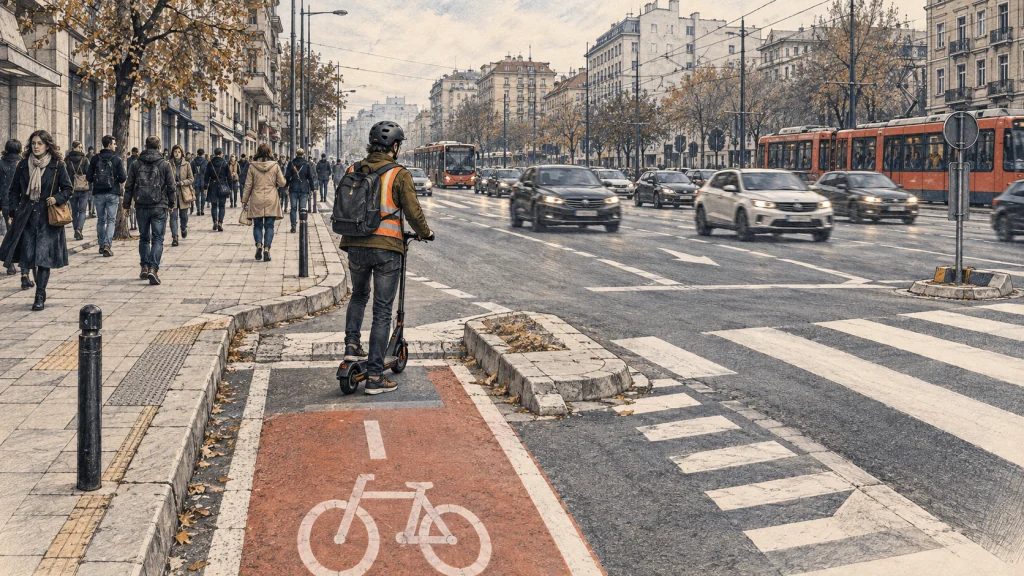
At the end of a cycle path, an e-scooter rider is left with three bad answers. They can continue on the pavement, where they are not allowed. They can move onto the carriageway, but only if the speed limit on that street and their age permit it. Or they can brake, dismount and become a pedestrian again for a few dozen metres.
This is not an edge case. It is an everyday point at which the e-scooter reveals itself as more than a new vehicle: it is a test of an old transport system. The city has already been divided among cars, bicycles and pedestrians. The e-scooter appeared between those categories — too fast for the pavement, too weak and too vulnerable for many carriageways, yet small enough for everyone to try to squeeze it into whatever space remains.
The real question, then, is no longer whether e-scooters are good or bad. It is whether we know how to organise traffic as a relationship among vehicle, person, road and city — or whether we will fasten all responsibility to the rider’s back along with a high-visibility vest.
A new vehicle on an old map
In Serbia, a light electric vehicle is defined precisely: at least two wheels, mechanical steering, no seat, up to 0.6 kW of continuous rated power, a design speed of no more than 25 km/h and an unladen mass of no more than 35 kilograms. A rider must be at least 14, wear a fastened cycle helmet and use a cycle path, shared pedestrian-and-cycle path or cycle lane. If movement on that infrastructure is not possible, the rider may use the carriageway where the speed limit is no more than 30 km/h; only an adult may also use a street limited to 50 km/h. On the carriageway, the rider must remain within one metre of the right-hand edge, except when turning left, overtaking or passing an obstacle, and must wear a high-visibility vest. At night and in reduced visibility on a cycle path or shared pedestrian-and-cycle path, the rider must wear a vest or be illuminated or marked with reflective material. The limit on a shared pedestrian-and-cycle path is 10 km/h. Across an ordinary pedestrian crossing, the e-scooter must be pushed.
This is not an absence of rules. On the contrary, the rules are highly specific. But they reveal the geography of the problem. Where there is no cycling infrastructure, a fourteen-year-old can legally reach the end of one path and find that there is not another permitted metre ahead. The e-scooter has not removed the person from the system. The system has removed the route in front of the vehicle.
Transport infrastructure is not background here. It is part of the vehicle’s function. The same e-scooter can be a sensible means of transport on a connected network of lanes and an impractical object on a street that suddenly changes from a 30 km/h zone into a four-lane carriageway. The law defines a 25 km/h vehicle, but the city often fails to provide it with an uninterrupted route even at 10 km/h. A legal speed threshold is not a design criterion. Network continuity is also measured at the end of a path, through an intersection, in the angle at which rails are crossed, the position of a drain grate, the quality of the surface, sight lines and the actual speed of motor traffic at a conflict point.
A properly designed cycle path is therefore not a concession to one group of road users. It separates speeds, clears the pavement, connects a neighbourhood to a station and gives a bicycle or e-scooter a genuine chance to replace a car. One continuous, legible corridor often does more for safety, the environment and the functioning of a city than another layer of prohibitions and limits. A rule tells a person what they may not do. A good route reduces the number of situations in which they must choose among three bad answers in the first place.
A bus stop shows the difference. If a cycle path passes through the space where people wait, step off a bus and approach its doors, the design has turned pedestrians and cyclists into opponents. They are not. Their flows have merely been forced into the same metre. The path should bypass the waiting area, usually behind a separate boarding island, while every unavoidable crossing with pedestrians should be short, visible, slowed and unambiguous. Everyone gets their own flow; crossings remain only where necessary and where everyone can read the situation. Pedestrians and cyclists do not cancel one another out. Bad design forces them to do so.
First, we regulated the person
Serbia’s response is most visible on the rider’s body: age, helmet, vest, direction of travel, position on the road. To take part in traffic on a public road, the vehicle must carry a sticker issued by the Road Traffic Safety Agency. The procedure records the make, motor power, design speed and unladen mass.
The rules do not stop at the sticker. An e-scooter must have a hand-operated brake, white front and red rear lights, side reflectors and an audible warning device, while its battery, controller and drive must conform to the manufacturer’s specification. Yet there are no uniform technical conditions or measurable braking-performance threshold for these devices. Serbia therefore has an equipment checklist, but the regime’s centre of gravity remains the rider.
The sticker is not a miniature annual roadworthiness test. It does not tell us how a particular model behaves when its front wheel hits the edge of a pothole, how steadily it brakes on wet asphalt, whether the steering assembly has loosened after a thousand kilometres, or how the battery survived three summers on a balcony. Serbia has published SRPS EN 17128:2020, but a standard and a mandatory technical regulation are not the same thing. A standard is applied voluntarily unless a regulation explicitly invokes it, and the published scope excludes vehicles intended for hire from unattended stations. The mere existence of a standard therefore does not prove that every e-scooter on the market has passed its tests.
According to Road Traffic Safety Agency data, 144 collisions involving a light electric vehicle occurred between September 2023 and the end of 2024. One person was killed and 131 were injured, including 27 children; the youngest injured child was eight. In the first half of 2025, another 39 people were injured, including nine children. In a pilot observation of 139 riders at three locations in Belgrade in August 2024, only 2.2 per cent complied with all six observed rules.
That is not the same as 97.8 per cent of rides being dangerous. An aggregate measure conceals which rule was broken and how much that violation alters risk. The figures are serious, but without the number of trips and kilometres travelled they do not provide risk per journey. The publicly released summary does not identify the vehicle model, surface type or precise mechanism of the fall either. The statistics count the consequences, but still describe the path to them poorly.
Statistics do not ride by themselves
Those 144 Serbian collisions cannot honestly be divided into “in traffic” and “outside traffic”: in the published total, all are recorded as road traffic collisions, while location and mechanism have not been publicly cross-tabulated. A comparison with bicycles therefore requires the same source, the same definition of serious injury and the same observation period.
In the hospital dataset published by the UK Department for Transport for the period from 2020 to June 2022, 69.2 per cent of cases involving seriously injured e-scooter riders and 70.6 per cent of those involving seriously injured cyclists occurred on the carriageway. No other road user was involved in 63.6 per cent of the e-scooter cases and 68.6 per cent of the cycling cases. In this cross-section, the difference is far smaller than the image of the e-scooter as an entirely distinct category of risk might suggest.
A similar distribution, however, is not proof of equal safety. It does not tell us how many trips were made, how many kilometres were travelled, at what speed, over what surface, or how severe the outcomes were within the “seriously injured” category. Vehicle design and street design are not the only parameters. For e-scooters and bicycles, training, attention and rider responsibility may be the most important factors a person can change immediately. As in a car, fatigue and alcohol do not help; nor do a phone, speed unsuited to the surface or an overestimate of one’s own skill. This applies to everyone: vulnerability does not erase the responsibility of an e-scooter rider or cyclist, while it demands extra care from the driver of a motor vehicle towards the person they can injure more severely.
A good system must allow for human error, but it cannot abolish rider responsibility. A trained, sober rider cannot compensate for a severed path; nor can the best path make an inattentive or intoxicated rider safe.
A small wheel is not the whole story
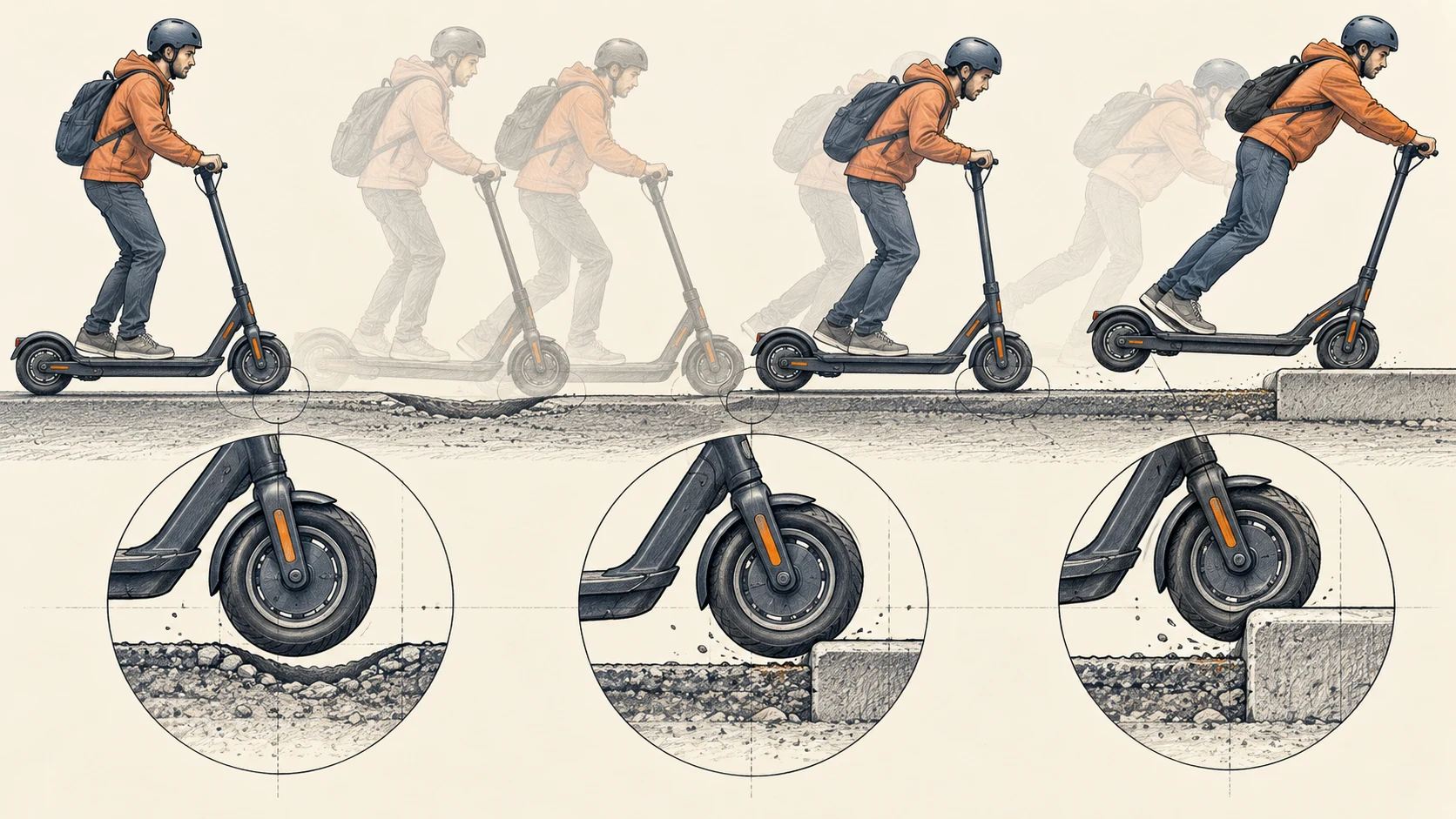
An e-scooter has a short wheelbase, relatively small wheels and a high centre of gravity, largely formed by the rider’s body. The rider stands; they are not connected to the machine by a seat and pedals as on a bicycle. When the front wheel abruptly loses speed on a pothole, rail or kerb, the body continues forwards. That is why the fall is often sudden and why the face, head and hands are among the first points of contact. Speed here is not merely a number on a display: at the same total mass, travel at 25 km/h carries about 56 per cent more kinetic energy than travel at 20 km/h.
A systematic review of 34 studies involving 5,705 patients found that a fall was the leading mechanism of injury, present in 74.4 per cent of clinically treated cases. That is the structure of treated cases, not the probability of a fall per trip or kilometre. It proves neither that every small wheel is unsafe nor that a single prescribed dimension would solve the problem. Diameter is only one part of the geometry. Tyres, wheelbase, structural rigidity, centre-of-gravity position, steering response, braking distribution and the behaviour of electronic control also matter.
It is therefore better to test performance than to declare one dimension magical. A UK Department for Transport technical study describes practical tests from the German approval system: depressions 50 and 20 millimetres deep, a deformed ramp and a 30-millimetre kerb are traversed at 8 km/h and at the maximum design speed, and deviation from the prescribed path must not exceed 20 degrees. That is a different kind of question. It asks not only how many watts appear on the specification sheet, but what happens when a real street strikes the wheel.
Neither unladen mass nor continuous rated power alone describes the system’s behaviour. The brakes stop the vehicle, rider and luggage, while the sense of control also depends on acceleration, peak torque and the rate at which acceleration changes. Designer, regulator and operator therefore care not only about the wattage, but about how predictably the vehicle receives and carries out a command.
The same e-scooter, three different countries
This is not a country ranking. Each illuminates a different layer of the same system: Germany the specific vehicle and insurance, Finland the fleet and the city, Serbia the category, basic equipment and rider behaviour.
Germany ties responsibility to the specific vehicle. The e-scooter is limited to 20 km/h, the rider must be at least 14, and the vehicle must have operating approval and a valid compulsory-insurance sticker. A helmet is recommended but is not a general legal requirement. Approval is more than an administrative label: the German regulation requires two independent brakes, total deceleration of at least 3.5 m/s² and residual performance when one brake fails, alongside requirements for lighting, dynamics, electrical systems and battery safety. The system checks both the person and the object entering the road.
Finland assigns more responsibility to the city and operator. A municipal permit for professional hire was introduced on 1 August 2025, and municipalities had to establish the procedure by the beginning of 2026 at the latest. Through the permit, a local authority can set speeds, zones, parking and operating times. Separately, operators provide the national agency Traficom with data on the number of trips, average and median distance and duration, and the role of e-scooters in journey chains. In spring 2026, more than 90 per cent of municipalities covered by the survey results had regulated speed, and almost 90 per cent parking. The e-scooter is treated not merely as a private object, but as a fleet using shared space.
Serbia checks that a vehicle belongs to the legal category and carries the required equipment, then regulates rider behaviour heavily. That is an understandable beginning, but it is not the whole system. A sticker without market surveillance, a helmet without a connected route and a penalty without data on the cause of a collision remain separate parts. Traffic becomes safer only when those parts begin to exchange information.
Age is not skill
The age threshold of 14 draws a clear legal line, but it does not create riding ability overnight. The day before a birthday, riding on a public road is forbidden. The day after, it is permitted without a special test, practical training or any check that the young rider knows how to brake progressively without locking a wheel and losing stability, look over a shoulder without swerving, judge a bus’s blind spot or recognise a surface on which the front wheel will not forgive an error.
The ban on riders under 14 resolves legal status, but it does not erase e-scooters from outside schools. If children already ride, parental choice and police enforcement are not the only points in the system. There is the retailer selling the vehicle as a toy, the school with no practical training for this new form of movement, the city that breaks the path, and the app that immediately gives a beginner the motor’s full response.
A good regime therefore does not choose between education and enforcement. It trains people before an offence, limits beginner mode, explains to a parent what they are buying and produces data that show where errors recur.
It is green only in a good system
An e-scooter is not ecological merely because it has a battery instead of an exhaust. Its outcome depends on how long it lasts, what charges it, how it is maintained, how much energy and van mileage are spent redistributing a shared fleet and — most importantly — which journey it replaced. The meaningful measure is therefore not a green icon in an app, but CO₂e emissions per passenger-kilometre, including manufacture, vehicle lifespan, charging and service-vehicle mileage. Privately owned and shared e-scooters do not have the same life cycle.
If it connects a neighbourhood to a railway station and replaces a short car journey, an e-scooter can be a highly rational part of the city. If it replaces walking, becomes electronic waste after a few months and is carried around by a van every night, the green remains in the app. Ecology is not a property of an object. It is the outcome of the entire chain.
The same applies to parking. An e-scooter left across the pavement is not minor clutter but an obstacle to a wheelchair user, a parent with a pushchair or a person using a white cane. Parking is therefore not an appendage to the ride. It is the final metre of the same transport service.
Ireland: the vehicle must earn its place on the road
Ireland legalised electric scooters on public roads in 2024, but did not stop at a speed limit. The national regulation sets maximums of 20 km/h, 400 W and an unladen mass of 25 kilograms including the battery, and requires wheels at least 200 millimetres in diameter, front and rear lights, reflectors, a bell and a manufacturer’s plate. It also requires two independent brakes — one for the front and one for the rear wheel — with a prescribed deceleration capacity of at least 3.5 m/s². The vehicle must remain stable under braking. Structural integrity, electrical and battery safety, and CE marking are regulated separately.
This is not a perfect system, nor is it stricter in every layer. Ireland requires neither registration, tax, insurance nor a driving licence for these vehicles, nor a periodic roadworthiness test; technical fitness remains the responsibility of the owner and rider. Under the Irish Road Safety Authority’s rules, helmets and high-visibility clothing became mandatory on 4 September 2026, while the rule raising the minimum age to 18 takes effect on 2 October 2026. E-scooters are not allowed on pavements, are governed by rules similar to those for bicycles and must be roadworthy. Compared with Serbia’s regime, the Irish regulation goes considerably deeper into measurable vehicle performance. It is not alone in doing so: German approval rests on comparable technical requirements.
Wexford: the city that did not let the app become the law
The most interesting Irish example is not a grand strategy on paper, but a small shared fleet in Wexford. Riding requires a registered account and a minimum age of 18; since January 2026, the user must also upload a photograph of an identity document. According to the municipal pilot documentation from 2024, a journey can end only at one of 42 designated parking locations. An onboard IoT device and GPS enable geo-parking and automatic speed reduction when a vehicle enters a sensitive zone.
The system description published by Wexford County Council identifies a beginner mode that the user can enable to limit acceleration and speed to 15 km/h. A three-axis accelerometer detects an abrupt change in mass as a possible tandem ride, while a night-time reaction test can refuse to unlock the vehicle. It is not a breathalyser but an additional app-based filter. According to the council’s guidance and in consultation with it, the operator can use geofencing to reduce speed to 15 km/h in congested areas or to 8 km/h where routes mix with pedestrians. The city can alter limits temporarily for events or seasons.
A digital boundary is not a kerb, however. GPS error and latency mean that geofencing cannot replace a physically safe street. It can be an additional layer that gives a vehicle behaviour tied to a specific place.
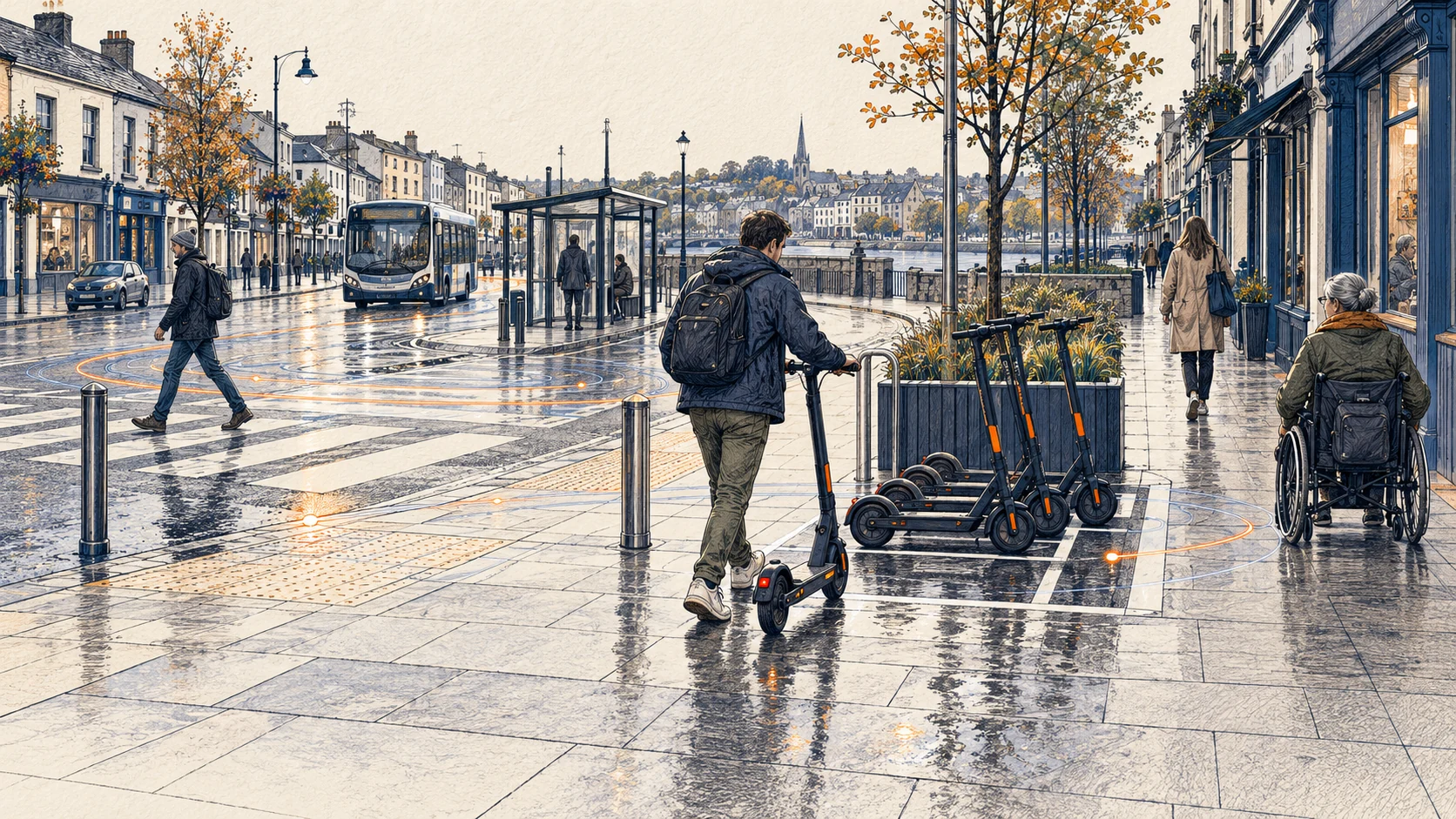
Wexford is not yet proof that the problem has been solved. An operator’s technical capabilities are not the same as an independently confirmed reduction in injuries. It is, however, a good example of what a city can keep in its own hands: parking, zones, speed, data, beginner mode and the ability to correct the system. Success is still to be measured in serious injuries per million trips and kilometres, pavement riding, blocked routes, genuine replacement of car journeys and fleet lifespan. Regulation then ceases to be a photograph taken once. It becomes a control loop.
That is the real lesson. E-scooter safety does not arise from one helmet, one sticker or one good wheel. It emerges when the manufacturer is accountable for the design, the importer for what it places on the market, the city for a continuous route and parking, the operator for fleet behaviour, the rider for their riding, and the state for the data from which everyone can learn.
The e-scooter is not an intruder that ruined an orderly transport system. It is a small, quiet instrument that has shown us where transport was already disconnected.