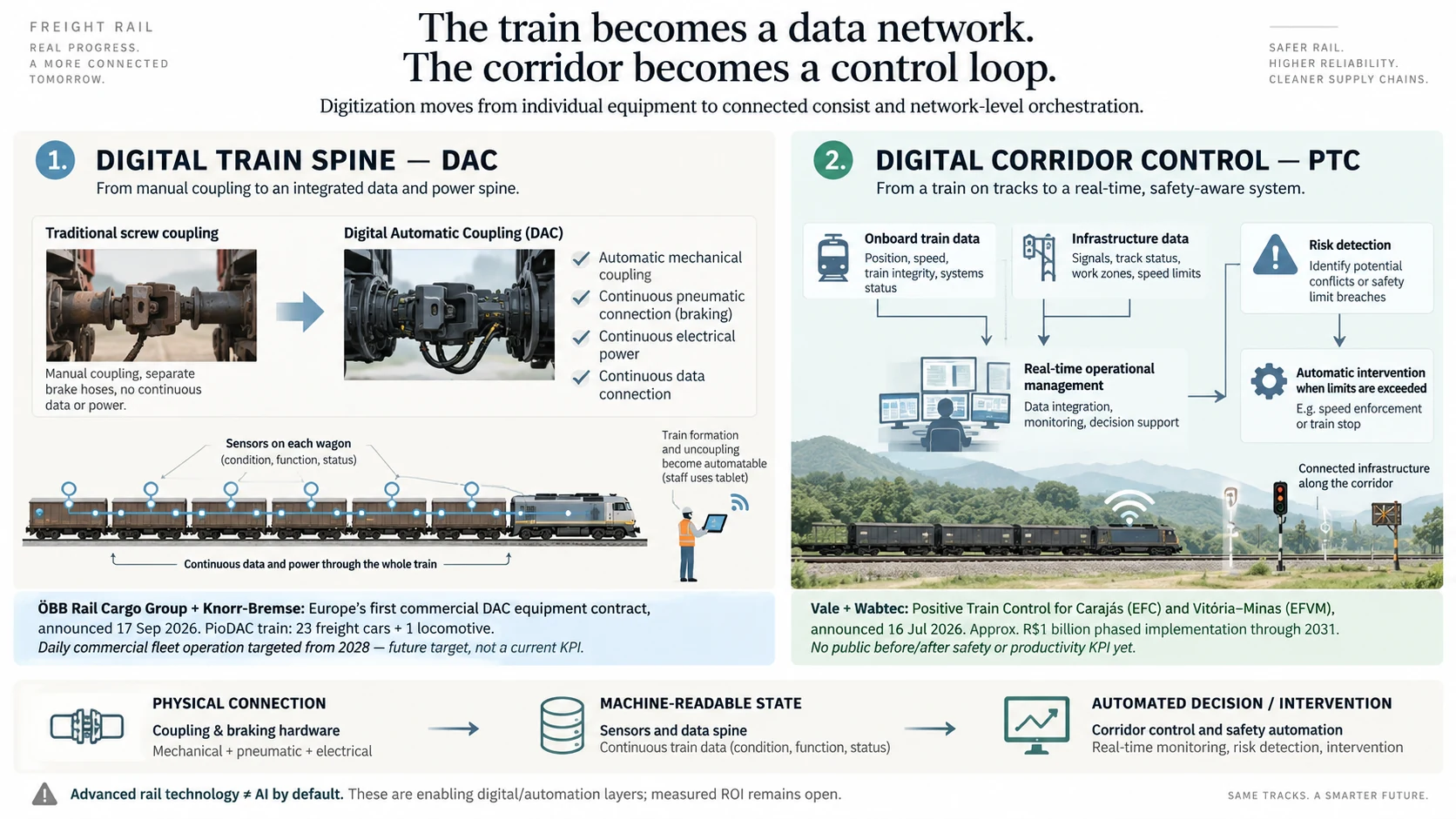
Cameras identify changes, couplers carry data, protection systems can stop a train, and digital platforms preserve the continuity of a shipment. Railway modernisation depends less and less on a single “smart” machine, and increasingly on how existing parts are connected.
A locomotive can pull wagons. Engine power cannot resolve an incorrect cargo record, unnoticed track damage or a lorry arriving at a terminal on the basis of wrong information.
These are different problems, but they share one question: does the right information reach the place where someone — a person or a clearly bounded automated system — can act on it?
The railway has long been a network of tracks and stations. The changes examined here add a second layer: they connect the condition of equipment, the train consist, route constraints and the work of the people who keep transport moving. A camera, a coupler, a signalling system and a booking platform are not the same technology. Seen together, they show how a physically connected train also becomes a data network — and why it is not enough to call everything artificial intelligence.
Seeing a Change Before It Becomes a Failure
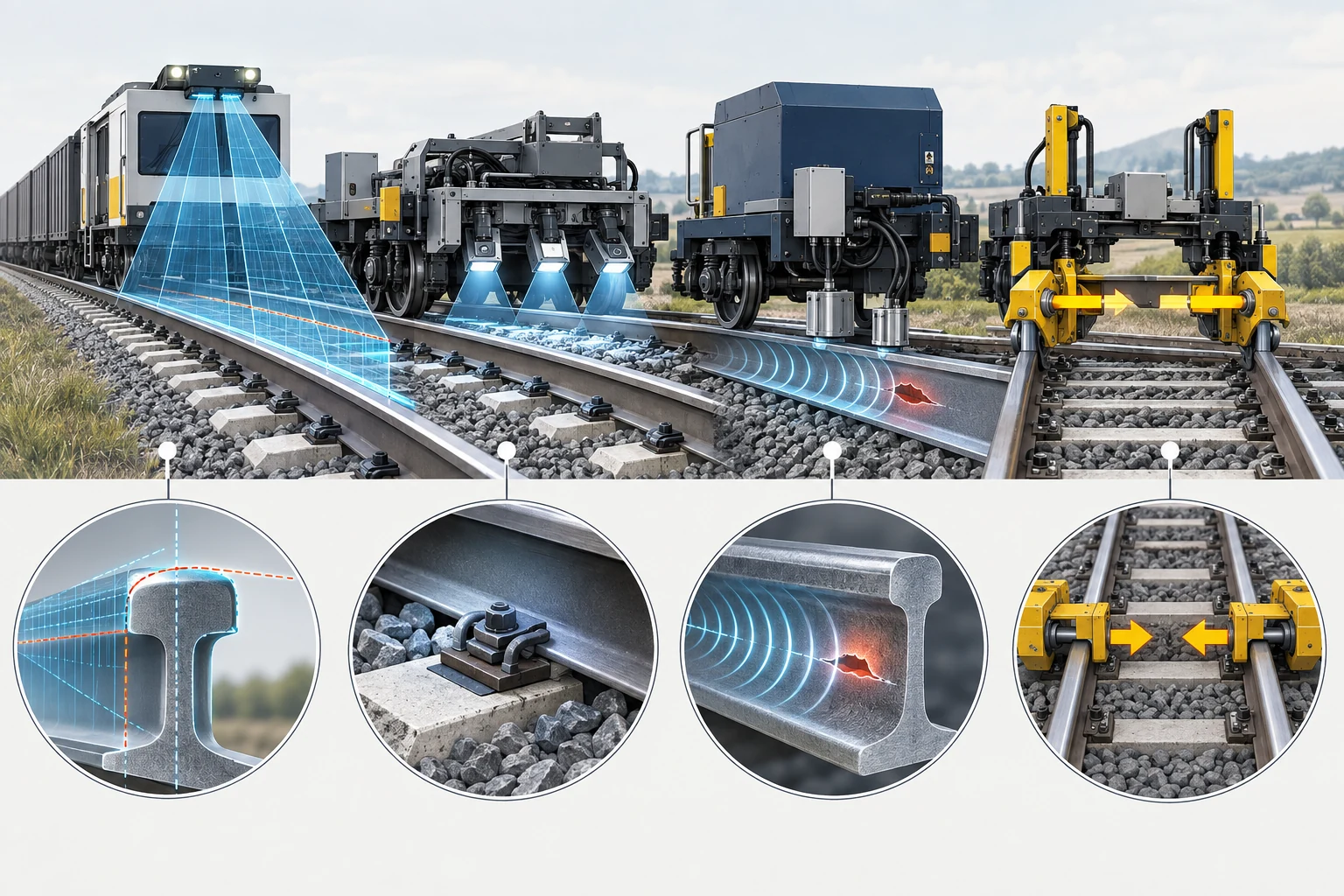
Union Pacific uses Machine Vision, combining high-resolution cameras, sensors and AI software, to inspect railway infrastructure. The system looks for patterns and small changes in track condition, then gives an inspector the precise location at which to investigate the cause. Instead of spreading the same amount of attention along the entire route, the specialist receives a more precise starting point.
For a railway specialist, it is important to separate what is being measured. Geometry systems monitor track alignment, elevation, curvature and rail-surface condition. Under-vehicle Machine Vision uses lasers and cameras to assess visible elements, including sleepers. Ultrasonic vehicles send high-frequency sound into the rail to find internal irregularities that a camera cannot see. The Gauge Restraint Measurement System, GRMS, takes another route: it applies a lateral load of about 9,000 to 10,000 pounds to the track and looks for places where the track gauge lacks sufficient stability. These are not four resolutions of the same image, but four different physical signals and four different failure modes. Source: Union Pacific, Safety Inspection Fleet.
What happens after detection matters. According to the operator’s account, inspectors assess all the circumstances and decide where a repair is needed, where a speed restriction should be imposed, and where track should be temporarily taken out of service. In 2025, track-geometry measurement systems inspected more than 644,000 track miles and produced more than 100 billion measurements. That shows the scale of the data; by itself, it does not prove that every finding is correct or that every decision is automated. Source: Union Pacific, 22 May 2026.
In its report on Automated Track Inspection, ATI, Union Pacific states that, since March 2026, the system has found more than 200 geometry defects on routes covered by the regulatory waiver — five times as many as visual inspection in that comparison. Monthly inspection mileage rose from more than 17,000 miles in March to more than 29,000 in June, with those routes inspected at least once a week. The operator also states that there have been no track-caused derailments on them since ATI began operating. That is an important operational signal, but not proof that ATI alone caused the outcome. Source: Union Pacific, 8 September 2026.
The Brotherhood of Maintenance of Way Employes Division, BMWED, provides a necessary counter-signal. Citing regulatory reports, it states that qualified Union Pacific inspectors found 931 defects after the ATI system had passed; for Union Pacific and BNSF together, it reports 5,354 findings. About 74 per cent of the conditions identified visually, according to the union’s assessment, belong to classes for which current ATI is not designed: sleepers, fasteners, ballast, drainage, switches, crossings, joints, obstructions and washouts. The source represents an interested party, but precisely identifies the limit of scope. At the same time, 96 per cent of the defects found on the observed routes could be addressed through routine maintenance. The synthesis is therefore narrower: ATI frequently measures geometry; the field inspector sees a broader set of conditions, confirms the cause and selects the response. Source: BMWED, 7 August 2026.
A finding is not a repair. Value arises when a finding changes what the team does next.
A Coupler That Connects More Than Wagons
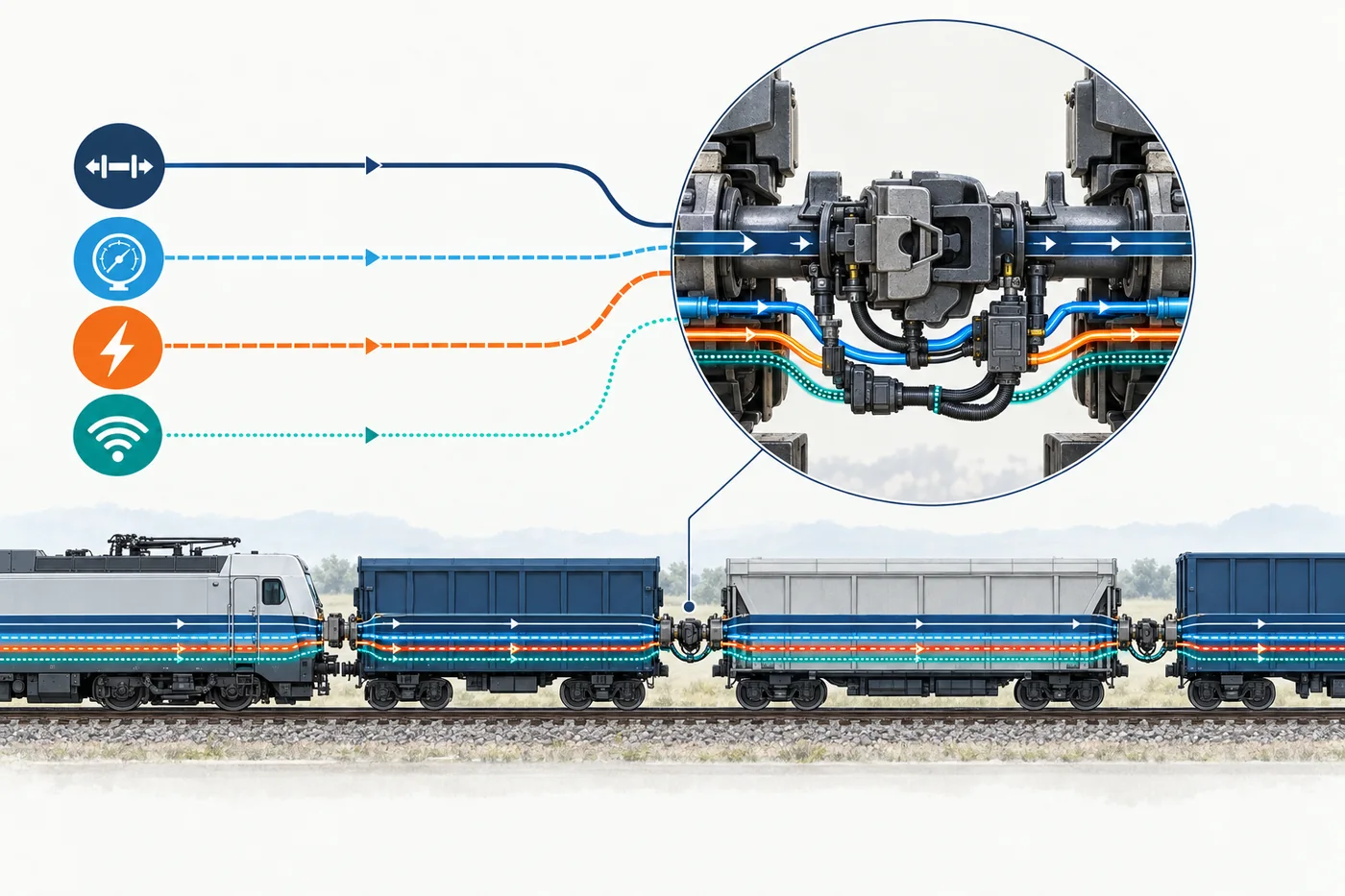
At first glance, the Digital Automatic Coupler, DAC, belongs to the world of metal rather than artificial intelligence. Its architecture connects the mechanical link between wagons, the compressed-air brake pipe, electrical power and data transmission. A communications backbone is thereby built through the train alongside its physical consist.
The designation Type 5 is not a marketing version of software, but a functional scale for the coupler. Type 1 establishes the mechanical connection, Type 2 adds the pneumatic line, Type 3 electrical power, Type 4 data transmission, and Type 5 automatic uncoupling and Digital Freight Train functions. The operational difference is substantial: only when mechanics, air, power and data are connected in a single engagement can a consist become both a train and a communications network at the same time.
Knorr-Bremse’s FreightControl processes brake status, wagon data and diagnostics, and forwards them to the locomotive. This creates the possibility for brake testing, confirmation of train integrity and condition monitoring to become system functions instead of a series of separate manual walkarounds and records. There is another technical problem during the transition: a locomotive must work both with DAC-equipped wagons and with a fleet retaining the conventional screw coupling. Knorr-Bremse therefore offers HybridLink for locomotives as a bridge between the two fleets. For logistics, that mixed phase is likely to be harder than demonstrating a fully equipped train. Source: Knorr-Bremse, FreightLink and HybridLink.
That connection opens the way to automatic recognition of the train consist, brake testing, train-integrity monitoring and controlled uncoupling of wagons. In March 2025, Europe’s Rail reported successful testing of these functions on a specially equipped prototype train. This is an important technical demonstration, but a test consist is not the same as broad deployment in European rail freight. Source: Europe’s Rail, 28 March 2025.
The next step is more concrete than another demonstration. On 17 September 2026, ÖBB Rail Cargo Group and Knorr-Bremse announced Europe’s first commercial contract to equip a PioDAC consist of 23 freight wagons and one locomotive. The wagons will use Knorr-Bremse’s FreightLink DAC system, with electronic control units and sensors for monitoring vehicle functions and condition. Operation of the specific consist under real-world conditions is planned from 2028.
Here, the train must be distinguished from the programme. The broader PioDAC initiative brings together 10 partners from seven countries and runs for 36 months. It provides for several pioneer trains from 2027, while the 2028 date refers to the start of real-world testing for this particular RCG–Knorr-Bremse train. The dates are not in conflict; they describe two levels of the same transition. Source: UIP, PioDAC memorandum.
The contract shows a transition from development to industrialisation, but the business case still has to be measured: train-formation and brake-test time, labour hours, wagon availability, retrofit cost, and the reliability of electrical and data contacts. The public announcement does not yet provide a before-and-after series for those indicators. DAC is not AI in itself. Its contribution is more fundamental: without continuous power and data through the consist, much future automation would remain a collection of separate devices. Source: Knorr-Bremse, 17 September 2026.
When Information Can Stop a Train
Inspection helps find a problem. A digital coupler enables parts of a train to exchange data. A third layer must respond while the train is moving.
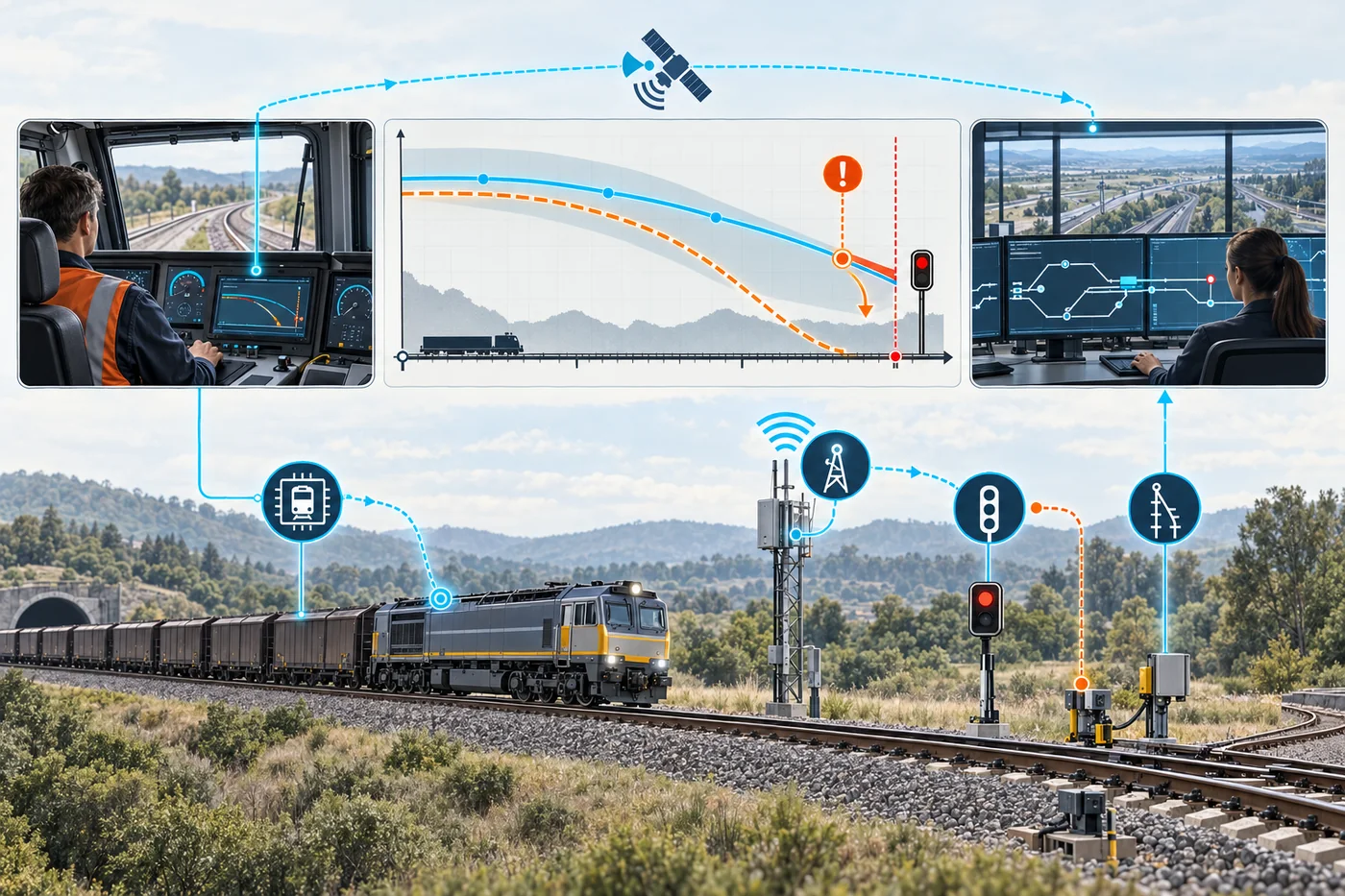
Positive Train Control, PTC, is safety automation with a defined task. Vale and Wabtec are introducing Wabtec’s I-ETMS on Brazil’s EFC, Carajás, and EFVM, Vitória–Minas, railways. The system connects onboard equipment with existing infrastructure, supports real-time management and can intervene automatically when defined risk conditions are exceeded.
I-ETMS is not a single box in a locomotive. Wabtec divides it into four segments: office, wayside, communications and locomotive. The onboard computer combines a geographical track database and GPS position with speed, movement authority, temporary and permanent restrictions, work zones and consist data. From these it continuously calculates warning and braking curves: it asks not only where the train is now, but whether, at its current speed and braking capability, it will remain within the permitted space. The wayside segment adds switch position, signal aspect and detector data, including indications of a broken rail. The crew operates the train while following instructions; the system intervenes when the calculation shows that the safety boundary will not be maintained without braking. This is primarily a deterministic protection loop, not “AI driving the train”. Source: Wabtec, technical architecture of I-ETMS.
Important integration and lifecycle questions remain for the Brazilian project: the communications layer, density of wayside equipment, validation and versioning of the track database, change control, and degraded-mode operation on EFC and EFVM. The system’s name states what the safety architecture is intended to do; it does not reveal how demanding maintenance will be alongside Vale’s existing signalling and operating rules. In a system of this kind, outdated track data is not merely an IT problem but a potential operational event.
The programme, worth approximately one billion Brazilian reais, will be introduced in phases through 2031. The starting point provides important context: according to Wabtec, the two railways are already among Brazil’s safest under ANTT regulator criteria and are the only lines in the country with regular passenger rail services. The investment therefore looks more like the addition of another protective layer to well-developed corridors than the solution of a problem from scratch. The announcement does not, however, provide a before-and-after result, so one billion reais speaks to the scale of the decision, not to a demonstrated return or causal safety effect. Source: Wabtec, 16 July 2026.
The distinction matters: DAC builds the train’s internal data backbone; PTC builds a protective loop between the train and the corridor. One makes it possible to see and share the condition of the consist. The other uses the state of the train and infrastructure so that, within a bounded safety framework, it can move from warning to intervention.
The Same Transport, Five Different Problems
When these cases are placed side by side, it becomes clearer what exactly the comparison should measure.
| System | What it observes or connects | Status of evidence in 2026 | Where people remain |
|---|---|---|---|
| Union Pacific Machine Vision / ATI | Track geometry and visible changes in infrastructure | In network operation; ATI covered more than 29,000 inspection miles in June, according to the operator; a union counter-signal identifies conditions ATI does not see | The inspector verifies the cause, sees broader classes of defects and selects the response |
| PioDAC / FreightLink | The consist’s mechanical, pneumatic, power and data connections | Prototype tests and the first commercial contract; the specific RCG consist in real-world operation from 2028 | Field and shunting teams maintain the equipment and resolve exceptions |
| Vale / Wabtec I-ETMS | The real-time safety relationship between the train and the corridor | Phased programme through 2031, with no published before-and-after result | The system can intervene automatically within a defined framework; people oversee operation and exceptions |
| Audi / Unikie AutoLog | Vehicle position and precise movement during transshipment | Demonstration in a research project | Terminal teams resolve edge cases and interruptions to the flow |
| RCG / Transporeon | Booking and shipment visibility across road and rail legs | Nearly 10,000 additional shipments since December 2023; no published effect on cost or modal shift | Planners resolve inconsistent data and operational exceptions |
The table does not show five steps towards one “intelligent railway”. It shows five different jobs and five different levels of evidential maturity: detection, consist connectivity, safety intervention, physical transshipment and shipment coordination. What they share is not the technology, but the moment at which data must become an operational decision. Automation does not erase responsibility; it moves the point at which it is activated.
How a Promise Becomes a Business Result
| System | Primary operational KPI | Main migration risk |
|---|---|---|
| ATI / Machine Vision | Time from finding to work order; share of confirmed and missed findings | Confusing sensor scope with the full coverage of field inspection |
| DAC / FreightLink | Train-formation and testing time; wagon availability; retrofit cost | Mixed fleet, interoperability and contact reliability |
| I-ETMS | System availability; number of interventions; minutes of degraded-mode operation | Outdated track database and integration with signalling and communications |
| AutoLog | Cycle time per vehicle; manual interventions; safe stops | Latency, loss of connectivity, and differences between vehicles and wagons |
| RCG / Transporeon | ETA error; manual corrections; missed connections; terminal dwell time | Misaligned identifiers and events, and responsibility split between partners |
These KPIs are not published results of the projects listed, but measures by which an operator or investment committee would test a supplier’s promise. A second bill appears after commissioning: sensor calibration, spare parts, software versions, cybersecurity, certification of changes, availability of specialists, and an exit from dependence on a single supplier. The digital layer does not abolish maintenance; it introduces a new kind of maintenance and a new division of responsibility.
The Freight Journey Begins Before the Rail
A digital train alone does not solve everything that happens before departure and after arrival. The greatest friction often arises precisely at the transition between systems.
Automated loading of cars onto railway wagons and unloading from them has been demonstrated at Audi’s plant in Ingolstadt. Unikie’s software uses data from external LiDAR sensors for precise guidance in confined space, while Deutsche Telekom provides 5G connectivity, SIM cards, edge-cloud infrastructure and a fibre-optic backbone. Around 70 per cent of new vehicles in the Volkswagen Group travel by rail, making the manual handover of vehicles between the factory and the train an important operational node.
The technical chain looks like this: external LiDAR builds a picture of the space around the ramp and wagon; Unikie’s control layer turns the picture into a manoeuvre; edge infrastructure processes data close to the point of operation; 5G and a SIM card connect the control system to the vehicle; and the fibre-optic network carries traffic across the site. Part of the “vision” is therefore not in every car, but in the terminal: the terminal becomes sensor infrastructure. The status must nevertheless remain precise — this is a demonstration in the AutoLog project, not the routine operating mode of the entire factory-dispatch process. A decision on serial deployment would require localisation accuracy, sensor-to-command latency, cycle time, the number of manual interventions, behaviour when connectivity is lost, safe stopping, cost per vehicle and reliability over a longer period. Those indicators have not yet been published. Source: Deutsche Telekom, 24 September 2026.
UPDATE — THE NETWORK IS ALREADY FORMING
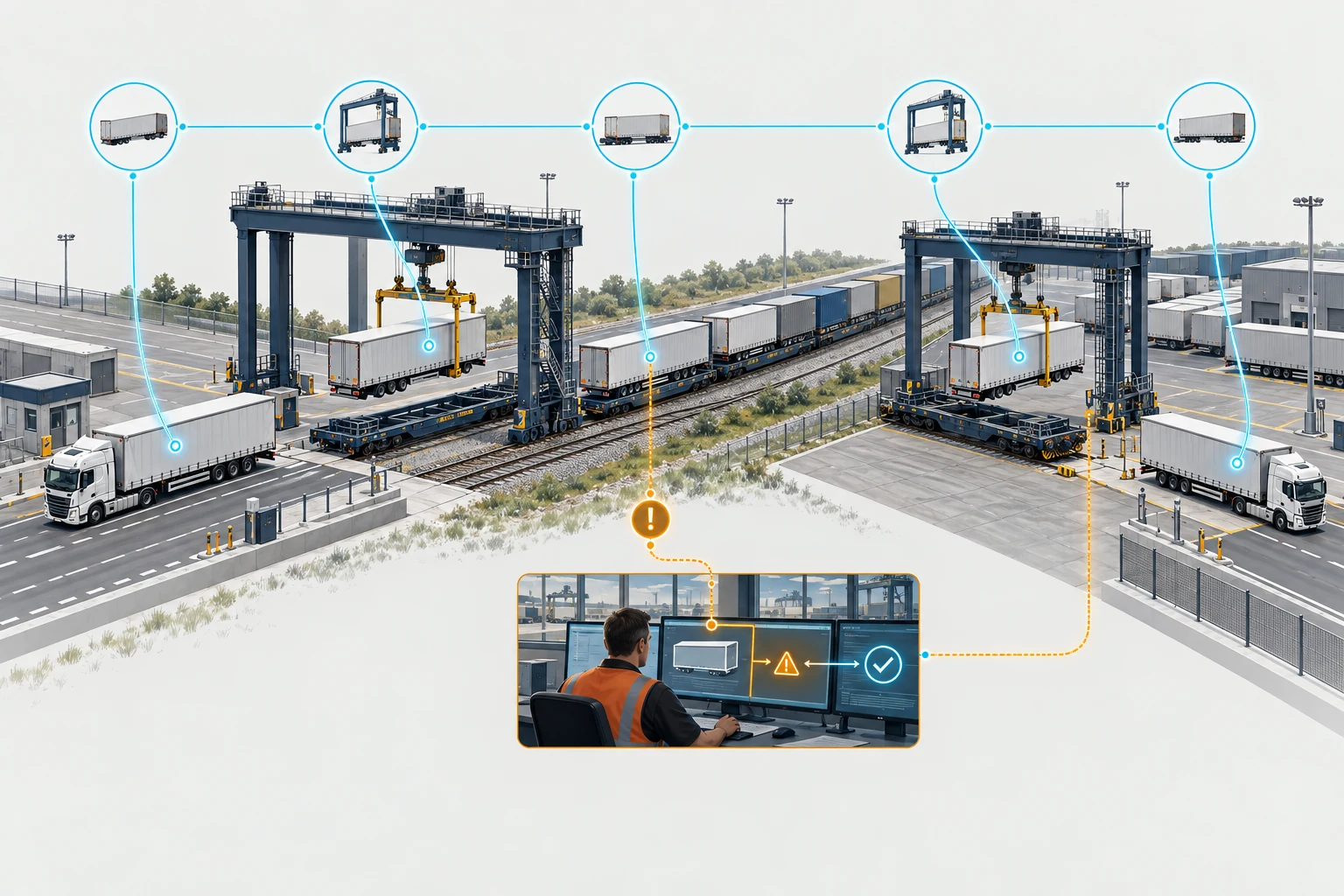
The transition is no longer only architectural. ÖBB Rail Cargo Group reports that nearly 10,000 additional multimodal shipments have already been processed through Transporeon since the cooperation officially began in December 2023. Rail remains the main transport leg, while trucks handle the first and last mile — but planning, booking and visibility increasingly belong to the same digital workflow.
The platform’s technical value is not merely a point on a map. The same shipment must retain its identity through enquiry, quotation, booking, execution, the first road leg, the main rail leg and the last mile. Telematics provides primary movement data, but someone must normalise different events — collected, arrived at terminal, loaded, train departed, handed over to the next carrier — into one chain of deadlines and exceptions. RCG and Transporeon publicly confirm booking, execution and visibility in a shared environment, but do not publish the event model, update frequency, API contracts or the rule used to resolve a conflict between two sources. For a logistics professional, this is precisely where integration cost and ETA quality reside. Sources: Transporeon and RCG, Digital Multimodal Logistics.
Audi/AutoLog and RCG/Transporeon close two different gaps. The first automates the physical moment when a vehicle enters another mode of transport. The second prevents shipment information from having to be translated manually at every change of transport mode. Nearly 10,000 additional shipments confirm adoption of the platform; its business value should next be measured through ETA error, the number of manual corrections, missed connections and terminal dwell time. Source: ÖBB Rail Cargo Group, 23 September 2026.
This is a small but important shift in perspective. The train is no longer merely connected to a network. The journey itself becomes the network.
For the shipper, the point of connectivity is not the number of applications. It is that the freight does not lose continuity when it changes vehicle.
Serbia Is Not Merely a Footnote
The route between Novi Sad and Herne, Germany, organised by LKW Walter, was launched on 5 March 2026. According to DP World, it has three weekly departures, a journey time of about 45 hours, and carbon-dioxide emissions that may be up to 80 per cent lower than those of an all-road journey. An industry source gives a more precise schedule — Tuesdays, Thursdays and Saturdays at 20:00 — as well as traction by Budamar Group locomotives in cooperation with the domestic operator Kombinovani prevoz. The service is designed for trailers suitable for crane lifting, or cranable trailers. These are operational facts about the corridor, not measured effects of artificial intelligence. Sources: DP World, March 2026 and Railmarket.
Before such a transshipment reaches the terminal, it must be known whether the unit has suitable lifting points, as well as its mass and profile. Public sources, however, do not show which of those data are exchanged digitally, through which system, or what is automated. That is not a gap to be filled with an assumption, but a good reporting question: do the terminal, the carrier and the consignee see the same version of the data; how much information is re-entered manually; and where does an exception arise that the system does not understand?
A focused logistics review would therefore seek at least the following data: a unique ID for the intermodal loading unit, the trailer type and lifting points, dimensions and gross mass, dangerous-goods status, booking reference, terminal cut-off, train and departure identity, the moment of handover, and the expected time of availability for the last mile. This is not a claim that the new service already exchanges all these fields through one system; it is a practical checklist for a conversation with the operator. The physical flow can stop because of an incompatible trailer, and the information flow because the same unit has a different identity or status in two systems.
These are research questions, not established shortcomings in the operation of this route. The monitoring log reviewed did not contain a sufficiently strong example from Serbia or the Western Balkans in which an operator publishes a measurable effect of an AI system in rail logistics. That absence is not evidence that no such use exists. It shows what should be documented next in the field.
Less Manual Work Holding the World Together
The Humanophilic criterion can be simple here: does the technology give people a better view and a more reliable basis for their work, or merely add another screen?
In the Union Pacific example, expert judgement remains with the inspector, but receives a more precise input. DAC seeks to reduce manual coupling work and give the train a shared data layer. PTC adds a protective intervention during movement. AutoLog addresses the transshipment bottleneck. The multimodal platform connects different stages within a familiar working environment.
The editorial conclusion is therefore not that one technology exists that will “make the railway smart”. We see several different ways to close the gap between what a system can learn and what it can do. The most mature evidence in this selection comes from inspection already in operation. The other examples show an architecture, a contract, a phased programme, a demonstration or the adoption of a digital flow — and each must remain in its own category.
For a logistics professional, the sequence of questions should therefore be more technical: which physical signal is measured, how often and with what tolerance; where does the signal acquire a timestamp and become an event; which identifier links a wagon, train, terminal unit and shipment; how old is the data when it reaches a decision; what is the safe degraded mode; who takes control, and how is an exception returned to the system as a trace for the next cycle?
A train becomes a network in the useful sense when connectivity supports the whole: from track inspection and wagon preparation, through safe movement, to the handover of freight to the next participant.
Progress is not measured only by how much freight a locomotive can pull. It is also measured by how much less disconnected information people have to carry on their backs.
Sources / Provenance
Radna sinteza iz postojećeg praćenja AI u logistici, sa građom do 25. septembra 2026. Primarni izvori u tekstu: Union Pacific (22. maj i 8. septembar 2026), Knorr-Bremse (17. septembar 2026) i Vale (16. jul 2026), ponovo pročitani 26. septembra 2026. Rezultati operatora, ugovoreni planovi i otvorena pitanja označeni su zasebno. Nacrt čeka autorsku razradu.