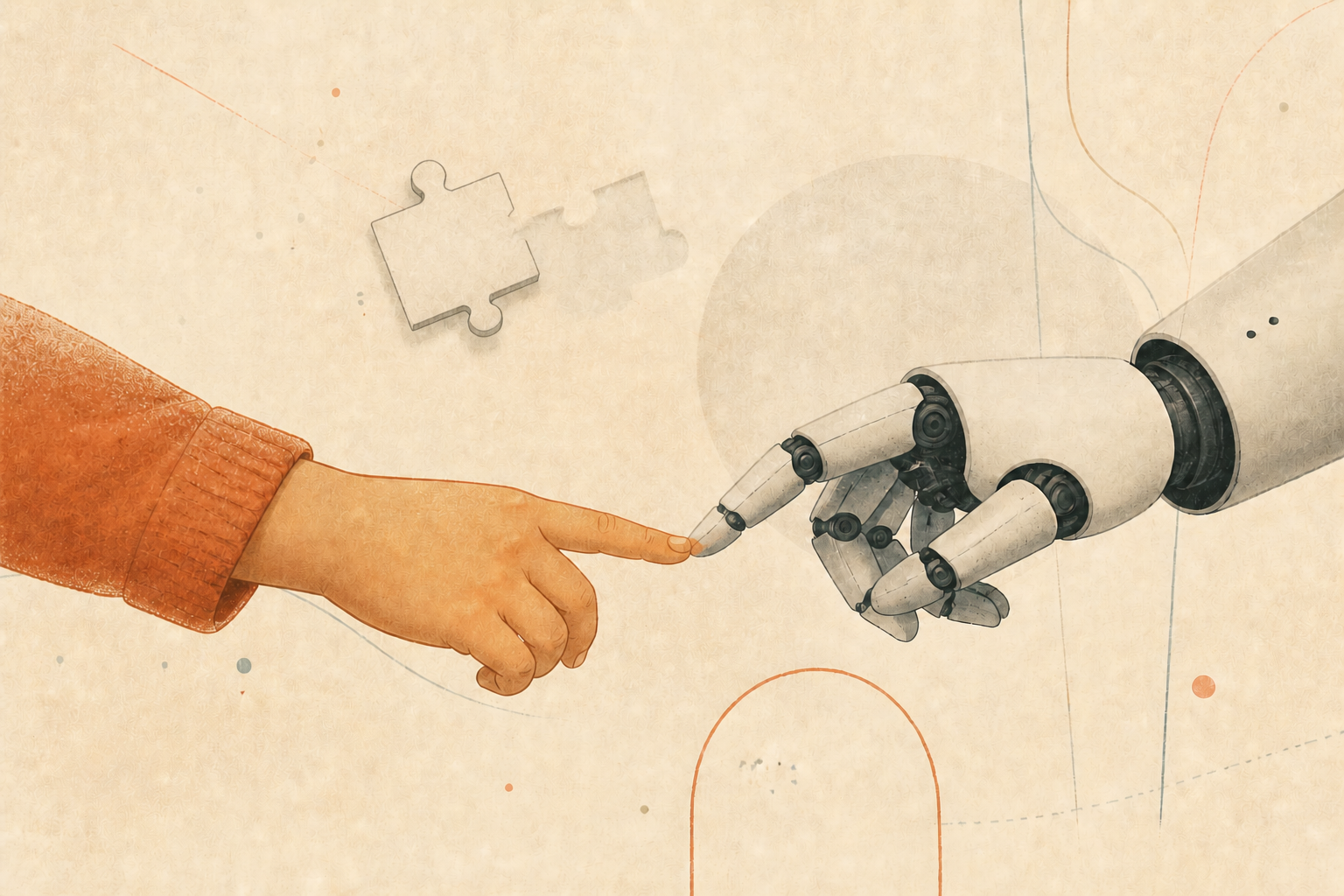
A robot enters the room without becoming the room’s main character.
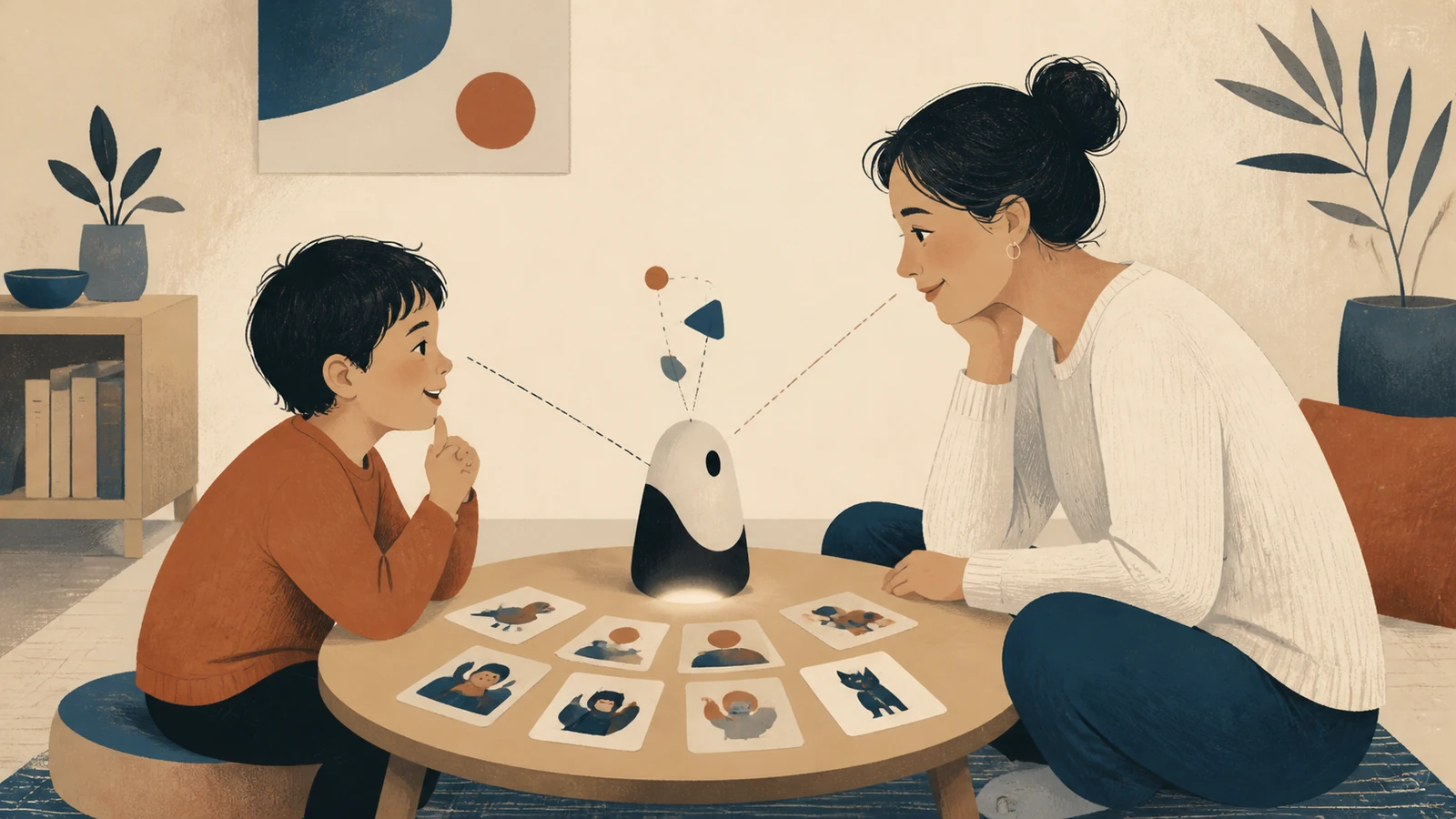
In a 2018 in-home study, twelve children aged six to twelve used an autonomous social robot for roughly thirty minutes a day over one month. The arrangement was not a machine replacing a parent, teacher or therapist. It was a triangle: child, caregiver and robot.
Storytelling and games gave the robot a job. It guided the interaction, adapted difficulty, modelled social behaviour and repeatedly directed skills back toward the caregiver. The machine performed, but the human relationship remained the destination.
That distinction changes the story.
THE ROBOT DOES NOT REPLACE THE RELATIONSHIP
A showy robot can be judged by its face, voice or imitation of a person. This system mattered for a quieter reason: enough social signal to invite a response, enough predictability to keep the interaction from becoming noise.
The study reported improvements in eye contact, communication initiation and response. Joint attention with adults also improved when the robot was absent. The useful result was not a child learning to perform for a machine. It was a child carrying those skills back into a human exchange.
The robot enables the relationship; it does not carry it.
CONTACT WITHOUT COLLISION
The right metaphor is not a substitute person. It is controlled coupling — a wet clutch between two human positions. Contact can begin without a forced lock. Turn-taking can acquire a rhythm. Attention can move through the robot and return to the caregiver.
That makes the robot less like a performer and more like a piece of infrastructure for meeting.
The fingertip carries the nonverbal layer. Two intelligent beings from different systems meet before explanation. That is semonics — meaning beginning in relation before language gives it a name.
The word sentient can enter here without claiming a machine’s inner life. A system can register an environment, respond to it and alter the relation around it. Environmental awareness is not self-awareness. The distinction matters because the social effect may be real even when consciousness is not the claim.
THE UNMEASURED PERSON
The caregiver is not background scenery. The caregiver is an active participant and daily observer. Yet the reviewed study material does not establish a separately measured therapeutic benefit for the caregiver — stress, burden, confidence or relationship quality. That gap should not be hidden. It is a question future studies should carry.
If a robot improves coordination between two people, who is the user of the system: the child, the caregiver, or the relationship?
Later evidence keeps the promise in proportion. A 2024 systematic review found social robots promising in autism care, while clinical validation and implementation still lagged behind technical development. A 2025 meta-analysis across 20 trials and 532 children reported a moderate overall effect on social-emotional skills, strongest in social reciprocity, and called for better evidence about long-term sustainability and transfer.
No miracle follows from those numbers. A useful machine still needs a useful setting, a human decision-maker and a path back to ordinary life.
The important scene is not the robot onstage. It is the moment the machine does just enough to let two people meet without forcing either one to become someone else.
The robot was not the relationship. It was a tool that helped the relationship find its rhythm.
SOURCES / PROVENANCE
Scassellati et al., Science Robotics (2018), “Improving social skills in children with ASD using a long-term, in-home social robot.”
2024 clinical systematic review
Editorial note: This article describes evidence and interpretation. It does not present social robots as a universal treatment for autism.
Sources / Provenance
Scassellati et al., Science Robotics (2018); 2024 clinical systematic review; 2025 meta-analysis.